Материал: 2076
products for specific applications and requirements. So the innovation comes from targeted applications, rather than any hot, new technology.
Over the past few decades, some innovations have indeed given industrial automation new surges of growth: The programmable logic
controller (PLC) – developed by Dick Morley and others – was designed to replace relay-logic; it generated growth in applications where custom logic was difficult to implement and change. The PLC was a lot more reliable than relay-contacts, and much easier to program and reprogram. Growth was rapid in automobile test-installations, which had to be re-programmed often for new car models. The PLC has had a long and productive life – some three decades – and (understandably) has now become a commodity.
СAt about the same time that the PLC was developed, another surge of innovation came through the use of computers for control systems. Mini-
иwith its TDC 2000. But, these were not really "distributed" because they were still relatively large clumps of computer hardware and cabinets filled with I/O connections.
computers replaced large central mainframes in central control rooms, and
On бАthe sensor side were indeed some significant innovations and developments which generated good growth for specific companies. With
gave rise to "distributed" control systems (DCS), pioneered by Honeywell
The arrival of the PC brought low-cost PC-based hardware and
software, which provided DCS functionality with significantly reduced cost and complexity. There was no fundamental technology innovation here— rather, these were innovative extensions of technology developed for other mass markets, modified and adapted for industrial automation requirements.
better specifications and good marketing, Rosemount's differential pressure flow-sensor quickly displaced lesser products. And there were a host of other smaller technology developments that caused pockets of growth for some
companies. But few grew beyond a few hundred million dollars in annual |
|
revenue. |
Д |
|
|
Automation software has had its day, and can't go much further. No |
|
|
И |
"inflection point" here. In the future, software will embed within products and systems, with no major independent innovation on the horizon. The plethora of manufacturing software solutions and services will yield significant results, but all as part of other systems.
So, in general, innovation and technology can and will reestablish growth in industrial automation. But, there won't be any technology innovations that will generate the next Cisco or Apple or Microsoft.
We cannot figure out future trends merely by extending past trends; it’s like trying to drive by looking only at a rear-view mirror. The automation industry does NOT extrapolate to smaller and cheaper PLCs, DCSs, and supervisory control and data acquisition systems; those functions will simply
171
be embedded in hardware and software. Instead, future growth will come from totally new directions.
New technology directions
Industrial automation can and will generate explosive growth with
technology related to new inflection points: nanotechnology and nanoscale assembly systems; MEMS and nanotech sensors (tiny, low-power, low-cost sensors) which can measure everything and anything; and the pervasive Internet, machine to machine (M2M) networking.
СMajor new software applications will be in wireless sensors and distributed peer-to-peer networks – tiny operating systems in wireless sensor
Real-time systems will give way to complex adaptive systems and multi-processing. The future belongs to nanotech, wireless everything, and
иThe fully-automated factory
complex adaptive systems.
nodes, and the software that allows nodes to communicate with each other as a larger complex adaptive system. That is the wave of the future.
Automated factories and processes are too expensive to be rebuilt for every modification and design change – so they have to be highly configurable and flexible. To successfully reconfigure an entire production line or process requires direct access to most of its control elements – switches, valves, motors and drives – down to a fine level of detail.
The vision of fully automated factories has already existed for some
time now: customers order online, with electronic transactions that negotiate |
|
|
Д |
batch size (in some cases as low as one), price, size and color; intelligent |
|
robots andбАsophisticated machines smoothly and rapidly fabricate a variety of |
|
customized products on demand. |
|
The promise of remote-controlled automation is finally making |
|
headway in manufacturing settings and maintenance applications. The decades-old machine-based vision of automationИ– powerful super-robots without people to tend them – underestimated the importance of communications. But today, this is purely a matter of networked intelligence which is now well developed and widely available.
Communications support of a very high order is now available for automated processes: lots of sensors, very fast networks, quality diagnostic software and flexible interfaces – all with high levels of reliability and pervasive access to hierarchical diagnosis and error-correction advisories through centralized operations.
The large, centralized production plant is a thing of the past. The factory of the future will be small, movable (to where the resources are, and where the customers are). For example, there is really no need to transport raw materials long distances to a plant, for processing, and then transport the resulting product long distances to the consumer. In the old days, this was
172
done because of the localized know-how and investments in equipment, technology and personnel. Today, those things are available globally.
Hard truths about globalization
The assumption has always been that the US and other industrialized
nations will keep leading in knowledge-intensive industries while developing nations focus on lower skills and lower labor costs. That's now changed. The Сimpact of the wholesale entry of 2.5 billion people (China and India) into the
global economy will bring big new challenges and amazing opportunities.
Beyond just labor, many businesses (including major automation companies) are also outsourcing knowledge work such as design and engineering services. This trend has already become significant, causing joblessness not only for manufacturing labor, but also for traditionally high-
иquarterly profits syndrome. Countries like Japan and Germany will tend to benefit from their longer-term business perspectives. But, significant
paying engineering positions.
Innovation is the true source of value, and that is in danger of being
dissipated – sacrificed to a short-term search for profit, the capitalistic
competition is coming from many rapidly developing countries with expanding technology prowess. So, marketing speed and business agility will be offsetting advantages.
The winning differences
In a global market, there are three keys that constitute the winning
edge: |
Д |
Proprietary products: developed quickly and inexpensively (and |
|
perhaps globally),бАwith a continuous stream of upgrade and adaptation to |
|
maintain leadership. |
|
High-value-added products: proprietary products and knowledge |
|
offered through effective global service providers, tailored to specific |
|
customer needs. |
И |
|
|
Global yet local services: the special needs and custom requirements of remote customers must be handled locally, giving them the feeling of partnership and proximity.
To implementing these directions demands management and leadership abilities that are different from old, financially-driven models. In the global economy, automation companies have little choice – they must find more ways and means to expand globally. To do this they need to minimize domination of central corporate cultures, and maximize responsiveness to local customer needs. Multi-cultural countries, like the U.S., will have significant advantages in these important business aspects.
In the new and different business environment of the 21st century, the companies that can adapt, innovate and utilize global resources will generate significant growth and success.
173

BUILDING FACULTIES
SCOTTISH CONSTRUCTION FIRMS 'MORE OPTIMISTIC'
2 February 2017
From the section “Scotland business”
СScottish construction firms are more optimistic about the year ahead
than they were in the autumn, according to a new survey.
The Royal Institution of Chartered Surveyors (Rics) found expectations of
growth strengthened in the last quarter, following a dip after the Brexit vote.
иThe survey found modest growth in the Scottish construction sector in the final three months of 2016, with 7% more respondents reporting increasing workloads.
Growth was forecast for 2017 in workloads, employment and profit.
However, concerns were raised over skills shortages.
Rics' UK Construction Market Survey found workload growth
expectations improved considerably in the fourth quarter, while 20% more survey respondents said they expected a rise in employment in 2017.
period. бА
The private industrial sector was seen to be driving growth, as 23% more respondents reported an increase.
Growth in private commercial and private housing also increased between September and December, but public non-housing works fell in the same
Respondents warned of skillsДshortages restricting growth, with half of those surveyed pointing to a lack of quantity surveyors.
Ric’s chief economist Simon Rubinsohn said: "The latest results suggest that the construction sector has shrugged off concerns about the effect of Brexit with key workload indicators remaining firm around the country.
rosier than it was back in the autumn, with more building anticipated as 2017 unfolds.
"That said, there remains some unease about access to skilled labour in the emerging new world and financial constraints still remain a major challenge for many businesses.
"Indeed, feedback regarding the outlook overИthe next 12 months is now
"And significantly, we are being told that a shortage of quantity surveyors is impacting on the development process at the present time."
http://www.bbc.com/news/uk-scotland-scotland-business-38830968
174
SCOTTISH BUILDERS RAISE CONCERN OVER BREXIT
SUPPLY COSTS
17 October 2016
From the section “Scotland business”
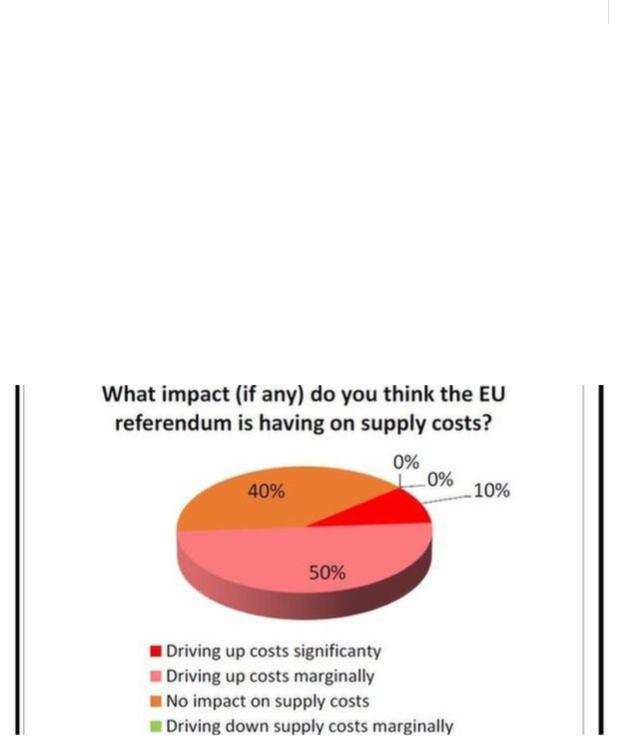
Scottish construction firms have suggested that the Brexit vote is Сdriving up building supply costs.
A Scottish Building Federation (SBF) survey found industry confidence improved after falling to a three-year low following June's EU referendum.
But 60% of respondents said they thought Brexit was driving up costs. SBF said many firms expressed concern that some suppliers may be using
economic uncertainty to increase costs artificially.
In the federation's latest quarterly Scottish Construction Monitor, companies reported a "noticeable" rise in the cost of bricks, timber and metal
|
бА |
products such as doors and windows. |
|
A total of 90% of those surveyed expected these costs to continue to rise |
|
иover the next 12 months. |
|
Nearly 50 construction firms took part in the survey between 1 and 12 |
|
October. |
|
|
Д |
|
И |
SBF director Vaughan Hart said: "At the moment, the construction industry is experiencing the same uncertainties as those facing the wider economy.
"In that context, I'm encouraged that our members' confidence seems quite resilient, having rebounded back into positive territory this quarter following last quarter's negative reading.
175