Материал: 2507

3. Home.
So, where do you live? Do you live in a house or a flat? Do you live in the centre or the suburbs?
10. Make some notes about yourself. Use the ideas below and add more ideas of your own.
1. Sports and hobbies.
I play a little ………
I used to play ………but now ………
I like to go ……… (+ verb with -ing) I collect ………
2. Cultural interests and holidays. |
|
|
|
(books) I like ……… |
|
|
И |
(music) I like ……… |
|
|
|
|
|
|
|
(films) I like ……… |
|
Д |
|
(magazines) I read ……… |
|
||
|
|
|
|
(holidays) On my last holiday I went to……… |
|
||
3. Home. |
|
|
|
I live near ……… |
|
|
|
I was born in ……… |
б |
|
|
I’m married with two children. Their names are……… |
|||
My husband/wife/partner……… |
|
|
|
и |
|
|
|
I’m single at the moment./I’m divorced.А |
|
||
С |
|
|
|
11. Use the questions to find out about other people. Then tell about them.
PEOPLE AROUND YOU
Pic. 3
16
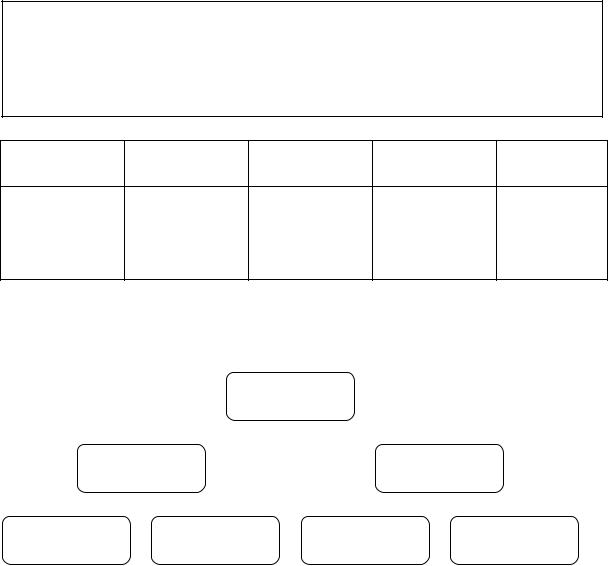
12. Check the meaning and pronunciation of the words in the box in your dictionary or with your teacher. Then write the words in the correct column below.
Best friend; parent; colleague; dean; relative; stranger; flatmate; neighbour; step-mother; husband; classmate; wife; daughter; mother; son; acquaintance; father; children; uncle; niece; ex-boyfriend; nephew; aunt; father-in-law; mother-in-law; boss; brother-in-law; student; grandparents; son-in-law; lecturer; daughter-in-law; granddaughter; sister-in-law.
Family |
Friends |
Work |
University Other |
Can you add any other words to each group? |
|
|
||||||||
13. Study the family tree of Victor (pic. 3). |
И |
|||||||||
|
|
|
|
|
|
|
|
|||
|
|
|
Alex |
+ Helen |
|
|
|
|||
|
|
|
|
|
|
|
Д |
|||
|
|
|
|
|
А |
|
|
|
||
|
|
|
|
|
|
|
|
|||
|
|
|
|
|
|
|
|
|
||
|
Eugene + Olga |
б |
|
|
Max + Kate |
|||||
|
|
|
|
|
|
|
||||
|
|
|
|
|
|
|
||||
|
|
|
|
|
|
|
|
|
|
|
Victor |
Laura |
|
|
|
Oleg |
|
Mary |
|||
|
|
и |
|
|
|
|
|
|
|
|
14. Complete theСgaps in the following sentences with information you have learned from the family tree.
Alex is Helen’s ….
Helen is Alex’s …. Eugene is Victor’s …. Kate is Mary’s ….
Max is Alex and Helen’s …. Laura is Olga’s ….
Max and Kate are Mary’s …. Victor and Laura are Olga’s ….
Victor is Max’s ….
Mary is Olga’s …. Alex is Kate’s …. Helen is Eugene’s …. Eugene is Max’s …. Kate is Olga’s …. Eugene is Alex’s …. Kate is Alex’s ….
17
Eugene is Mary’s …. |
Mary is Helen’s …. |
Kate is Laura’s …. |
Alex and Helen are Laura’s …. |
15. Draw your own family tree and tell you partner about your family, ask him/her to draw your family tree. Read the text and try to draw a family tree of the speaker.
Два приятеля встретились в баре и разговорились. Через некоторое время один из них сказал: "Ты думаешь, у тебя семейные проблемы? Послушай про мою историю. Несколько лет назад я встретил молодую вдову со взрослой дочерью, и мы поженились. Недавно мой отец женился на моей падчерице. Это сделало мою падчерицу моей мачехой, а мой отец стал моим пасынком. Кроме того, моя жена стала те-
щей собственного свекра. Идем дальше, у дочери моей жены (моей
сын. Теперь сестра моего сына, моя теща, сталаИеще и бабушкой. Это делает моего отца шурином моего ребенка, сводная сестра которого -
мачехи) родился сын. Этот мальчик мне единокровный брат, потому
что он сын моего отца, но он также сын дочери моей жены, что делает
его внуком моей жены. Это делает меня дедушкой моего единокров-
ного брата. Это было бы еще терпимо, пока у нас с женой не родился
жена моего отца. Я шурин моей мачехи, моя жена - тетя ее собствен- |
|||||
|
|
|
|
|
Д |
ного ребенка, мой сын - племянник моего отца, а я свой собственный |
|||||
дедушка, а ты тут жалуешься на семейные проблемы!" |
|||||
|
|
|
|
А |
|
16. Read the following letters to a newspaper. Fill in the gaps with the |
|||||
|
|
|
б |
|
|
expressions from the list below (make changes if necessary). |
|||||
break the ice |
|
|
mark (verb) |
virtually |
|
draw out |
|
и |
|
widespread |
|
|
|
outlook |
|
||
fill the void |
|
|
take things as |
wind up |
|
in the first place |
|
think of |
|
|
|
|
С |
|
|
|
|
Each week the Star Daily summarizes responses to a question we pose to our readers. Here are some of our favorite responses to the question: Birth order: does it matter?
1.I’m the youngest of five children. I know that ___________ (1. most) all later-born children are reserved, but not necessarily aloof. I have a positive
____________ (2. point of view) on life and ____________ (3. accept experiences) as they come.
2.I’m the firstborn in my family. My siblings complain that I’m arrogant, but I don’t ___________ (4. consider) myself that way. At social gather-
18
ings, I _______________ (5. end up) being the life of the party. I see my role as ___________ (6. encouraging) my more introverted friends.
3.I realize that acceptance of this birth order theory is becoming more and more ___________ (7. common), but I just can’t buy it. _____________
(8. First of all) I think personality traits are determined by genetics. Second, theories like birth order are actually harmful in that they may
________ (9. label) people unfairly, that is, lead to misattributions about people’s personalities.
4.I’m an independent, only child. So I spent a great deal of time alone. To
_________________ (10. overcome loneliness) I had to learn more skills. For example, I learned how to lose my awkwardness and selfconsciousness. In fact, nowadays. I’m usually the one to
__________________ (11. get people socializing and enjoying themselves) at social occasions. ИHow Your Birth Order Influences YourДLife Adjustment
When we are born into a familyАunit or brought into it through adoption or as step-child, we takeбa certain place in the family hierarchy. We become only child, oldest child, middle child, or youngest child.
The first and mostиobvious effect of taking a certain position in the family is the relationship we have with respect to the people already there. If there are onlyСadults present, we are in a very close and often intense relationship with them, as anyone knows who has had a child or who has watched first-time parents hovering over their infants. This constant and close relationship gives the first child in the family an opportunity to imitate and learn from these adults to the fullest possible extent. The first child imitates their physical mannerisms and learns speech from them. He learns many more things and much of the learning takes place on an unconscious level. That is, neither the parents nor the child verbalize that thus and so is the way to do something. The child observes and imitates.
Relationship with parents
From the beginning the parents treat the child in accordance with his place in the family and soon the child recognizes that place. He is the child in the family, and he tends to think of himself as a child in relation to adults. The only child never has any reason to change such perception of
19
his role and tends to carry into adulthood a strong feeling of being a child in relation to other people.
The first child, who becomes the older or oldest child, does not have this unlimited time to view himself as the child in the relationship with his parents. When a sibling arrives, he tries to suppress the view himself as the child and he struggles to be parental. We shall find that in both childhood and adulthood the older or oldest child’s emphasis upon being “parental” offers him both advantages and problems.
Children who follow the first child in the family come into a situation where the relationship with the parent is, except in most unusual cases, shared with another child. The parents themselves have been changed by the preceding child or children in many ways. They are more experienced
as parents. They may not welcome their later children with as might delight as they did their first child, but they are probablyИless tense and anx-
ious about being able to care for them properly. The later children enjoy
many advantages as a result of having moreДrelaxed parents. They benefit
from the tendency of parents to try out ideas on their first child and to be more tolerant with later children.
The first child serves as a barrier between later children and the par-
ents. He is one of the models for his siblings. Later children in a family do
not feel the same dependency on the parents for sustenance and compan-
ionship as did the first child. They do not have such intense feelings of |
||
|
и |
|
loneliness when the attention of Аthe parents is directed elsewhere, nor do |
||
they seem to feel so inadequate when they do not meet the standards of |
||
their parents. |
С |
б |
|
||
Extremely important to differentiating later children from first children is the extent to which direct identification with the parents is diluted for the later children. The later children seem more content to move gradually from child to adult. They do not seem to try as hard, as does the oldest child, to be parental and adult even during childhood.
The child becomes known as the family’s only child, oldest child, middle child, or youngest child, depending on his birth order. He is thought and talked about as having that place in the family. Both in his mind and in the minds of other people an important part of his identity is his family position.
The other members of the family assume certain attitudes toward each child in terms of his birth order. Parents usually expect their oldest child to be more capable and more responsible than the younger children. The oldest child comes to think about himself in the same way. These ways
20