Материал: CITY_OF_GIRLS_by_Elizabeth_Gilbert
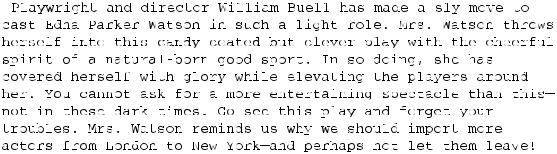
When it came time for the big-finish number of “Let’s Make Ours a Double,” I grew annoyed and distracted by watching Arthur Watson. He was trying to keep up with the dance steps of the other cast members, and making a poor job of it. Thankfully, his awfulness didn’t seem to disturb the audience too much, and you couldn’t hear his tuneless singing over the orchestra. Anyway, the audience was singing and clapping along with the chorus (“Sin babies, gin babies / Come right on in, babies!”). The Lily Playhouse glittered with a sheen of pure, shared joy.
Then it was over.
Curtain calls followed—so many curtain calls. Bows and more bows. Bouquets of flowers thrown upon the stage. Then finally the houselights came up, and the audience gathered their coats and were gone like smoke.
The whole exhausted lot of us, cast and crew, wandered out on that empty stage and just stood there for a moment in the dust of what we had just created—speechless in the staggering incredulity of what we had just seen ourselves do.
—
From Nichols T. Flint, in the New York Daily News:
—
We spent the rest of the night at Sardi’s, waiting for the reviews to come in and drinking ourselves half blind in the process.
Needless to say, the Lily Players were not a theater group normally accustomed to waiting for reviews at Sardi’s—or to getting reviews at
all—but this had not been a normal show.
“It all depends on what Atkinson and Winchell say,” Billy told us. “If we can nail down both the high-end praise and the low-end praise, we’ll have a hit.”
“I don’t even know who Atkinson is,” Celia said.
“Well, babycakes, as of tonight he knows who you are—that much I can promise you. He couldn’t keep his eyes off you.”
“Is he famous? Does he have money?”
“He’s a newspaperman. He’s got no money. He’s got nothing but power.”
Then I watched a remarkable thing happen. Olive approached Billy, carrying two martinis in her hands. She offered one to him. He took it in surprise, but his surprise only deepened when she raised her glass to him in a toast.
“You’ve done ably well with this show, William,” she said. “Very ably well.”
He burst out laughing. “Very ably well! I will take that, coming from you, as the highest praise ever given to a director!”
Edna was the last cast member to arrive. She’d been mobbed at the stage door by admirers who wanted her autograph. She could have dodged them just by going upstairs to her apartment and waiting it out, but she’d indulged the populace with her presence. Then she must have taken a quick bath and changed clothes, because she walked in looking clean and fresh, and wearing the most expensive-looking little blue suit I’d ever seen (only expensive looking if you knew what you were looking for, which I did), with a fox stole thrown casually over one shoulder. On her arm was that good-looking idiot husband of hers, who had almost ruined our finale with his terrible dancing. He was beaming as though he were the star of the night.
“The much-praised Edna Parker Watson!” Billy cried, and we all cheered.
“Be careful, Billy,” said Edna. “The praise hasn’t come in yet. Arthur, darling, could you fetch me the most icy cocktail available?”
Arthur went wandering off in search of the bar, and I wondered if he would be smart enough to find his way back.
“You’ve made a wild success of things, Edna,” said Peg.
“You did it all, my loves,” said Edna, gazing up at both Billy and Peg. “You are the geniuses and the creators. I’m just a humble war refugee, grateful to have a job.”
“I have the worst desire to get falling-down drunk just about now,” said Peg. “I can’t bear the wait for the notices. How do you remain so calm, Edna?”
“How do you know I’m not already falling-down drunk myself?”
“Tonight I should be sensible and mind my intake,” said Peg. “No, never mind, I don’t feel like it—Vivian, will you chase after Arthur and tell him to bring back about three times the number of drinks he had originally planned?”
If he can manage the math, I thought.
I headed to the bar. I was trying to wave down the bartender when a man’s voice said, “Could I buy you a drink, miss?” I turned around with a flirty smile, and there was my brother, Walter.
It took me a moment to recognize him, because it was so incongruous to see him in New York City—in my world, surrounded by my people. Also, the family resemblance threw me for a loop. His face and mine were so similar that for a disorienting instant, I almost thought I’d bumped into a mirror.
What on earth was Walter doing here?
“You don’t look too happy to see me,” he said, with a careful smile.
I didn’t know if I was happy or unhappy; I was just tremendously disoriented. All I could think was that I must be in trouble. Maybe my parents had gotten wind of my immoral behavior and sent my big brother to retrieve me. I found myself glancing over Walter’s shoulder to see if my parents were with him, which definitely would have signaled the end of a good time.
“Don’t be so jumpy, Vee,” he said. “It’s just me.” It was as if he could read my mind. Which didn’t serve to relax me any further. “I came by to see your little play. I liked it. You kids did a fine job.”
“But why are you in New York City at all, Walter?” I was suddenly aware that my dress was revealing too much cleavage and that there was a hickey remnant on my neck.
“I quit school, Vee.”
“You quit Princeton?”
“Yes, I did.”
“Does Dad know?”
“Yes, he does.”
None of this made any sense. I was the delinquent member of the family, not Walter. But now he had dropped out of Princeton? I suddenly got a vision of Walter breaking wild—throwing away all his years of good behavior to come to New York to join me in a carnival of drinking, carousing, and dancing himself to smithereens at the Stork Club. Maybe I’d inspired him to be bad!
“I’m joining the Navy,” he said.
Ah. I should’ve known better.
“I start Officer Candidate School in three weeks, Vee. I’ll be in training right here in New York City, just up the river, on the Upper West Side. The Navy’s got a decommissioned battleship moored on the Hudson and they’re using it as a school. Right now, they’re short of officers, and they’ll take anyone with two years of college. They’ll train us in just three months, Vee. I start right after Christmas. When I graduate, I’ll be an ensign. I’ll ship out in the spring and go wherever they need to send me.”
“What does Dad have to say about you quitting Princeton?” I asked.
My voice sounded weird and stilted in my ears. The awkwardness of this encounter was still throwing me off, but I was doing my best to make conversation, pretending as though everything was perfectly normal—pretending as though Walter and I chatted with each other at Sardi’s every week.
“He hates it like gum,” Walter said. “But it’s not his call to make. I’m of age, and I can make my own choices. I called Peg and told her I was coming to the city. She said I could stay with her for a few weeks before OCS training begins. See a bit of New York, take in the sights.”
Walter would be staying at the Lily? With us degenerates?
“But you didn’t have to join the Navy,” I said dumbly.

(To my mind, Angela, the only people who became sailors were working-class kids with no other options for advancement. I think I’d even heard my father say that, at some point.)
“There’s a war on, Vee,” said Walter. “America will be part of it sooner or later.”
“But you don’t have to be part of it,” I said.
He looked at me with an expression that was both puzzled and disapproving. “It’s my country, Vee. Of course I have to be part of it.”
There was a wild cheer from the other side of the room. A newsboy had just walked in with a handful of early editions.
The raves were already coming in.
—
And look here, Angela, I’ve saved my favorite for last.