Материал: 2507
Start by thinking about what you can do well and what you do badly. You can gain more marks by improving on your weaknesses than by polishing things which you can already do well.
Make sure you understand the exact requirements of the examination and your own strengths and weaknesses. Make a focused revision programme which concentrates on the things which can gain the most marks.
Don't overwork! Always build some relaxation (not too much!) into your revision programme.
If you like working with friends, don't let your revi-
sion programme be a lonely time. Work in co- |
И |
||
operation with other students. You can learn as much |
|||
through helping as by being helped! |
Д |
||
Use multi-sensory revision |
|||
|
|
||
We learn and remember information as pictures, sounds and movements. Think about linking the things you have learnt to pictures, diagrams, music, sounds, movements or sensations. You will find they are easier to re-
member. |
б |
|
Think of past events in black and white, present events in real colour and |
||
future events in strange futuristic colours. |
||
|
и |
А |
Memorising vocabulary |
||
You can memorise vocabulary by making pictures in your mind or on paper and labellingСthe different things in the picture. Test yourself regularly. Vocabulary cards, with the word on one side and an example sentence, translation or picture on the reverse, are very useful for revising vocabulary when travelling (NOT if you are driving!). Practise making word families like happiness, happy, happily.
 Understanding Grammar
Check through your grammar reference notes and tick off the things you really understand. Concentrate on the areas where your understanding is not so clear. Try to make examples from your own knowledge or experience to help you remember the forms.
 Use past papers
Practice exams are very useful for your revision particularly if you time yourself strictly. Don't let practice exams make you depressed. They can be really useful in showing what you need to practise and learn.
71

 Use your teacher
Your teacher knows you very well. Ask your teacher for advice on your revision programme.
 Build some 'rewards' into your revision programme!
Make a tough revision programme for yourself and work hard but build in some rewards for yourself after you have completed each stage of revision satisfactorily.
A week before the examination
Look back at your revision programme. Is it complete?
Aren't there some things you want to look at again? Use this week for some focused revision.
Review your revision notes every day. Try reviewing your
Remember that the examination asks you to do things in
notes without looking at them. Which parts are difficult to remember? Concentrate on learningИthose parts.
English. It is not a test ofДhow well you remember your
notes. Use your time to do some relaxing things in Eng-
lish. |
А |
Look back at the written work you did a year ago. Do you |
|
see how much you have improved? Think positively about yourself andбyour achievements.
Thinkиabout what you are going to wear for the examination. You should be comfortable, but try to choose something special for this special day. This means that when Сyou put on those clothes, you will already be preparing yourself for the examination.
Get as much sleep as you can. Don't waste time worrying about the examination. You will not learn anything by worrying. Find some time to take exercise. You can try to remember phrasal verbs when you are jogging or plan a composition whilst you take a walk.
Travel to the place where you will take the examination. Check that you know the way and the time. Use the journey time to plan your examination strategy.
Remember to send 'good luck' messages to all your friends who are taking the same examination.
The night before the examination don't eat a heavy meal. Eat something light but nutritious. Avoid alcohol. Take some exercise and go to bed early.
72
On the day of the examination
Dress in your 'examination clothes' and prepare yourself for this special day. Open and read the 'good luck' messages from your friends. Have a good breakfast but don't drink too much. You shouldn't feel hungry or uncomfortable in any way during the examination.
Check through the 'time plan' you have made for the examination. Know how much time you will give to each question. Check you have given yourself time for checking and correcting.
Check that you have all the pens and papers you need for the examination. For many examinations you may need some identification papers.
As you travel to the place of the examination, remind yourself of your examination strategy.
During the examination
Focus your mind on what you have to do. Don't be distracted by outside things or by other students.
Keep an eye on the clock but try not to hurry. Always give yourself time to
check your work. |
И |
|
|
Remember you will get no marks for any questions you do not attempt so |
|
make sure that you complete as much of the examination as possible. |
|
|
Д |
AfterбtheАexamination
Don't worry about theиmistakes you made and the things you got wrong. You will have a long wait for the results so go out and enjoy your freedom! The results are Сnot as good as you expected? Well, you can always take the examination again. You are now a better, more organised person and a better learner. It will be much easier next time.
The results are good? Congratulations! http://www.pearsonlongman.com/exams/extra/study-tips/study-tips2.html
25. Read the text7 in Ex. 24 again and find the words that mean:
-the process of going over a subject again in study or recitation in order to fix it in the memory or summarize the facts;
-a plan or schedule of activities, procedures, etc., to be followed;
-relief from bodily or mental work, effort, etc.;
-to bring all efforts, faculties, activities, etc., to bear on one thing or activity;
-examine so as to determine accuracy, quality, or condition;
-to move or act with speed or haste.
73
26. Is it true or false?
1.Make sure you understand the exact requirements of the examination and your own weaknesses and strengths.
2.Work as much as you can.
3.Vocabulary cards are useless for revising vocabulary.
4.Ask your groupmate for advice on your revision programme.
5.Review your revision notes five times a day.
6.You should wear special clothes for the day of examination.
7.Eat more meat the night before the examination.
8.During the examination try to do everything very quickly.
9.Don't worry about the mistakes you made.
27. Design a poster for your friend to help him/her to get good results |
||||
at the examination. In group, choose the best poster. |
||||
28. Read the text about our memory to find out: |
||||
1. What are the three ‘Rs’? |
|
|
Д |
|
|
|
|
|
|
2. What types of memory do you know? |
|
|||
|
|
А |
|
|
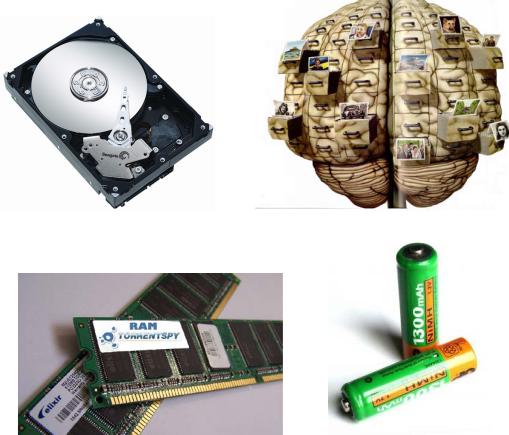
3. Can you match the pictures (pic. 20 – 23) withИmemory types (There is a |
||||
picture you do not need)? |
б |
|
|
|
|
|
|
||
и |
|
|
|
|
С |
|
|
|
Pic. 21 |
Pic. 20 |
|
|
|
|
Pic. 22 |
Pic. 23 |
74
4.What is the difference between the three types of memory?
5.How does your working memory receive information?
6.Why do people forget?
7.What learning strategies are there?
Memory techniques
'All learning depends on memory – without it everything would be new and unknown every day.'
'You have more brain cells in your head than the number of trees in the Amazon rainforest. You have more connections between brain cells than the number of leaves on all the trees in the Amazon rainforest.'
|
What is memory? |
|
|
Memory is our ability to receive, retain and retrieve ideas and infor- |
|
|
И |
|
mation. Remember the three 'Rs' of memory: receive, retain, retrieve. |
||
|
A convenient way to think about memory is in three distinct parts: |
|
|
Д |
|
short term memory; medium term memory; long term memory. |
||
ways. |
We think of these three types of memory as operating in different |
|
Short term memory ('Electrical' memory) |
||
|
||
|
Short term memory is like the RAM on your computer. It is limited |
|
which you only partially 'understand'б(like telephone numbers) but you require 'understanding' to receive and retain information for longer.
in capacity, it's the holding centre for about seven pieces of information. If
we try to add an item to short term memory, the new item pushes out one |
||
of the older ones. |
и |
А |
Your short term memory can retain (for short periods) information |
||
С |
|
|
When the power is switched off, all short term memory disappears.
Medium term memory ('Chemical' memory)
Medium term memory can store more data (information and ideas) for longer periods. Data can only be received into medium term memory by regularly activating and using the data. Even if we activate the material regularly over a period of time, a long period of inactivity will cause the memory to disappear. We can all remember how to ride a bicycle, but do we remember the colour of our first bicycle? Medium term memory is like the hard disk on your computer.
Long term memory ('Structural' memory)
Long term memory is so deep that it actually changes the structure of our brain. In computer terms the memory is 'hard-wired'. Even if the power is switched off and the computer is left unused for many years the memory
75