Материал: Russian Journal of Building Construction and Architecture
Russian journal of building construction and architecture
dome chamber that is the real theism house, and the most important Shiite Sufi house is founded based on number twelve. Moreover, where the polygon ends, the start of dome movement circle and reaching peak occurs (Gholamreza Kiani, p. 148, 152). For example, in Dome of the Taj-ul- Mulk (Khagy) in Jame Mosque of Isfahan, perhaps one of the most beautiful decorative effects of the building is a visual one, and the presence effect of the bricks in creating these effects. Producer of the building might have had knowledge in painting, music, and graphic in addition to architecture. Nowadays, our findings in this dome flourish some thoughts in minds that do not age more than one or few hundred years in the art history. Presence of visual elements such as script, surface, volume, color and pattern in this building is so strong and effective that its soft and pleasant coordination penetrates into soul of each viewer regardless of nationality, language and nation. The pleasant color of bricks in this building and type of the used decoration in it as well as light of different hours of day create such deep and different visual effects that are only visible in Khagi dome of Jame mosque of Isfahan (Tavusi, 2007, p. 33). In the architecture of Iranian mosque, light has never been applied unreasonably. In fact, incoming light in addition to physical dimension has been very effective in shaping the space in mosques, especially the spiritual dimension (Saadat, 2014, p. 9).
Table 4
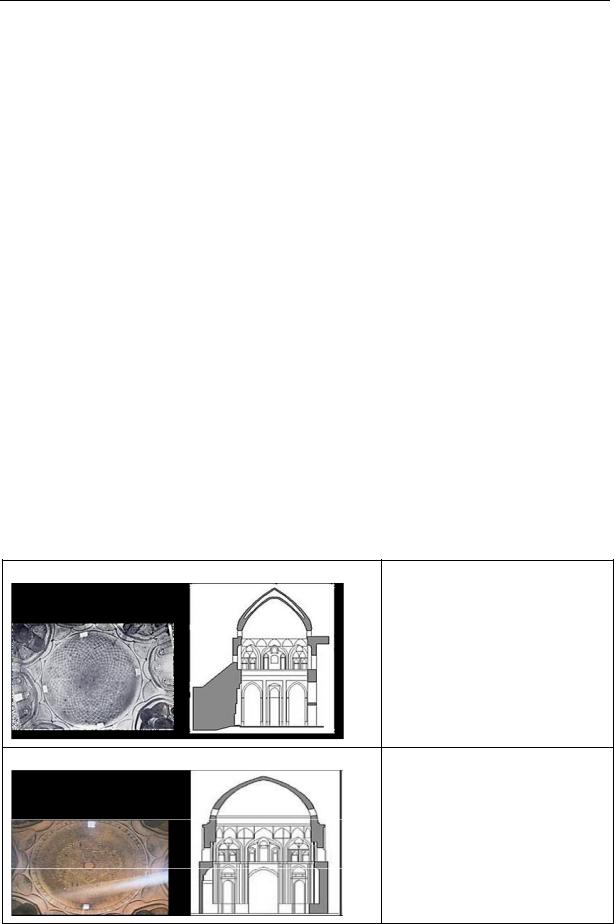
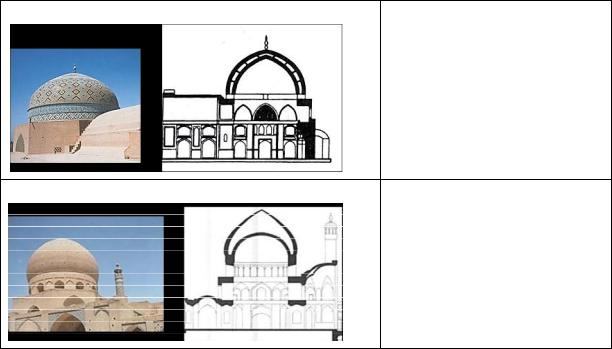
A sample of structures of four Iranian Islamic architecture styles, and the location of lightwells in domes of structures
Khorasani style; Ardestān Jame mosque dome: the section and under dome facades (Memarian, 2006: 212)
Razi style; dome of Taj al-Mulk Jame Mosque of Isfahan: the section and under dome facades (Hajighasemi, 2012.63)
106
Issue № 2(34), 2017 |
ISSN 2542-0526 |
End of Table 4 Azeri style, dome of Jame mosque in
Yazd: section of Dome (Pir nia, 2006,234) and Façade (Hajighasemi, 2012.171).
Isfahani style; Agha Bozorg School dome mosque. Kashan: the section and facades (Hajighasemi, 2012.153)
|
|
|
|
Table 5 |
|
Location and number of lightwells in four styles of Islamic architecture of Iran, Pirnia |
|||||
|
|
|
|
|
|
Name |
Architecture style |
Number |
Dome opening |
Location |
|
of lightwells |
of lightning |
||||
|
|
|
|||
|
|
|
|
|
|
Ardestan mosque |
Khorasanian |
4 |
10 m |
shekargah |
|
|
|
|
|
|
|
Dome of Taj |
|
|
|
|
|
al-Mulk Jame |
Razi |
2 |
10.5 m |
Shekargah of dome |
|
Mosque of Isfahan |
|
|
|
|
|
|
|
|
|
|
|
Jame Mosque |
Azari |
4 |
15 m |
Drum of dome |
|
of Yazd |
|||||
|
|
|
|
||
|
|
|
|
|
|
Agha Bozorg |
Isfahani |
12 |
10.30 m |
Drum of dome |
|
mosque of Kashan |
|||||
|
|
|
|
||
|
|
|
|
|
|
3-2-2. Evolution process of lighting in dome chambers
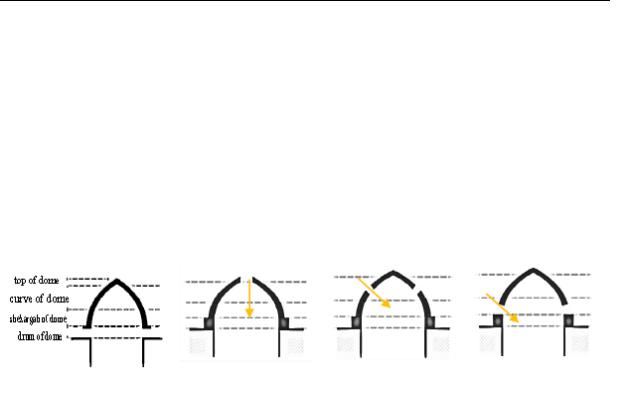
Dome-shaped forms have always been considered as metaphysic and heavens powers in the viewer's idea, and the spherical shape of the sky and the planets has enhanced these images and references. Mechanical needs and symbolic values depend on the dome-shaped form have led the technical history of Iran in this regard to be very rich and fruitful. In order to achieve aesthetic goals and gain secrets of truth and divinity, Islamic architecture has constantly tried to remove the structural problems and obstacles of Dome, and create a hole for light to inter into space (Mahdavinejad, Mathur, p. 2). At the beginning of construction of the dome during
107
Russian journal of building construction and architecture
the Sassanid era and the early arrival of Islam in Iran, Only the lightwell in the middle of the dome was used to direct light into the place. However, with the advancement of dome construction techniques and a better understanding of how to distribute the forces and tensions in its structure, architects could somehow overcome this problem by creating the optimal forms and/ or certain construction methods, and they were able to use the body of dome for creating a hole (Nemat Gorgani, 2004, p. 35). In the courses of mosque architecture of Iran, we witness an upward trend of inward light, and it seems that the subject of light promoted from a quantitative process to a qualitative process in the late Qajar (Saadat, 2014, p. 5).
Conclusion
The position of light in Islamic architecture is higher than visual values. Symbolic procedure and spiritual attention of Islamic artist to light places the image in the highest level of spiritual wayfaring. Light is the symbol of existence flow in the figure of levels. Settlement in the Muslim world paints each worldly and religious issue with the color of faith. Therefore, Islamic artist is dominated by the Supreme Islamic. Manifestation of light in Islamic art in Shamses and Mogharnas is all display of a scared matter, for which Iranian Islamic architecture is a meeting place.
References
1.Khwaja Abdullah Ansari. Compiled by Imam Ahmad Meybodi, Literary and mystical interpretation of the Holy Koran: in 2 vol. Iqbal publisher, eleventh, 2006.
2.Naser Seyyed Hossein. Islamic art and spirituality, translation of Rahim Ghasemian. Tehran, Wisdom Publications, 2011.
3.Pir Nia, Mohammad Karim. The style of Iranian architecture, fourth edition. Tehran, Soroush Danesh, 2006.
4.Bolkhari, Hassan. The manifestation of light and color in Iranian art – Islam. Tehran, the Mehr Sureh, 2006.
5.Hekmat, Nasrallah, Mahboubeh. Hajizadeh, light in the wisdom of Suhrawardi. Two-seasonal philosophical Journal of Shenakht, Research Bulletin of human Sciences, Spring and Summer 2013, no. 66.1, pp. 25––7.
6.Saadat, Davud. Analysis of the concept of transparency in the mosques of Iran. Theoretical roots and New Horizons in art and Architectural, 2014, pp. 1––12.
108
Issue № 2(34), 2017 |
ISSN 2542-0526 |
7.Bemanian, Mohammad Reza. Review of lightwells and light supply in the mosques of Tehran Qajar era. Journal of Islamic architecture, the third number, 2015, first year, pp. 60––74.
8.Madadpur, Mohammed. Light and its role in Islamic art. Visual arts, iss. 22, pp. 34_3.
9.Gorgani, Mehraneh. Background of lighting in architecture and lighting fixtures in art of Islamic period of Iran. Heritage, no. 17, pp. 49––55.
10.Habib, Farah. Unison of light and color in Iranian city space. Fine arts publication, 2007, iss. 27, pp. 34––27.
11.Mirmiran, Hadi. A journey from material to spirit. Journal of urban construction and architecture, 1999, no. 42––43.
12.Nemat Gorgani, Om al-banin. The background of light in the architecture and lighting fixtures in Islamic art, Asar magazine, 2004, iss. 35.
13.Memarian, GH. Stagnation of vaulted structures in Islamic architecture; the first volume. Tehran, Jihad publishing, University of Science and Technology, 1945.
14.Mahdavinejad, Mohammed, Mathur, Saha. Quality of lightwells in the Persian dome. The Naghshe Jahan, iss. 3, pp. 1––12.
15.Hajighasemi, Kambiz. A cultural treasure of Islamic monuments, mosques. Tehran, Shahid Beheshti University, University Press, 1979, Book VI.
16.Noorbakhsh, Sima. Light in the wisdom of Suhrawardi, Second Edition. Tehran, Saeed mohebi press, 2005.
17.Tawusi, Mahmoud, Azadi, Fariba. The Alchemy of bricks and Khagy dome role in the Jame mosque of Isfahan mosque. Art teacher Journal, 2006, no. 1, vol. 1, pp. 29––44.
18.Madadpur M. The manifestations of spiritual wisdom in Islamic art. The third edition of Tehran International Publication, 2011.
19.Abbasi, Manijeh, Nowshadi, Zohreh. The concept of light in aesthetic aspect in Iranian traditional architecture. Proceedings Conference on Islamic-Iranian architecture and urban planning. Mashhad, 2012.
20.Rahbarnia, Zahra, Roozbehani, Roya. The manifestation of God's light with the mystical and artistic aspects in Islamic Iranian architecture with an emphasis on Sohrvardi's idea. Nghshe Jahan, 2014, fourth year, no. 1.
21.Memarian, GHolam Hussein. A process in the theoretical foundations of architecture. Tehran, Soroush Danesh, 2005.
22.Mais, Pier Phoun. Translation of Simon Aivazian, a look at the fundamentals of architecture. Tehran, Tehran university press, 2005.
23.Bemanian, Muhammad Reza. Approaches in explaining Muslim architecture, Tehran, municipal and village administrations, 2006.
24.Nezhat B. A symbol of light in Sufi literature, Spiritual Studies, 2009.
25.Kiani, Gholam Reza. From the monastery to school, work 29 and 30, pp. 146––158.
26.Mohammad, Ali Reza. The first National Conference on Science. Engineering, new ideas, higher education institutions of Ayandegan, 2014, may, 11, pp. 1––10.
27.Mahdavinejad M. J & Mtoor M. H. Recognition of light openings in Iranian mosques' domes. Journal of Architectural Engineering & urban planning, 2011.
28.Ashkan M. & Ahmad. Persian Domes: History, Morphology and Typologies. Archnet-IJAR, 2009, vol. 3, iss. 3, pp. 98––115.
109

Russian journal of building construction and architecture
INSTRUCTIONS TO AUTHORS
1.General Requirements. Contributions reporting original research or reviews and analyses dealing with aspects of environmental quality in natural and agricultural ecosystems will be considered from all disciplines, and from both members and nonmembers, by the editorial board.
To be acceptable a manuscript must make a significant contribution to the advancement of knowledge or toward a better understanding of existing concepts. The study should define principles of broad applicability, be related to problems over a sizeable geographic area, or be of potential interest to a representative number of scientists.
The minimum length for the manuscript is six pages.
The manuscript should be written in English in a clear style.
2.Creating the Manuscript File. Accepted manuscripts are prepared for typesetting with a word processing file. Therefore, authors should compose the manuscript in Word.
The file should contain the following elements: Title page;
Abstract; Text;
References list; Figures;
Tables.
3.Notice for Word 2007 Users. If you have equations, they must be composed using MathType. Do not use INSERT EQUATION, which creates images (when converted) that cannot be used for typesetting.
4.Title Page. The title page should include:
1.A short (<12 words) title that accurately identifies and describes the manuscript content.
2.An author-paper documentation list, with author name(s), affiliation, and complete address(es).
3.Author should avoid the use of non-standart abbreviations.
4.The corresponding author’s email address.
5.Abstract. Include an informative, self-explanatory abstract, containing not less than
250words. The main sections are problem statement, results, and conclusions. It should be
110