Материал: 100_Cases_in_Clinical_Medicine
I |
aVR |
V1 |
V4 |
II |
aVL |
V2 |
V5 |
|
|
||
III |
aVF |
V3 |
V6 |
|
|
||
II |
|
|
|
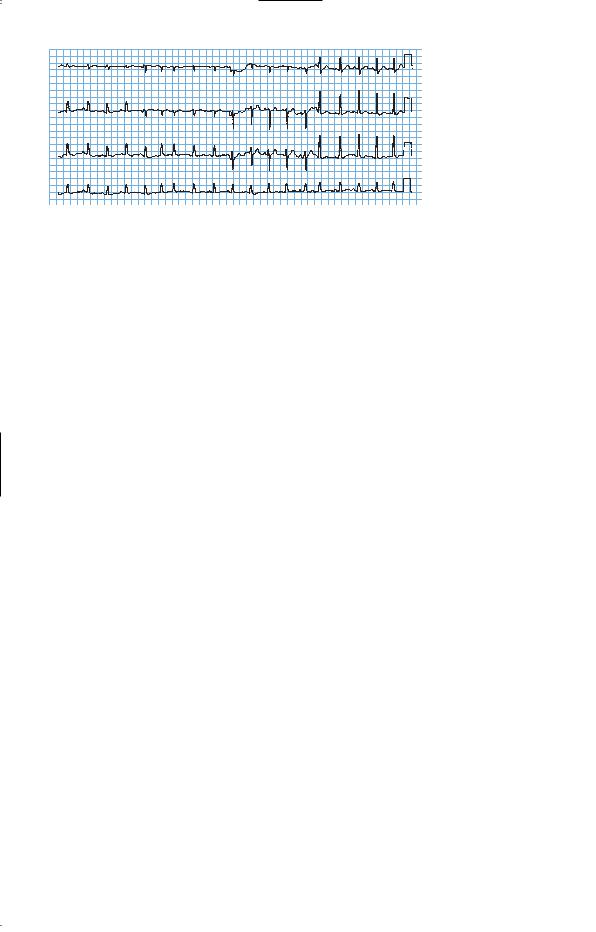
Figure 87.1 Electrocardiogram.
Question
• What are the most likely diagnoses?
219

ANSWER 87
There are a number of possibilities to explain falls in the elderly. Some more information in the history about the circumstances of these falls would be helpful. On further enquiry, it emerges that the falls are most likely to occur when he gets up from bed first thing in the morning. The afternoon events have occurred on getting up from a chair after his post-lunch doze. These circumstances suggest a possible diagnosis of postural hypotension. This was verified by measurements of standing and lying blood pressure – the diagnostic criteria are a drop of 15 mmHg on standing for 3 min. This showed a marked postural drop with blood pressure decreasing from 134/84 to 104/68 mmHg. This is most likely to be caused by the antihypertensive treatment; both the alpha-blocker which causes vasodilatation and the diuretic might contribute. Another possible candidate for a cause of the postural hypotension is the diabetes which could be associated with autonomic neuropathy. In this case the diabetes is not known to have been present for long and there is evidence of only very mild peripheral sensory neuropathy. Diabetic autonomic neuropathy is usually associated with quite severe peripheral sensory neuropathy, with or without motor neuropathy.
The ECG shows evidence of sino-atrial node disease or sick sinus syndrome. Clinically, it is easily mistaken for atrial fibrillation because of the irregular rhythm and the variation in strength of beats. The ECG shows a P-wave with each QRS complex although the P-waves change in shape and timing. It may be associated with episodes of bradycardia and/or tachycardia which could cause falls. This might be investigated further with a 24-h ambulatory recording of the ECG.
Coughing bouts can cause falls through cough syncope. The positive intrathoracic pressure during coughing limits venous return to the heart. The cough is usually quite marked and he might be expected to remember this since he gives a good account of the falls otherwise. Syncope can occur in association with micturition. Neck movements with vertebrobasilar disease, poor eyesight and problems with balance are other common causes of falls in the elderly. A neurological cause, such as transient ischaemic episodes and epilepsy, is less likely with the lack of prior symptoms and the swift recovery with clear consciousness and no neurological signs.
Another diagnosis which should be remembered in older people who fall is a subdural haematoma. Symptoms may fluctuate, and this might be considered and ruled out with a computed tomography (CT) scan of the brain.
The doxazosin should be stopped and another antihypertensive agent started if necessary. This might be a beta-blocker, long-acting calcium antagonist or angiotensin convertingenzyme (ACE) inhibitor, although all these can cause postural drops in blood pressure. His symptoms all disappeared on withdrawal of the doxazosin. The blood pressure rose to 144/86 mmHg lying and 142/84 mmHg standing, indicating no significant postural hypotension, with reasonable blood-pressure control.
KEY POINTS
•Falls in the elderly are a symptom in need of a diagnosis.
•Postural hypotension is a common side-effect of diuretics, vasodilators or other antihypertensive therapy. Lying and standing blood pressures should be measured if this is suspected.
•Autonomic neuropathy in diabetes is associated with significant peripheral sensory neuropathy.
220

CASE 88: FATIGUE
History
A 63-year-old woman is brought in to the surgery by her neighbour who has been worried that she looks increasingly unwell. On direct questioning she says that she has felt increasingly tired for around 2 years. She has been off her food but is unclear whether she has lost any weight. She was diagnosed with hypothyroidism 8 years ago and has been on thyroxine replacement but has not had her blood tests checked for a few years. Her other complaints are of itching for 2–3 months, but she has not noticed any rash. She says that her mouth has been dry and, on direct questioning, thinks her eyes have also felt dry.
There has been no disturbance of her bowels or urine although she thinks that her urine has been rather ‘strong’ lately. She is 14 years postmenopausal. There is a family history of thyroid disease and of diabetes. She does not smoke, and drinks two glasses of sherry every weekend. She has never drunk more than this regularly. She has taken occasional paracetamol for headaches but has been on no regular medication other than thyroxine and some vitamin tablets she buys from the chemist.
Examination
Her sclerae look a little yellow and she has xanthelasmata around the eyes. There are some excoriated marks from scratching over her back and upper arms. The pulse is 74/min and regular, blood pressure is 128/76 mmHg. No abnormalities are found in the cardiovascular or respiratory system. In the abdomen, the liver is not palpable but the spleen is felt 2 cm under the left costal margin. It is not tender.
INVESTIGATIONS
|
|
Normal |
Sodium |
142 mmol/L |
135–145 mmol/L |
Potassium |
4.2 mmol/L |
3.5–5.0 mmol/L |
Urea |
5.6 mmol/L |
2.5–6.7 mmol/L |
Creatinine |
84 &moI/L |
70–120 &mol/L |
Calcium |
2.24 mmol/L |
2.12–2.65 mmol/L |
Phosphate |
1.09 mmol/L |
0.8–1.45 mmol/L |
Total bilirubin |
84 mmol/L |
3–17 mmol/L |
Alkaline phosphatase |
494 IU/L |
30–300 IU/L |
Alanine aminotransferase |
63 IU/L |
5–35 IU/L |
Gamma-glutamyl transpeptidase |
568 IU/L |
11–51 IU/L |
Thyroid stimulating hormone |
1.2 mU/L |
0.3–6.0 mU/L |
Cholesterol |
7.8 mmol/L |
!5.5 mmol/L |
Fasting glucose |
4.7 mmol/L |
4.0–6.0 mmol/L |
Antinuclear antibody: ' |
|
|
Antimitochondrial antibody: ''' |
|
|
Thyroid antibodies: '' |
|
|
Questions
•What is your interpretation of these findings?
•What is the likely diagnosis and how might this be confirmed?
221

ANSWER 88
The liver function tests show a predominantly obstructive picture with raised alkaline phosphatase and gamma-glutamyl transpeptidase, while cellular enzymes are only slightly raised. The symptoms and investigations are characteristic of primary biliary cirrhosis, an uncommon condition found mainly in middle-aged women. In the liver there is chronic inflammation around the small bile ducts in the portal tracts. Hypercholesterolaemia, xanthelasmata and xanthomata are common. The dry eyes and dry mouth may occur as part of an associated sicca syndrome. Itching occurs because of raised levels of bile salts, and can be helped by the use of a binding agent such as cholestyramine which interferes with their reabsorption. The presence of antimitochondrial antibodies in the blood is typical of primary biliary cirrhosis. These antibodies are found in 95 per cent of cases.
Hypothyroidism might explain some of her symptoms but the normal thyroid-stimulating hormone (TSH) level shows that her current dose of 150 &g thyroxine is providing adequate replacement. The thyroid antibodies reflect the autoimmune thyroid disease which is associated with other autoantibody-linked conditions such as primary biliary cirrhosis.
The diagnosis is confirmed by a liver biopsy. This should only be carried out after an ultrasound confirms that there is no obstruction of larger bile ducts. Ultrasound will help to rule out other causes of obstructive jaundice although the clinical picture described here is typical of primary biliary cirrhosis. No treatment is known to affect the clinical course of this condition.
KEY POINTS
•The pattern of liver enzyme abnormalities usually reflects either an obstructive or hepatocellular pattern.
•Symptoms such as itching have a wide differential diagnosis. Dealing with the underlying cause, wherever possible, is preferable to symptomatic treatment.
222

CASE 89: LOSS OF CONSCIOUSNESS
History
A 40-year-old man is admitted to the emergency department having been found unconscious at home by his wife on her return from work in the evening. He has suffered from insulin-dependent diabetes mellitus for 18 years and his diabetic control is poor. He has had recurrent hypoglycaemic episodes, and has been treated in the emergency department on two occasions for this. Over the past few weeks he has developed pain in his right foot. His general practitioner diagnosed cellulitis and he has received two courses of oral antibiotics. This has made him feel unwell and he has complained to his wife of fatigue, anorexia and feeling thirsty. In his medical history he had a myocardial infarction 2 years ago. He has had bilateral laser treatment for proliferative diabetic retinopathy. He was a builder but is now unemployed. He smokes 25 cigarettes per week and drinks 30 units of alcohol per week. His treatment is twice-daily insulin, he checks his blood glucose irregularly at home.
Examination
He is clinically dehydrated with reduced skin turgor and poor capillary return. His pulse is regular and 116/min. His blood pressure is 92/70 mmHg lying, 72/50 mmHg sitting up. He seems short of breath with a respiratory rate of 30/min. Otherwise, examination of his respiratory and abdominal systems is normal. He has an ulcer on the third toe of his right foot and the foot looks red and feels warm. He is rousable only to painful stimuli. There is no focal neurology. Funduscopy shows bilateral scars of laser therapy.
INVESTIGATIONS
|
|
Normal |
Haemoglobin |
15.2 g/dL |
11.7–15.7 g/dL |
White cell count |
16.3 % 109/L |
3.5–11.0 % 109/L |
Platelets |
344 % 109/L |
150–440 % 109/L |
Sodium |
143 mmol/L |
135–145 mmol/L |
Potassium |
5.5 mmol/L |
3.5–5.0 mmol/L |
Chloride |
105 mmol/L |
95–105 mmol/L |
Urea |
11.3 mmol/L |
2.5–6.7 mmol/L |
Creatinine |
114 &mol/L |
70–120 &mol/L |
Bicarbonate |
12 mmol/L |
24–30 mmol/L |
Urinalysis: '' protein; '' ketones; ''' glucose |
|
|
Blood gases on air |
|
|
pH |
7.27 |
7.38–7.44 |
paCO2 |
3.0 kPa |
4.7–6.0 kPa |
paO2 |
13.4 kPa |
12.0–14.5 kPa |
Questions
•What is the cause for this man’s coma?
•How would you manage this patient?
223