Материал: 100_Cases_in_Clinical_Medicine

ANSWER 89
This man has signs of dehydration and the high urea with a normal creatinine is consistent with this. He is acidotic. The blood glucose level is not given but the picture is likely to represent hyperglycaemic ketoacidotic coma. The key clinical features on examination are dehydration and hyperventilation, and the triggering problem with the infection in the foot. A persistently high sugar level induced by his infected foot ulcer causes heavy glycosuria triggering an osmotic diuresis. This leads to hypovolaemia and reduced renal blood flow causing prerenal uraemia. The extracellular hyperosmolality causes severe cellular dehydration, and loss of water from his brain cells is the cause of his coma. Decreased insulin activity with intracellular glucose deficiency stimulates lipolysis and the production of ketoacids. He has a high anion gap metabolic acidosis due to accumulation of ketoacids (acetoacetate and 3-hydroxybutyrate). The anion gap is calculated from the equation:
[Na'] ' [K'] * ([Cl*] ' [HCO*3 ])
and is normally 10–18 mmol/L; in this case it is 31.5 mmol/L. Ketones cause a characteristically sickly sweet smell on the breath of patients with diabetic ketoacidosis (about 20 per cent of the population cannot smell the ketones). The metabolic acidosis stimulates the respiratory centre leading to an increase in the rate and depth of respiration (Kussmaul breathing) producing the reduction in paCO2 as respiratory compensation for the acidosis. In older diabetic patients there is often evidence of infection precipitating these metabolic abnormalities, e.g. bronchopneumonia, infected foot ulcer.
The differential diagnosis of coma in diabetics includes non-ketotic hyperglycaemic coma, particularly in elderly diabetics, lactic acidosis especially in patients on metformin, profound hypoglycaemia, and non-metabolic causes for coma, e.g. cerebrovascular attacks and drug overdose. Salicylate poisoning may cause hyperglycaemia, hyperventilation and coma, but the metabolic picture is usually one of a dominant respiratory alkalosis and mild metabolic acidosis.
The aims of management are to correct the massive fluid and electrolyte losses, hyperglycaemia and metabolic acidosis. Rapid fluid replacement with intravenous normal saline and potassium supplements should be started. In patients with cardiac or renal disease, a central venous pressure (CVP) line is mandatory to control fluid balance. Regular monitoring of plasma potassium is essential, as it may fall very rapidly as glucose enters cells. Insulin therapy is given by intravenous infusion adjusted according to blood glucose levels. A nasogastric tube is essential to prevent aspiration of gastric contents, and a bladder catheter to measure urine production. Antibiotics and local wound care should be given to treat this man’s foot ulcer. In the longer-term it is important that this patient and his wife are educated about his diabetes and that he has regular access to diabetes services. His smoking and alcohol consumption will also need to be addressed. There may be social issues to be considered in relation to his unemployment.
KEY POINTS
•Dehydration, tachypnoea and ketosis are the key clinical signs of diabetic ketoacidosis.
•Twenty per cent of the population (and therefore doctors) cannot smell ketones.
224
This page intentionally left blank

CASE 90: COUGH AND BREATHLESSNESS
History
A 69-year-old widower smoked 20 cigarettes a day for over 40 years but then gave up 9 months ago when his first grandchild was born. He has had a cough with daily sputum production for the last 20 years and has become short of breath over the last 3 years. He coughs up a little white or yellow sputum every morning. He has put on weight recently and now weighs 100 kg. His ankles have become swollen recently and his exercise tolerance has decreased. He can no longer carry his shopping back from the supermarket 180 m (200 yards) away. He worked as a warehouseman until he was 65 and has become frustrated by his inability to do what he used to do. He is not able to look after his grandchild because he feels too short of breath.
There is no other relevant medical or family history. He lives alone and has a cat and a budgerigar at home.
His general practitioner (GP) gave him a salbutamol metered-dose inhaler which produced no improvement in his symptoms.
Examination
He is overweight. He appears to be centrally and peripherally cyanosed and has some pitting oedema of his ankles. His jugular venous pressure is raised 3 cm. He has poor chest expansion. There are some early inspiratory crackles at the lung bases.
INVESTIGATIONS
Respiratory function test results are shown: |
|
|
|
Actual |
Predicted |
FEV1 (L) |
0.55 |
2.8–3.6 |
FVC (L) |
1.35 |
3.8–4.6 |
FER (FEV1/FVC) (%) |
41 |
72–80 |
PEF (L/min) |
90 |
310–440 |
FEV1: forced expiratory volume in 1 s; FVC, forced vital capacity; FER, forced expiratory ratio; PEF, peak expiratory flow.
His chest X-ray is shown in Fig. 90.1.
226
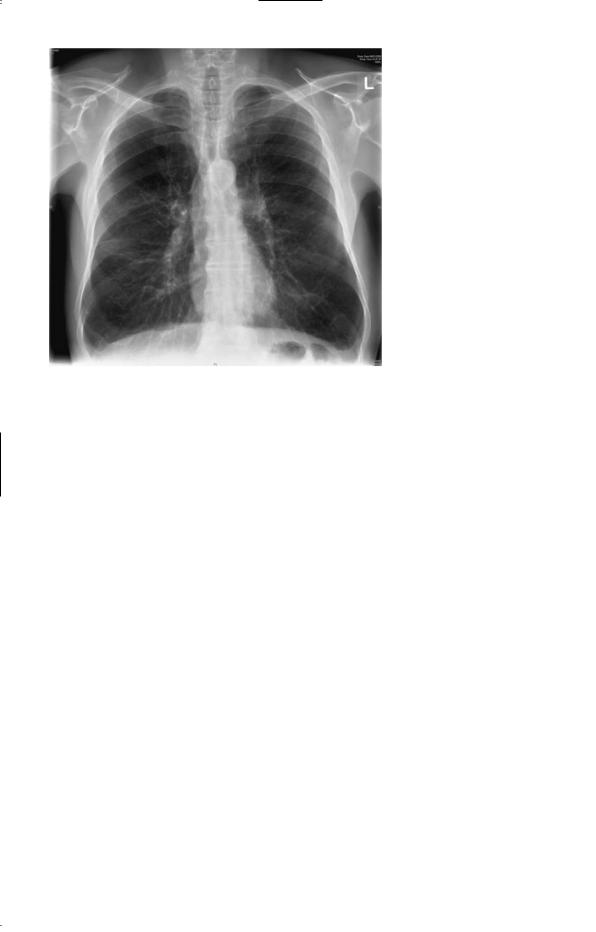
Figure 90.1 Chest X-ray.
Questions
•What is the likely diagnosis?
•What management is appropriate?
227

ANSWER 90
The most likely diagnosis is chronic obstructive pulmonary disease (COPD). The physical signs and chest X-ray indicate overinflation. The early inspiratory crackles are typical of COPD.
Treatment with bronchodilators should be pursued looking at the effect of $2-agonists and anticholinergic agents, judging the effect from the patient’s symptoms and exercise tolerance rather than spirometry. Theophylline may sometimes be useful as a third-line therapy but has more side-effects.
With this degree of severity, inhaled corticosteroids and long-acting bronchodilators (salmeterol/formoterol or tiotropium) would be appropriate inhaled therapy. Careful attention would need to be given to inhaler technique.
He is cyanosed and has signs of right-sided heart failure (cor pulmonale). Blood gases should be checked to see if he might be a candidate for long-term home-oxygen therapy (known to improve survival if the pressure of arterial oxygen (paO2) in the steady-state breathing air remains !7.2 kPa). Gentle diuresis might help the oedema although oxygen would be a better approach if he is sufficiently hypoxic. Annual influenza vaccination should be recommended and Streptococcus pneumoniae vaccination should be given. Antibiotics might be kept at home for infective exacerbations.
Exercise tolerance will be reduced by his obesity and by lack of muscle use. A weightreducing diet should be started. If he has the motivation to continue exercising, then a pulmonary rehabilitation programme has been shown to increase exercise tolerance by around 20 per cent and to improve quality of life. Other more dramatic interventions such as lung-reduction surgery or transplantation might be considered in a younger patient. Depression is often associated with the poor exercise tolerance and social isolation, and this should be considered.
COPD is often regarded as a condition where treatment has little to offer. However, a vigorous approach tailored to the need of the individual patient can provide a worthwhile benefit.
KEY POINTS
•In COPD $2-agonists and anticholinergic agents produce similar effects or a greater response from anticholinergics. The combination may be helpful. In contrast, in asthma $2-agonists produce a greater effect.
•Assessment for home oxygen should be made in a stable state on optimal inhaled therapy.
•Exercise and diet are important elements in the management of COPD.
•Depression is common in chronic conditions such as COPD.
228