Материал: 100_Cases_in_Clinical_Medicine

CASE 95: CLUMSINESS
History
A 66-year-old woman notices that she is having trouble performing some everyday tasks such as doing up buttons on her blouse and chopping up vegetables in her cooking. She complains that her muscles feel stiff, and it is taking her longer than it did to walk to the local shops. She is anxious about these problems since she lives alone and has to do everything for herself. She has noticed a little shakiness which she ascribes to anxiety. Her daughter has told her that it is becoming increasingly difficult to read the small writing in the letters she sends. She is a retired journalist and has no significant past medical history. There is no disturbance of her bowels or micturition. Her appetite has been good and her weight steady. She complains that she has been sleeping poorly and is, consequently, rather tired. She does not smoke tobacco and drinks only occasionally. She has hypertension and takes atenolol 50 mg daily.
Examination
Her pulse is 60/min and regular, blood pressure is 134/84 mmHg. There are no abnormalities in the cardiovascular or respiratory systems. On neurological examination there is no muscle wasting. She has generally increased muscle tone throughout the range of movement and equal in flexors and extensors. There is a slight tremor affecting mainly her right hand, which is suppressed when she tries to do something. She has problems with fine tasks such as doing up buttons. Power, reflexes, co-ordination and sensation are all normal. When asked to walk she is a little slow to get started and has difficulty stopping and turning.
Questions
•What is the diagnosis?
•How would you investigate and manage this patient?
239

ANSWER 95
There is evidence in the history and examination of tremor, rigidity and bradykinesia. Her writing shows micrographia secondary to the rigidity and slowness of movement. Her hypertension is well controlled on the beta-blocker. Beta-blockers can cause tiredness and slowness but not to the extent seen in this woman. This woman has Parkinson’s disease presenting with the classic triad of tremor, rigidity and hypokinesia. Tremor is usually an early symptom and may be unilateral. The combination of tremor with rigidity leads to the cogwheel form of rigidity. The patient often goes on to have a blank mask-like facies. There is difficulty starting to walk (freezing) and the patient uses small steps and has difficulty stopping (festination). There is generally normal intellectual function, but there is often depression. Sleep is often disturbed contributing to daytime tiredness. The characteristic pathological abnormality is degeneration of dopamine-secreting neurones in the nigrostriatal pathway of the basal ganglia.
Parkinsonian features (parkinsonism) may occur in a variety of diseases:
•Parkinson’s disease
•postencephalitic parkinsonism
•neuroleptic drug-induced Parkinson’s disease
•parkinsonism in association with Alzheimer’s/multi-infarct dementia.
!Classification of tremor
•Rest tremor: the tremor is worse at rest and is typical of parkinsonism.
•Postural tremor: this is characteristic of benign essential tremor, physiological tremor and exaggerated physiological tremor caused by anxiety, alcohol and thyrotoxicosis. Benign essential tremor is not present at rest, but appears on holding the arms outstretched but is not worse on movement (finger–nose testing). Tests of co-ordination are normal and walking is unaffected. There is usually a family history of tremor and the tremor is helped by alcohol and beta-blockers.
•Intention tremor: the tremor is worse on movement and is most obvious in finger–nose testing. It is usually caused by brainstem or cerebellar disease caused by such diseases as multiple sclerosis, localized tumours or spinocerebellar degeneration.
A variety of drugs are available to treat this woman’s Parkinson’s disease. Selegiline, an inhibitor of monoamine oxidase B may delay the need to start levodopa and may slow the rate of progression of the disease, but has significant side-effects. Levodopa is usually used in combination with a selective dopa decarboxylase inhibitor which does not cross the blood–brain barrier and reduces peripheral adverse effects. The commonest side-effects are nausea, vomiting, dizziness, postural hypotension and neuropsychiatric problems. After many years of treatment the effects tend to diminish and the patient may develop rapid oscillations in control – the ‘on–off’ effect. When these develop, a sustained release formulation of levodopa or a dopamine agonist, e.g. bromocriptine, may produce improvement. Because of the loss of effect with time, treatment should not be started too early. This requires careful discussion with the individual patient. She should be assessed by a physiotherapist and occupational therapist and provided with advice and aids. With time her house may need to be altered to aid her mobility.
KEY POINTS
•Parkinson’s disease is characterized by tremor, rigidity and hypokinesia.
•Patient management is long term and multidisciplinary.
•Benefits of levodopa treatment in Parkinson’s disease may lessen with time.
240
This page intentionally left blank

CASE 96: SHORTNESS OF BREATH
History
A 35-year-old woman presents with a 6-month history of increasing shortness of breath. This has progressed so that she is now short of breath on walking up one flight of stairs and walks more slowly on the flat than other people her age. In addition she has developed a dry cough over the last 3 months.
In her previous medical history she had mild asthma as a child. She thinks that her father died of a chest problem in his 40s. She takes occasional paracetamol and has taken ‘slimming pills’ in the past.
She is a lifetime non-smoker and drinks less than 10 units of alcohol per week. She has worked in the printing trade since she left school. She has two children aged 8 and 10 years and they have a cat and a rabbit at home.
Examination
There is no clubbing, anaemia or cyanosis. Examination of the cardiovascular system is normal. In the respiratory system expansion of the lungs seems to be reduced but symmetrical. The percussion note is normal as is tactile vocal fremitus. On auscultation there are fine late inspiratory crackles at both lung bases.
INVESTIGATIONS
Respiratory function tests revealed the following: |
|
|
|
Actual |
Predicted |
FEV1 (L) |
3.0 |
3.6–4.2 |
FVC (L) |
3.6 |
4.5–5.3 |
FER (FEV1/FVC) (%) |
83 |
75–80 |
PEF (L/min) |
470 |
450–550 |
FEV1: forced expiratory volume in 1 s; FVC, forced vital capacity; FER, forced expiratory ratio; PEF, peak expiratory flow.
Her chest X-ray is shown in Fig. 96.1 and a high-resolution computed tomography (CT) scan in Fig. 96.2.
242
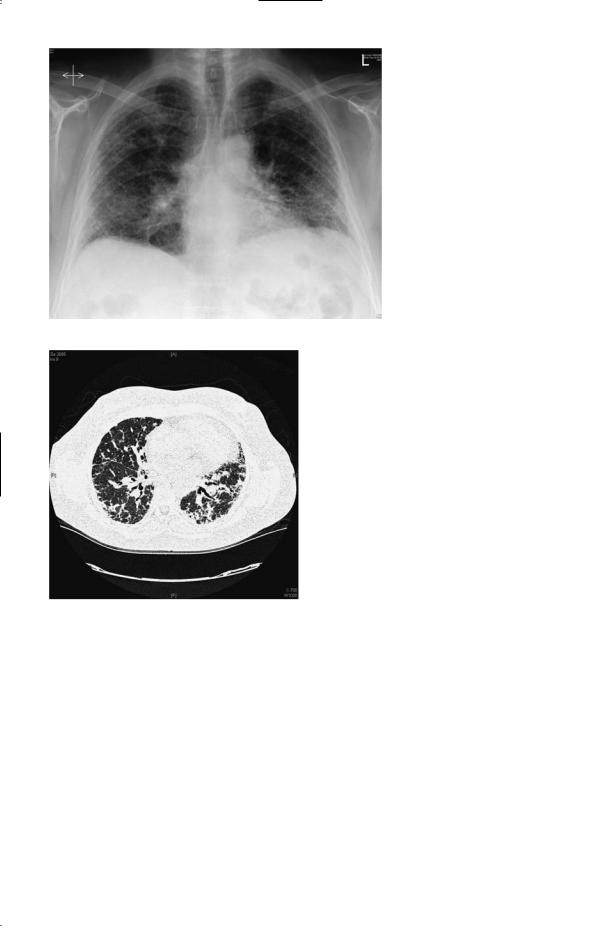
Figure 96.1 Chest X-ray.
Figure 96.2 High-resolution computed tomography scan.
Questions
•What is the likely diagnosis?
•What further investigations and treatment are indicated?
243