Материал: 2507
tour of the Chapel and its grounds. We hope that you will be able to join us during this very significant time in the life of Rosslyn Chapel.
29.Look at the title and the pictures. Why do you think these giant stones are so mysterious? Do you know when Stonehenge appeared? In what country? Who built it and why?
30.In which context do you expect to find these words in the text?
Imagination; to brood in contemplation; hustle and bustle; wizard Merlin; to whisk; the Druids; summer and winter solstices; people dressed in white; to move the vast stones; astronomy; to support the theory; eclipses.
31.Read the text and underline the answersИto the questions in the headings.
Who built Stonehenge? ДА
|
б |
и |
|
С |
|
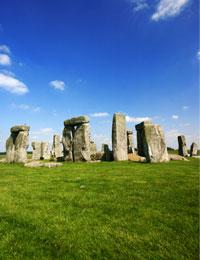
Pic. 76
Stonehenge (pic. 76) has haunted the British imagination for centuries. Jammed as it is between two busy motorways, with all the hustle and bustle of modern life, the ancient stone megaliths seem to brood in quiet contemplation of an age long gone.
A vast number of theories have been put forward to explain the strange construction on Salisbury plain. The great questions surrounding Stone-
186
henge have always been the same: Who built it? Why did they build it? And how did they build it? Succeeding generations of scholars have answered the questions in different ways, but despite the best efforts of modern research, some of the answers still remain elusive.
Stonehenge first appears in the documentary record in Geoffrey of Monmouth's History of the Kings of Britain, written in the 12th century. Referring to it as The Giants' Dance, he credited its construction to the wizard Merlin, who is said to have whisked the giant stones away from Ireland to Britain on the orders of Aurelius, a British king who desired to erect a monument to a group of Britons who had been murdered by the Saxons.
Stonehenge - Who Built It?
Mixing its construction in with figures from Arthurian legend would have dated it to around 400 - 500 A.D. Later theories pushed the hypothetical construction date back even further. Inigo Jones,Иin the 17th century, believed it had been built by the Romans. Others however, writing not long after Jones, believed it had been built Дin pre-Roman times by the Celtic priest sect known as the Druids. This theory, became the dominant one and still is down to the present-day. In fact, in more recent times, various societies of people claiming to be druidsАsprang up over the years and began holding ceremonies at the monument on the occasion of the summer and winter solstices. Large crowdsбoften gathered at these ceremonies, even in the 19th century, but it's not clear how seriously any of it was taken. As venerable a figure asиWinston Churchill is known to have been inducted into something calling itself the Ancient Order of Druids so perhaps the whole thing wasСregarded as a bit of a laugh.
Even in our own day, people dressed in white, flowing robes and calling themselves druids continue to perform ceremonies at the Stonehenge site. It does seem that the monument's attribution to the druids may have been utterly wrong, however. Modern scholarship has dated the beginning of construction at Stonehenge to around 3000 B.C., pushing it back into the pre-historic age, before the druids are known to have lived. The truth is that we know very little about the Britons who lived in that time, so the 3000 B.C. date just makes Stonehenge more of a mystery than ever.
Stonehenge - How Was It Constructed?
The most obvious question begged by this earlier date is how did people living in such a primitive age, without the tools and techniques of modern engineering, manage to move the vast stones (the largest weighing up to 50 tons) over large distances and heft them into position? Various theories have been advanced to account for it. Some scholars have argued that the
187
great stones could have been moved on a rolling carpet of logs; others believe they might have been transported on a kind of primitive un-wheeled railway wagon, sliding along lubricated and specially-built tracks.
Stonehenge - What Was Its Purpose?
The most intriguing question about Stonehenge has always been what is it for? Early speculation had the druids performing human sacrifices there and indeed, the headless body of a Saxon was recovered during 20th century excavations on the site but since William Stukeley first advanced the idea in the 17th century, the notion that there is a connection between Stonehenge and astronomy has gathered growing support and now constitutes the most common interpretation of the structure's purpose. Sir Norman Lockyer bolstered the case for this connection around the turn of the
when the American professor Gerald Hawkins published his book Stone-
20th century, arguing that Stonehenge was in fact, a calendar. But the strongest confirmation of the astronomical hypothesisИcame in the 1960s
henge Decoded, in which he demonstratedДthat on the day of a summer sol-
stice, a person standing at key points in the structure would see the sun rise above the Heel Stone (one of the most distinctive stones in the site) and set between a trilithon, which is a three-stone arrangement of two vertical stones capped by a horizontal lintel. Hawkins believed the arrangement of stones could be used to predict eclipses.
many ways recent scholarshipбhas only added to the monument's mystery.
Conclusion |
и |
Modern research has clarified someАof the uncertainties that previously ex- |
|
isted about Stonehenge but has provided few definite answers. Indeed, in |
|
|
С |
For 5000 years, the structure on Salisbury Plain has continued to baffle and intrigue all those who have considered it and it seems it will continue to do so for many more.
http://www.spookystuff.co.uk
32. Think about your country. Are there any mysterious places? Write an article. Remember to include the following information: location, history, modern usage, why to visit.
188
Adventurous America
Lost World Adventures
In the 19th century most of the American west was a great wilderness-just trees, lakes, rivers, plains, and a couple of cities sprinkled here and there. Few people saw the wilderness as something beautiful. Instead, most saw the land as hundreds of thousands of acres just waiting to be mined, settled, and farmed. Luckily, some people in the American government decided to set aside some of the wilderness for the purpose of keeping it as wilderness. And that was the beginning of the national park system. Thanks to those people, there are all sorts of amazing places in the US!
|
|
|
|
И |
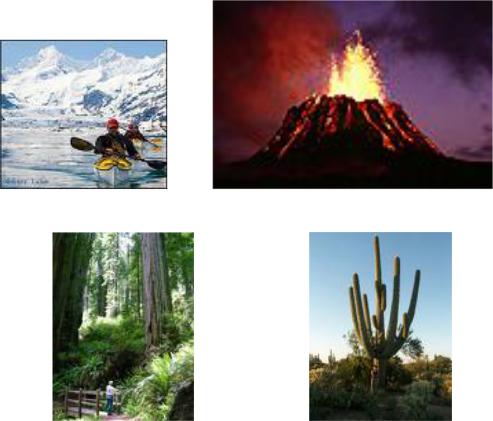
1. Look at the pictures (pic. 77 - 80).Which one is: |
||||
The Redwood National Park |
|
Д |
||
The Saguaro National Park |
|
|||
|
|
|
||
Alaska’s Glacier Bay National Park |
|
|
||
The Hawaii Volcanoes National Park |
|
|
||
|
|
А |
|
|
|
б |
|
|
|
и |
|
|
|
|
С |
|
|
|
Pic. 78 |
Pic. 77 |
|
|
|
|
Pic. 79 |
Pic. 80 |
189
2.Read the text to find out.
1.What is the Mesa Verde National Park famous for?
2.When did the Anasazi Indians disappear?
3.Where can you see petroglyphs (rock carvings) and pictographs (rock paintings)?
4.Where can you see the world’s most active volcanoes?
5.What is called a dry ocean?
6.Where is the Petrified Forest National Park located?
7.What are the true natural wonders of the world?
8.What is the first and the oldest national park in the United States of America?
9.What is it famous for?
10.What is the best hiding place in the world?
11.What is home to the oldest trees in the world?И
12.Where you can find the magnificent saguaro cactus?
13.What is the hottest place in the UnitedДStates?
14.What are the summer temperatures in Death Valley?
15.In what place is it easy to imagine what our planet looked like at the end of the Ice Age? Аб
и |
|
С |
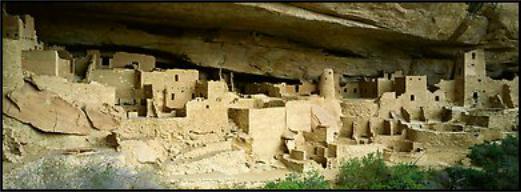
Pic. 81 |
|
Mystery People
The Mesa Verde National Park (pic. 81) in Colorado is The Mesa Verde National Park its ‘cliff dwellings’. The Anasazi Indians, who lived there over a thousand years ago, built many houses, both underground and on the tops of the cliffs. For some unknown reason, the Anasazi Indians disappeared suddenly and mysteriously in 1300 AD.
190