Материал: BASIC_SURGICAL_TECHNIQUES budapest
Conrad Ramstedt (1867-1963) was a surgeon from Munster. In 1912, Ramstedt described a new technique to save the life of the infants suffering from spastic hypertrophic pyloric stenosis.
1914. William T. Bovie developed an innovative method. His electrosurgical unit let the high frequency alternating current pass through the body allowing it to cut or coagulate (electrocautery).
1923. With the support of the Charite in Berlin, they opened the Institute of Medical Cinematography. They put a camera above the operating table which was electrically directed and could make films from operations. These medical films primarily demonstrated the operative techniques.
1931. Rudolf Nissen (1896-1981) was a German surgeon. He was the first who performed a pulmonectomy in a patient who was suffering from bronchiectasia. He also developed the method of fundoplication of the stomach.
1938. János Veres (1903-1979) was a pulmonologist in Kapuvár. In order to prevent injuries of the lung while getting through the thoracic wall, Veres used his own new, special, springloaded needle to create safely an artificial pneumothorax which was a technique for treatment of the tuberculosis at that time. The instrument (Veres-needle) is spreaded world-wide in creating pneumoperitonuem during laparoscopy.
1944. Alfred Blalock (1899-1964) was an American heart surgeon in Baltimore. In the Johns Hopkins Hospital, he performed the first successful operation on a cyanotic infant (”bluebaby”), who had a syndrome of tetralogy of Fallot.
1950. Richard H. Lawler (1896-1982) was an American surgeon in Chicago. He performed the first kidney allotransplantation. He used a cadaver’s kidney without application of any immunsuppression. The transplanted kidney functioned well at the begining, but they had to reoperate the patient 10 months later, when they found a shrunken and pale kidney graft.
1954. Joseph E. Murray (1919- ) performed the world's first successful renal transplantation between the identical twins at the Peter Bent Brigham Hospital in Boston. He was awarded the Nobel Prize in 1990.His surgical technique is – with minor modifications – still used.
1958. Pope Pius XII (1876-1958) said that doctors could not define the death: ”within the competence of the Church to define death”. This produced an ambivalent opinion in the public: ”You are dead when your doctor says you are”. In 1966, the French Medical Academy for the first time used the irreversible injury to the brain as a factor to establish (determine) the death instead of the cardiac standstill.
III. Period: From the 1960s
1962. András Németh performed the first kidney transplantation in Szeged.
1967. Christiaan Neething Barnard (1922-2001) performed the world's first human heart transplant operation in Cape Town, South Africa. The donor heart came from a 24-year-old woman, who had been killed in a road accident .The recipient was the 54-year-old Louis
11
Washkansky. The operation took 3 hours. Washkansky survived the operation and lived for eighteen (18) days when he died due to a severe infection.
1985. Erich Mühe (1938-2005) performed the first laparoscopic cholecystectomy in Böblingen. That time, the German surgical society degradated the method as the ”keyhole surgery”.
1990. Kiss Tibor performed the first laparoscopic cholecystectomy in Hungary (Pécs).
1998. Friedrich-Wilhelm Mohr (1951- ) using the Da Vinci surgical robot performed the first robotically assisted cardiac bypass in the Leipzig Heart Centre (Germany).
2001. In New York Jacques Marescaux used the Zeus robot to perform a laparoscopic cholecystectomy on a 68 year old woman in Strasbourg (France).
2004. They started to perform the NOTES (Natural Orifice Transluminal Endoscopic Surgery) interventions with the use of flexible endoscopes in animal models. The human use of the technique promises the reduction of postoperative pain (no pain surgery), the decrease in possibilty for adhesion, and the elimination of postoperative abdominal hernias. It also leads to an incisionless or no scar surgery.
12
3. LAYOUT AND EQUIPMENTS OF THE OPERATING ROOM, TECHNICAL BACKGROUND, STERILIZATION, DISINFECTIONING, POSSIBILITIES TO PREVENT WOUND INFECTION: ASEPSIS AND ANTISEPSIS
3.1. Operating theatre
Operation
All such diagnostic or therapeutic interventions, in which we disrupt the body integrity or reconstruct the continuity of the tissues are called operations.Two types exist: bloodless operations (e.g. reducing a joint dislocation or treating a closed fracture) and bloody operations (e.g. abdominal or thoracic operations).
Layout and equipments of the operating room
We talk about two types of operating theatres: septic and aseptic ones. In the septic operating theatre the infected parts of the body are operated (e.g. infected purulent wounds or a gangaerenous part). In the aseptic operating theatre the danger of bacterial infection does not usually exist (e.g. varicectomy).
There is no need to build the septic opearting room in a separate area. These two (i.e. septic and aseptic operating rooms) can even have a common corridor. The essence of it is: always to prepare the surgical area for the patient in a way that we do not put him (or her) in a danger of infection. Before entering into the operating room, you should change your dresses in the dressing (or locker) room (of the operating complex) and wear the surgical cap and the face mask. Follwing this, you can enter into the surgical territory. The patients are brought into the operating theatre –with the help of a specifically used transporting chair or bedafter passing through a separate locker room (of the operating complex).
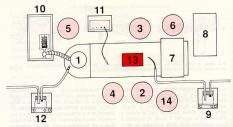
The operating theatre is a 50-70 m² room, which does not usually have any windows. It is adequately lighted and its walls are covered with tiles up to the ceiling. It is artificially ventilated and is air-conditioned. The operating complex must be architecturally separated from the wards and the intensive care unit. The operating complex consists of: locker rooms (dressing rooms), scrub-up area, preparing rooms, and opearting theatres. The walls and floor of the operating room should have no gaps. They should be cleaned easily. The doors should work auomatically. It is equipped with central and portable vacuum system, as well as pipes for gases. Main layout: operating lamp, operating table, Sonnenburg’s table, supplementary instrument stand, kick bucket, suction apparatus, diathermy, microwave oven, anesthesia machine and other instruments required during anesthesia (Figure 1.).
Figure 1. Equipments and positioning of surgical team: 1. oparating table, 2. operator, 3. first assistant, 4. second assistant, 5. anesthesiologist and assistant, 6. scrub nurse, 7. Sonnenburg’s table, 8. supplementary instrument stand, 9. suction apparatus, 10. anesthesia machine, 11. diathermy, 12. suction apparatus, 13. surgical territory, 14. waste bin
13
3.2. Rules in the opearting theatre
1.Only those people whose presence is absolutely neccessary should stay in the operating room.
2.Activity causing superfluous air flow (talking, laughing, and walking around) should be avoided.
3.Entry into the operating theatre is allowed only in operating room attire and shoes worn exclusively in the operating room. This complete change to the garments used in the operating theatre should also apply for the patient placed in the holding area (i.e. dressing room).
4.Leaving the operating area in surgical attire is forbidden.
5.The doors of the operating room must be closed.
6.Movement into the operating room out of the holding area is allowed only in a cap and mask covering the hair, mouth and nose.
General rules of asepsis concering the personnal attire
Taking part in an operation is permitted only after surgical hand washing and scrubbing. The scrubbing person must not wear jewels. Watches and rings should be removed. Fingers and nails should be clean. The nail should be short. Nail polish and artificial nail are forbidden.
Surgical team members in sterile attire should keep well within the sterile area; the sterile area is limited by isolation. Scrubbed team members should always face each other, and never show their backs to each other. They should face the sterile field at all times. Non-scrubbed personnel should not come close to the sterile field or the scrubbed sterile person, they should not reach over sterile surfaces, and they should handle only non-sterile instruments.
Behaviours and movements in the sterile operating room
The personnel is always keeping in mind the rules of asepsis while moving: they face each other and the sterile territory (e.g. operating table) while turnnig. They move in a way that their backs are facing the non-sterile surfaces. Always ”the thorax is facing the thorax” and ”the back is facing the back”! Hands must be kept within the sterile boundary of the gown. Sterile hands must not touch the cap, the mask or the nonsterile parts of the gown. Even spectacles must not be touched. You must not stretch out your hand to attempt to catch falling instruments and you are not allowed to pick them up. Do not take any instrument from the instrument stand; ask the scrub nurse to give it to you.
General rules of the aseptic opereating room
Only sterile instruments can be used to perform a sterile operation. Sterile personnel can handle only sterile equipment. The sterile instrument will stay so if only the sterile person touch it (or if it comes in contact with only a sterile object). Instruments are locating below the waist is not considered sterile. If a sterile instrument comes in contact with an instrument of doubtful sterility, it will loss its sterility. The edges of boxes and pots can not be considered sterile. A surgical area can never be considered sterile. However, the applications of aseptic rules of operations are mandatory!
3.3. Asepsis, antisepsis
Asepsis
Includes all those procedures, activities and behaviours designed to keep away the microorganisms (bacteria, fungi, viruses) from patient’s body and the surgical wound. In other words, the purpose of asepsis is to prevent the contamination.In a wider sense, the asepsis means such an
14
ideal state when the instruments, the skin, and the surgical territory do not contain microorganisms.
Antisepsis
Includes all those procedures and techniques designed to eliminate contamination (bacterial, viral, fungal) present on objects and skin by means of sterilization and disinfection. Because skin surfaces and so the operating field and the surgeon’s hands can not be considered sterile, in these cases we can not talk about the superficial sterilization. In a wider sense, antisepsis includes all those prophylactic procedures designed to ensure surgical asepsis.
3.4. Prevention of the wound contamination
Before the operation
1.A careful scrub and preparation of the operative site (cleansing and removal of hair) is necessary.
2.Knowledge and control of risk factors (e.g. normalization of the serum glucose level in cases of diabetes mellitus, etc.).
3.In septic and high-risk patients, there is a need for perioperative antibiotic prophylaxis.
During the operation
1.Appropriate surgical techniques must be applied
2.Change of gloves and rescrub if necessary.
3.Normal body temperature must be maintained. Narcosis may worsen the thermoregulation. Hypothermia and general anesthesia both induce vasodilatation, and thus the core temperature will decrease.
4.The oxygen tension must be maintained at a proper level.
After the operation
1.Wound infection generally evolves shortly (within 2 hours) after contamination.
2.Hand washing is mandatory and the use of sterile gloves is compulsory while handling wound dressings and changing bandages during the postoperative period.
3.5. Sterilization, disinfection
Sterilization
This involves the removal of viable microorganisms (including latent and resting forms such as spores) which can be achieved by different physical and chemical means and methods. Important methods which are used frequently: autoclaves, gas sterilization by ethylene oxide, cold sterilization, and irradiation. Instruments and materials used during operations are sterilized.
Disinfection
This is the reduction of the number of viable microorganisms by destroying or inactivating them. Generally used methods: low-temperature steam, and chemical disinfectants (e.g., phenolics, chloride derivatives, alcohols, and quaternary ammonium compounds). Surgical hand scrub and surgical area disinfectioning are considered as disinfectining procedures.
15