Материал: Методические указания для практических занятий по дисциплине «Иностранный язык» (английский язык) для студентов 4 курса специальности «Биотехнические и медицинские системы и аппараты». Малютина Ю.В., Прибыткова О.В
ФГБОУ ВПО «Воронежский государственный
технический университет»
СПРАВОЧНИК МАГНИТНОГО ДИСКА (Естественно-технический колледж)
МЕТОДИЧЕСКИЕ УКАЗАНИЯ
для практических занятий по дисциплине «Иностранный язык» (английский язык) для студентов 4 курса специальности 12.02.06 «Биотехнические и медицинские системы и аппараты»
Составители Малютина Юлия Владимировна
Прибыткова Ольга Васильевна
МУ для СРС.doc 200Кб 26.03.2015 1,3 уч.-изд.л
(наименование файла) (объем файла) (дата) (объем издания)
ФГБОУ ВПО «Воронежский государственный
технический университет»
Естественно-технический колледж
МЕТОДИЧЕСКИЕ УКАЗАНИЯ
для практических занятий по дисциплине «Иностранный язык» (английский язык) для студентов 4 курса специальности 12.02.06 «Биотехнические и медицинские системы и аппараты»
Воронеж 2015
Unit 1
1. Study Russian equivalents of these words and word combinations:
medicine – медицина
ancient – древний
human – человеческий
occupation – занятие
art – искусство
to develop – развивать
science – наука
century – век
civilization – цивилизация
Middle аges – Средние века
modern – современный
animal – животное
subject – предмет
illness – заболевание
death – смерть
contribution – вклад
discovery – открытие
blood – кровь
History of medicine
Medicine is among the most ancient of human occupations. It began as an art and gradually developed into a science over the centuries. There are 3 main stages in medicine development: Medicine of Ancient Civilizations, Medicine of Middle Ages and Modern Medicine.
Early man, like the animals, was subject to illness and death. At that time medical actions were mostly a part of ceremonial rituals. The medicine-man practiced magic to help people who were ill or had a wound. New civilizations, which developed from early tribes, began to study the human body, its anatomic composition. Magic still played an important part in treating but new practical methods were also developing. The early Indians, e. g., set fractures and practiced aromatherapy. The Chinese were pioneers of immunization and acupuncture. The contribution of the Greeks in medicine was enormous. An early leader in Greek medicine was Aesculapius. His daughters, Hygeia and Panacea gave rise to dynasties of healers (curative medicine) and hygienists (preventive medicine). The division in curative and preventive medicine is true today. The ethic principles of a physician were summarized by another Greek, Hippocrates. They are known as Hippocrates Oath.
The next stage of Medicine's development was the Middle Ages. A very important achievement of that time was the hospital. The first ones appeared in the 15-th century in Oriental countries and later in Europe. Another advance of the Middle Ages was the foundation of universities during 13-14-th centuries. Among other disciplines students could study medicine. During 18-th century new discoveries were made in chemistry, anatomy, biology, others sciences. The advances of that time were invention of the stethoscope (by Rene Laennec), vaccination for smallpox, discovery of anesthetics and development of immunology and scientific surgery.
The next century is rise of bacteriology. Important discoveries were made by Louis Pasteur and Robert Koch. The development of scientific bacteriology made possible advances in surgery: using antiseptics and control of wound infection.
Medicine in the 20-th century made enormous contribution in the basic medical sciences. These are discovery of blood groups and vitamins, invention of insulin and penicillin, practice of plastic surgery and transplantation.
2. Answer the questions.
1. When the history of medicine began?
2. How did it begin?
3. How many the main stages are there in the history of medicine?
4. What practices medicine-men?
5. What role did magic play at those times?
6. Who began to study medicine?
7. Who were the pioneers of immunization and acupuncture?
8. Who was the early leader in Greek medicine?
9. When appeared the first hospitals?
10. What Louis Pasteur and Robert Koch discovered?
3. Make the sentences of your own using the new words (10 sentences).
4. Find the definite and indefinite articles in the text.
5. Find one word, which is a little bit different in meaning from others (найдите одно слово, которое немного отличается от других по смыслу):
1) a) medicine; b) theatre; c) doctor;
2) a) patient; b) lamp; c) pain;
3) a) dance; b) science; c) studying;
4) a) mushroom; b) human; c) man;
5) a) century; b) age; c) honey.
Unit 2
Health services in Great Britain
In Great Britain the authorities concerned in the administration of public health are central and local.
In England and Wales the chief central authority is the Ministry of Health.
The National Health Service was established in 1948. The Minister of Health has assumed direct responsibility for the provision on a national basis of all hospital and specialist services, the conduct of research work into any matters relating to the prevention, diagnosis or treatment of illness or mental defect, a public health laboratory service and a blood transfusion service. He has indirect responsibility for the establishment and maintenance of general practitioner services and all other services.
The local authorities charged with the administration of public health services are the Rural and Urban District councils. These bodies are assisted in the discharge of their duties by a technical staff consisting of the Medical Officer and the Chief Sanitary Inspector.
Among others, upon the Local Health Authority rests an obligation to make arrangements with the medical practitioners for the vaccination of those who live within its area against small-pox and also for immunization against diphtheria.
At the very core of the scheme remains the family doctor. The duty generally falls on him to advise on the need for the various forms of treatment. Each Local Executive Council prepares and publishes a list, which is kept up to day, of doctors providing general medical services in the area.
In theory everyone is permitted to choose his own general practitioner. A full choice is not always possible, because if the doctor's list has reached the permitted maximum (3,500 patients) he cannot accept the would-be patient. If a doctor has an assistant, he is allowed to add additional 2,000 patients to his list.
The family doctor service is free to everyone who chooses to make use of it. If someone decides not to use the service, he may choose to be a paying and private patient. In this case, the provision of drugs under the service cannot be claimed. Any drugs prescribed for a private patient must be paid for by the patient.
It is a doctor's responsibility to provide his own accommodation in the area of his practice. This must include proper and sufficient surgery and waiting-rooms for his patients.
Where the family doctor considers that his patient requires the services of a consultant, or needs hospital treatment the doctor is empowered to arrange this on his own initiative.
Hospital services are available to everyone and no insurance qualification is required but most hospitals have long waiting lists for in-patient treatment.
The provision of ambulances and other means of transport is another duty of every Local Health Authority. But as the Ambulance Service and the Hospital Service are not under the same authority there is room for possible friction and misunderstanding between them.
An expectant mother is entitled to the services of a doctor who undertakes maternity work (whether he is her doctor or not) and of a midwife, as well as general care before and after the confinement.
The doctor will advise whether there is need for the confinement to take place in hospital. If this is unnecessary on medical grounds, the expectant mother can make her own choice as to whether or not she has her baby at home.
1. Complete the following sentences:
1. Public health services in our country … 2. Hospital services in Russia are available … 3. From the point of view of prevention and cure early recognition of many diseases … 4. According to the advice given by the doctor the expectant mother … 5. Ambulance Service provides transport for patients who require … 6. To be accepted in hospital one must … 7. The National Health Service in Great Britain … 8. Though it is the family doctor who … 9. If a patient requires the services of a consultant …
2. Make short dialogues using as many of the underlined words as possible.
3.Summarize the text using the following plan:
The title of the text is It is taken from the book written by...The text can be divided into ... logical parts. The first part/ paragraph tells us about... From the second part we learn about... The third part is devoted to/ gives information about/ deals with/ describes/ gives some facts about/ contains information about... The main idea of the text is ... I can say that the text is which is very useful for our future professional activity.
Unit 3
1. Study Russian equivalents of these words and word combinations:
to contribute to - вносить вклад, содействовать, способствовать,
surgery - хирургия, surgical - хирургический,
ultrasound equipment - ультразвуковая техника, оборудование,
radiation measuring - измерение (уровня) ионизирующих излучений,
nuclear - содержащий ядро, ядерный,
densitometer - денситометр (прибор для измерения оптической плотности),
therapeutic - терапевтический,
reliability and migration - надежность и перемещение, to expand horizons - расширять диапазон знаний, diverse - многообразный, разнотипный, requirement - требование,
to pursue - следовать неотступно за, рассматривать, расследовать (вопрос, дело), заниматься.
2. Read the text and single out its main ideas:
Watching the 21st Century
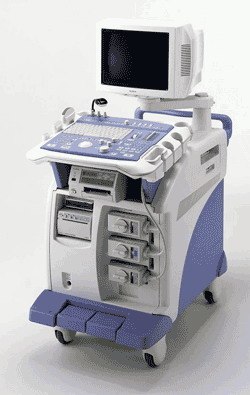
For more than 50 years ALOKA has been developing, manufacturing and marketing medical equipment. At Aloka they are proud that contribute to global medical care by providing a wide range of excellent products. Aloka develops equipment for diagnosis, treatment and surgery. Aloka's products include diagnostic ultrasound equipment, radiation-measuring equipment, nuclear imaging equipment, bone densitometers, clinical laboratory equipment, therapeutic and surgical equipment.
With more than fifty years of expertise in diagnostic ultrasound, Aloka breathes ultrasound. The result is a range of the highest quality ultrasound products providing all users with the latest innovative technologies. Quality, reliability and migration of innovative technologies among a wide range of products are the keys that contribute to expand horizons in diagnostic ultrasound imaging.
The role of medical care is becoming increasingly important as the social environment changes. Against this background, Aloka has been satisfying diverse needs and enhanced medical care requirements by supplying medical equipment.
Aloka's product line covers diagnostic ultrasound systems, which are enlarging their examination range, as the major tool in image diagnosis, as well as nuclear medicine diagnostic systems, clinical laboratory systems, and therapeutic and surgical systems.
Each Aloka product pursues enhanced performance and improved reliability and is appreciated by customers all over the world. Aloka radiation measuring instruments are used extensively for measurement and analysis in the fields of nuclear power generation, medical care, biochemistry, pharmacy and others, and are playing an important role in research and examination.