Материал: 100_Cases_in_Clinical_Medicine
This page intentionally left blank

CASE 20: FEVERS AND FATIGUE
History
A 33-year-old woman is admitted to hospital because of general fatigue, fever and weight loss. She has lost 5 kg in weight over the last 3 months. She has felt increasingly fatigued and has a poor appetite. Over the past few weeks she has felt as if she was feverish and has developed night sweats. She has no chest pain or shortness of breath. She and her two children, aged 4 and 6 years, have come from Nigeria to visit her husband who has been in this country for 2 years. She has visited the UK twice before. She has had occasional fevers over the last 10 years and these have been treated presumptively as malaria with a good response. She has been otherwise well, although her periods have been irregular over the last 3 months. She has had no other serious medical illnesses. She is a non-smoker and drinks no alcohol. The ward receptionist has suggested that she is not entitled to NHS treatment.
Examination
She is thin and looks unwell. Her temperature is 38.2°C. There are no abnormalities in the cardiovascular or respiratory systems and there are no lymph nodes palpable. Her conjunctivae look pale. Physical examination is otherwise normal.
INVESTIGATIONS
|
|
Normal |
Haemoglobin |
8.6 g/dL |
13.3–17.7g/dL |
Mean corpuscular volume (MCV) |
85 fL |
80–99 fL |
White cell count |
12.0 % 109/L |
3.9–10.6 % 109/L |
Neutrophils |
10.6 % 109/L |
1.8–7.7 % 109/L |
Lymphocytes |
0.9 % 109/L |
0.6–4.8 % 109/L |
Platelets |
97 % 109/L |
150–440 % 109/L |
Erythrocyte sedimentation rate |
87 mm/h |
!10 mm/h |
Sodium |
134 mmol/L |
135–145 mmol/L |
Potassium |
4.5 mmol/L |
3.5–5.0 mmol/L |
Urea |
4.4 mmol/L |
2.5–6.7 mmol/L |
Creatinine |
87 &mol/L |
70–120 &mol/L |
Bilirubin |
15 mmol/L |
3–17 mmol/L |
Alanine transaminase |
26 IU/L |
5–35 IU/L |
Alkaline phosphatase |
244 IU/L |
30–300 IU/L |
Blood film: immature red cells/nucleated red cells present
Serum electrophoresis: normal
Urinalysis: no protein; no blood
Blood and urine cultures: negative
A chest X-ray is shown in Fig. 20.1.
50
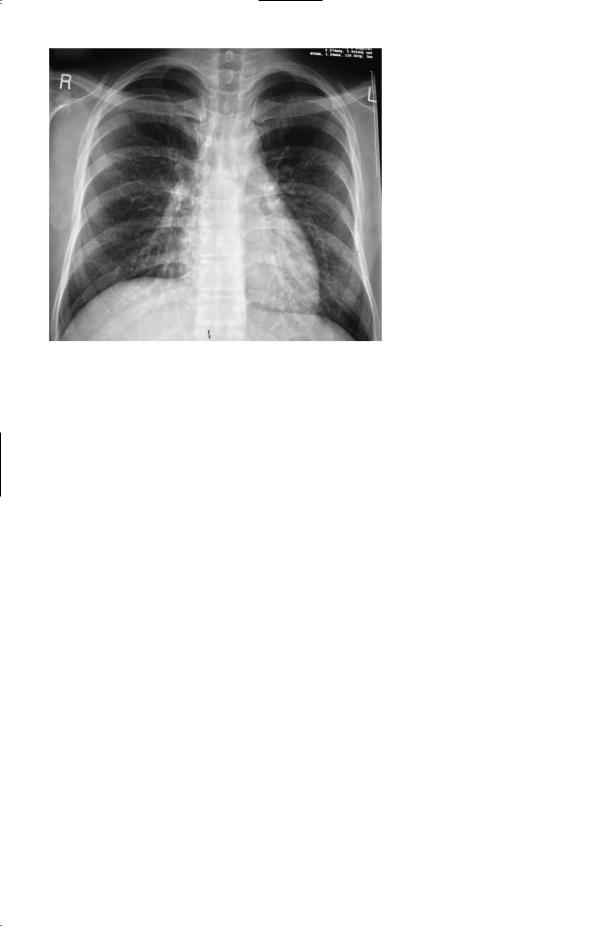
Figure 20.1 Chest X-ray.
Questions
•What is the diagnosis?
•How would you investigate and manage this patient?
51

ANSWER 20
This patient has fever, marked weight loss and a leucoerythroblastic anaemia. The length of the symptoms makes infections such as malaria unlikely, although this should be checked since she arrived from Nigeria and combined infections are possible. A very important finding is that immature red and white cells are seen in the peripheral blood. This leucoerythroblastic anaemia indicates bone-marrow replacement by tumour or infection forcing immature cells out into the blood. This woman has miliary tuberculosis. Miliary tuberculosis is characterized by tuberculous granulomata throughout the body due to widespread dissemination of tubercle bacilli. It is now usually seen in elderly persons and the diagnosis is often only made at autopsy. The chest X-ray shows miliary lesions (multiple small nodules 2–5 mm in diameter). These are often subtle or not visible at presentation. There may be choroidal tubercles in the eyes on funduscopy and hepatosplenomegaly.
!Differential diagnoses of fevers !3 weeks
•Other infections: visceral abscesses, infective endocarditis, specific organisms (e.g. brucellosis, actinomycosis or toxoplasmosis) and tropical diseases (e.g. malaria or trypanosomiasis).
•Neoplastic diseases: lymphomas, renal cell carcinomas, pancreatic tumours.
•Collagen vascular diseases, e.g. systemic vasculitis, rheumatoid arthritis, systemic lupus erythematosus, temporal arteritis.
•Miscellaneous: recurrent pulmonary emboli, drug fever, sarcoidosis.
This patient needs an urgent diagnosis. Bronchoscopy with lavage may reveal acid-fast bacilli. Biopsy of her liver and bone marrow may show tubercle bacilli or caseating granulomas. The tissue should also be sent for culture. The tuberculin test may be negative because of immunoincompetence induced by the disease. Antituberculous treatment with four agents must be started immediately once biopsy material has been obtained. In a woman of child-bearing age a pregnancy test should be done, particularly in the face of menstrual irregularities. In severely ill patients corticosteroids are of benefit. The total lymphocyte count is low and, in a patient from Africa, HIV infection is a distinct possibility. Informed consent should be sought for an HIV test. Tuberculosis is a notifiable disease and the diagnosis should be notified and arrangements made to screen her children and any other close contacts.
Although eligibility for treatment needs to be assessed by appropriate managers, this woman has an acute life-threatening illness and is a potential infective risk to others. Investigation and treatment should be undertaken in the normal way.
KEY POINTS
•Miliary tuberculosis is often missed as a cause of weight loss and fever in the elderly.
•Miliary tuberculosis may present with a leucoerythroblastic anaemia.
•Always culture biopsy material in patients with pyrexias of unknown origin.
52

Section 2 GENERAL SELF-ASSESSMENT CASES