Материал: 100_Cases_in_Clinical_Medicine
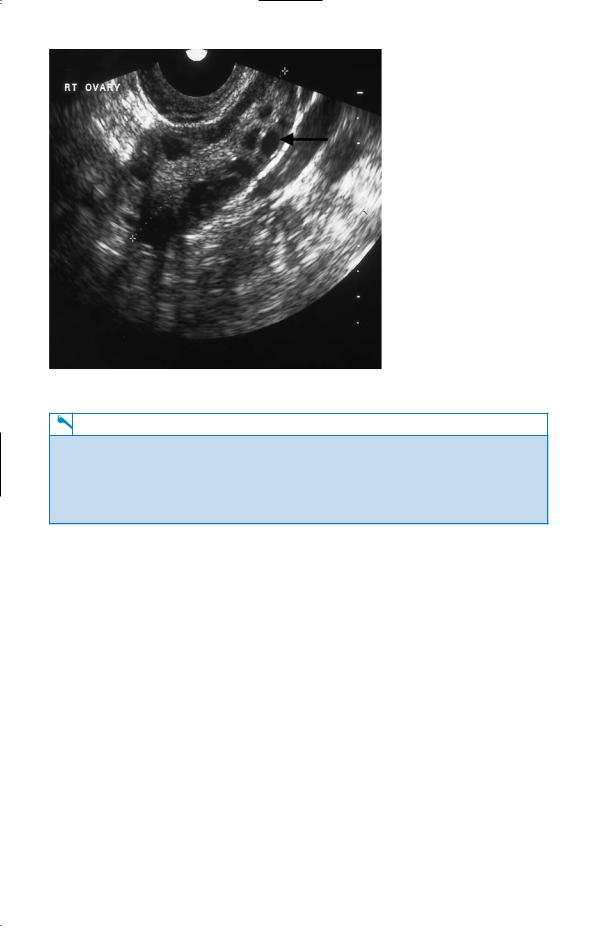
Figure 45.1 Ovarian ultrasound.
KEY POINTS
•True hirsutism is due to excessive androgens, whereas constitutional hirsutism is found in certain ethnic groups.
•The association of menstrual irregularities and obesity is suggestive of true hirsutism and polycystic ovary syndrome.
•In transplant patients, the anti-rejection drug ciclosporin causes marked hirsutism.
119
This page intentionally left blank

CASE 46: NAUSEA AND VERTIGO
History
A 17-year-old woman is admitted to the emergency department complaining of severe vertigo. This has developed over the past few hours and previously she was well. She has the sensation of her surroundings spinning around her. She feels nauseated and sleepy. She does not have a headache. She has not had any previous medical illnesses. She is a non-smoker, and says that she does not drink alcohol or take recreational drugs and she is taking no regular medication. She lives with her parents and is due to sit her A-levels in 3 weeks. Her father suffers from epilepsy and her mother has hypothyroidism.
Examination
She is drowsy and her speech is slurred. Her pulse rate is 64/min, blood pressure 90/70 mmHg and respiratory rate 12/min. Examination of her cardiovascular, respiratory and abdominal systems is otherwise normal. Her peripheral nervous system examination is normal apart from impaired co-ordination and a staggering gait. Funduscopy is normal. Her pupils are equal and reacting. There is a normal range of eye movements but she has multidirectional nystagmus. Her hearing is normal as is the rest of her cranial nerve examination.
Questions
•What is the diagnosis?
•What are the major differential diagnoses of vertigo?
•How would you manage this patient?
121

ANSWER 46
The acute onset of these symptoms and signs with drowsiness in a 17-year-old girl raise the possibility of a drug overdose. Her father is epileptic and is likely to be taking anticonvulsants. The most likely explanation is that this patient has taken a phenytoin overdose, tablets which her father uses to control his epilepsy. She has taken an overdose as a result of concern about her imminent exams. Excessive ingestion of barbiturates, alcohol and phenytoin all cause acute neurotoxicity manifested by vertigo, dysarthria, ataxia and nystagmus. In severe cases coma, respiratory depression and hypotension occur.
Vertigo is an awareness of disordered orientation of the body in space and takes the form of a sensation of rotation of the body or its surroundings.
! Causes of vertigo
Peripheral lesions |
Central lesions |
Benign positional vertigo |
Brainstem ischaemia |
Vestibular neuronitis |
Posterior fossa tumours |
Ménière’s disease |
Multiple sclerosis |
Middle-ear diseases |
Alcohol/drugs |
Aminoglycoside toxicity |
Migraine, epilepsy |
The duration of attacks is helpful in distinguishing some of these causes of vertigo. Benign positional vertigo lasts less than 1 min. Attacks of Ménière’s disease are recurrent and last up to 24 h. Vestibular neuronitis does not recur but lasts several days, whereas vertigo due to ototoxic drugs is usually permanent. Brainstem ischaemic attacks occur in patients with evidence of diffuse vascular disease, and long tract signs may be present. Multiple sclerosis may initially present with an acute attack of vertigo that lasts for 2–3 weeks. Posterior fossa tumours usually have symptoms and signs of space-occupying lesions. Acoustic neuromas often present with vertigo and deafness. Migrainous attacks are often accompanied by nausea and vomiting. Temporal lobe epilepsy may also produce rotational vertigo, often associated with auditory and visual hallucinations. Central lesions produce nystagmus which is multidirectional and may be vertical. Peripheral lesions induce a unilateral horizontal nystagmus.
The diagnosis in this case can be made by measuring plasma phenytoin levels and by asking the patient’s father to check if his tablets are missing. Gastric lavage should be carried out if it is within 12 h of ingestion of the tablets. Oral activated charcoal may be useful. National poisons information services are available to advise on treatment. Before discharge she should have counselling and treatment by adolescent psychiatrists.
KEY POINTS
•Vertigo can be caused by a variety of neurological disorders.
•A careful history and examination may reveal the cause of vertigo.
•Overdose should be considered in any patient presenting with decreased conscious level and respiratory depression.
122
CASE 47: CHEST PAIN
History
A 64-year-old woman has a 10-year history of retrosternal pain. The pain is often present in bed at night and may be precipitated by bending down. Occasionally, the pain comes on after eating and on some occasions it appears to have been precipitated by exercise. The pain has been described as having a burning and a tight quality to it. The pain is not otherwise exacerbated by respiratory movements or position.
Her husband has angina and on one occasion she took one of his glyceryl trinitrate tablets. She thinks that this probably helped her pain since it seemed to go off a little faster than usual. She has also bought some indigestion tablets from a local pharmacy and thinks that these probably helped also.
Examination
She is 1.62 m (5 ft 4 in) tall and weighs 82 kg, giving her a body mass index of 31.3 (recommended range 20–25) There are no abnormalities to find in the cardiovascular, respiratory or gastrointestinal systems.
INVESTIGATIONS
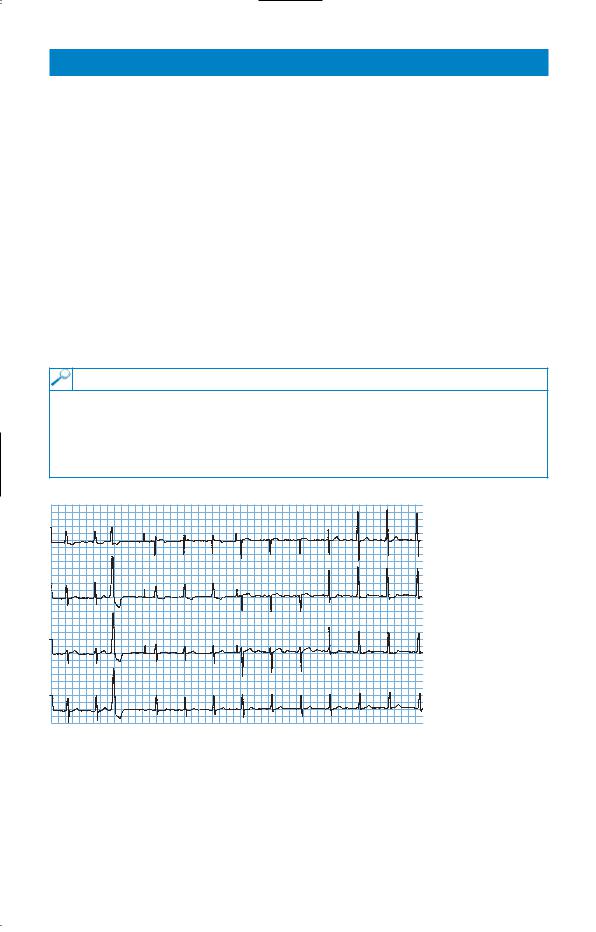
•Her chest X-ray is normal and the electrocardiogram is shown in Fig. 47.1.
•She had an exercise electrocardiogram (ECG) performed and she was able to perform 8-min exercise. Her heart rate went up to 130/min with no change in the ST segments on the ECG and normal heart and blood-pressure responses.
•The haemoglobin, renal and liver function are normal.
I |
|
V4 |
|
|
|
|
aVR |
V1 |
II |
aVL |
V5 |
|
|
V2 |
V6
aVF
V3
II
Figure 47.1 Electrocardiogram.
Questions
•What is the likely diagnosis?
•What would be appropriate management?
123