Материал: 2033
7. |
The rising air conditioning needs account for almost 70 % of this growth |
||
in … demand. |
|
|
|
|
A) power |
B) our |
C) owner |
8. |
… air conditioning blemishes on any building. |
||
|
A) old fashioned |
B) modern |
C) ancient |
9. |
Centralized DC set ups are …than five times as energy efficient as |
||
traditional. |
|
|
|
СибАДИ |
|||
|
A) more |
B) less |
C) the most |
10. Modern DC represents a paradigm shift in increasing efficient |
|||
comfortable … environments. |
|
||
|
A) outdoor |
B) domestic |
C) indoor |
31
PART 2. PROFESSIONAL ORIENTED TASKS
1. Read the definition and write your own.
Definition of district heating(DH):
Interconnection of various heat sources to customers by means of hot water (or steam) networks to serveroom space heating(SH) and usually domestic hot
water(DHW) as well.
СибАДИ2. Read about benefits provided by DH and add the list.
Benefits provided by DH:
Economy of scale:
•By connecting many customers with varying heat demands, central plant runs continuously instead of many individual plants running sporadically.
•Biomass and waste incineration are most feasible at large-scale. Environment:
•Centralized plant almost certainly has higher efficiency than many individual plants •Enables surplus heat to be recycled instead of thrown away.
•Flexibility enables many low carbon and renewable heat sources to be used...
•...including combined heat and power production which is the only way to generate electric power at 90+ % efficiency.
•High quality flue gas cleaning is possible at large plants. Safety:
•No flue gases nor fuel explosion risk at customer premises. Reliability:
•Having several heat sources and looped networks interconnected, the reliability is very high.
Maintenance:
•Centralized plant can be continuously monitored and pro-actively maintained.
•Long lifetime: well-maintained DH networks last at least 50 years.
3. Get acquainted with requirements and find information about parameters valid in Russia.
General Requirements of DH:
High heat load density: as heat networks are very capital intensive (3001200€/m), the heated area has to be densely built to minimize the required pipelength •Economic viability: As a rule of thumb the heat load density for DH should be higher than 2 MWh per meter of planned network length to be commercially viable •Location of buildings: the buildings to be connected to the DH networks should be close to the existing network to minimize the connection pipe length. This will reduce both investment and operational costs •Location of heat sources: modern heat sources have high quality flue gas cleaning systems. Therefore, subject to planning conditions, heat sources can be located near or in
32
the centre of urban areas to minimize network length. The location of the heat sources has to be agreed in advance
Land use requirements: it is very useful to develop a heat demand map, and a corresponding heat plan for a town or city to identify which areas are most suitable for DH, and which areas are best served by individual building systems •Heat sources should be close to the customer (economy) but should take into account noise prevention and transportation logistics •Underground networks
СибАДИrequire space that is already partly occupied by other infrastructure: e.g. electricity, telecommunications, sewage, water •Possible booster pump stations •Fuel and ash transportation routes should minimize any harm and risk to the population.
Municipal support is needed: Enabling access to roads and public land to build networks and heat sources •Ensuring municipal buildings are connected to the DH system wherever possible
Modern DH with looped network: Heat can be delivered to most customers from two directions, increasing security of supply. Several heat sources connected to the same network also increases security. Different fuel/heat source combinations can be used in parallel to minimize fuel costs •Fuels are handled centrally, so that fire and explosion risks in buildings are avoided.
Customers: A contract is needed with the customer that stipulates the rights and responsibilities of both parties: the heat supplier and the heat customer. The customer representative must have access to the substation room at any time in order to adjust the control system as needed and supervise the overall condition of the substation. The heat supplier has to have access to the substation room at any time in order to read the heat meter and supervise the overall condition of the substation.
4. Read about consumer substation functions then analyze the scheme and describe the process using the scheme.
Consumer substation -main functions.
• Heat exchangers (HE) keep the water circulation in the primary network separate from that in the secondary network.
• Space heating (SH) controls regulate the supply temperature (secondary side) according to outdoor temperature.
• Domestic hot water control keeps the DHW water temperature constant at about 55oC.
• Heat meter: calculates and stores energy consumption, using information from the flow sensor and temperature.
33
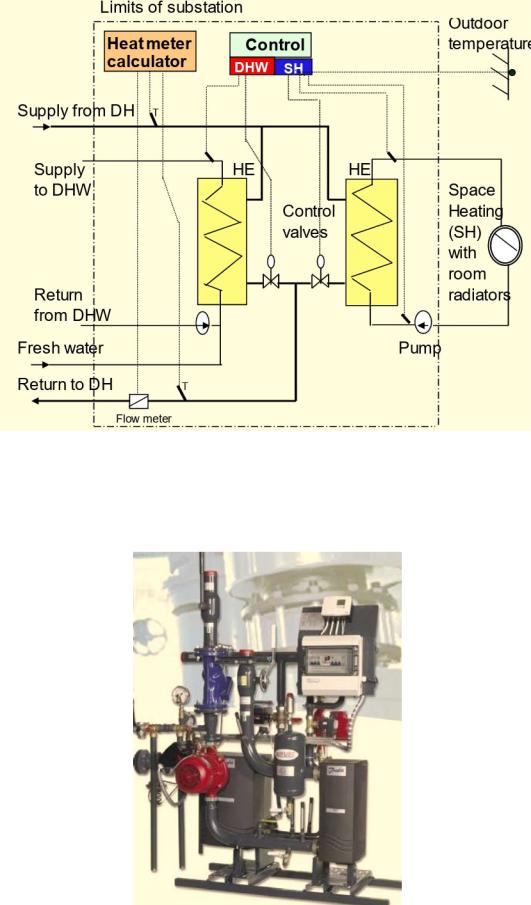
СибАДИConsumer substation – main functions
5. Look at the picture and put the proper color in to description (then check your answers).
34
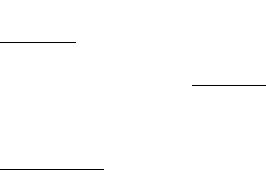
Consumer substation – main components:
•The …boxes at the bottom are the heat exchangers for SH and DHW
•The third box between the heat exchangers is the cylindrical expansion vessel
•The … box above is the temperature controller
•The … unit on the left is the DHW circulation pump •The … unit on the left is the mud filter
СибАДИTechnical features of DH. Water temperatures: DH supply water ranges from 80 to 120C and the return water from 30 to 70oC depending on the system and weather conditions. Pressures: the nominal pressure levels are typically 16 bar (1,6 MPa). Pipelines: Two main types as follows: 1. Modern pre - insulated pipelines comprise a steel pipe covered by poluyurethane thermal insulation and polyethylene jacket pipe. 2.Olderpipelines were installed in concrete channels, where the steel pipe is covered by mineral wool. Speed of water: the velocity of water circulating in the pipelines is usually below 2 m/s. Therefore, it may take several hours to reach the customer at the far end of the network. Heat losses: the heat losses from modern networks usually range from 5 to 10% of the produced heat.
•The heat meter is missing in the picture but will be delivered by the heat
supplier.
Check yourself:
•The grey boxes at the bottom are the heat exchangers for SH and DHW
•The third box between the heat exchangers is the cylindrical expansion vessel •The white box above is the temperature controller •The red unit on the left is the DHW circulation pump •The blue unit on the left is the mud filter •The heat meter is missing in the picture but will be delivered by the heat supplier.
6. Give a title to each paragraph (then check your answers).
Technical features of DH:
• |
: DH supply water ranges from 80 to 120C and the return water |
|
from 30 to 70oC depending on the system and weather conditions |
||
• |
: the nominal pressure levels are typically 16 bar (1,6 MPa) |
|
•Pipelines: Two main types as follows: |
|
|
1.Modern |
pre-insulated |
comprise a steel pipe covered by |
poluyurethane thermal insulation and polyethylene jacket pipe |
||
2.Olderpipelines were installed in concrete channels, where the steel pipe is |
||
covered by mineral wool. |
|
|
• |
: the velocity of water circulating in the pipelines is usually |
|
below 2 m/s. Therefore, it may take several hours to reach the customer at the far |
||
end of the network. •Heat losses: the heat losses from modern networks usually |
||
range from 5 to 10% of the produced heat. |
|
|
Check yourself: |
|
|
35