Материал: 2076
2. Internal Combustion (I.C.) Engine
It is an engine in which combustion of fuel take place inside the engine. When the fuel burns inside the engine cylinder, it generates a high temperature and pressure. This high pressure force is exerted on the piston (A device which free to moves inside the cylinder and transmit the pressure force to crank by use of connecting rod), which used to rotate the wheels of
Сvehicle. In these engines we can use only gases and high volatile fuel like petrol, diesel. These engines are generally used in automobile industries, generation of electric power etc.
Advantages of I.C. engine It has overall high efficiency over E.C. engine. These engines are compact and required less space. Initial cost of I.C. engine is lower than E.C. engine. This engine easily starts in cold because of
иmay be classified in many manners. Today I am going to tell you some important classification of an automobile engine.
it uses high volatile fuel.
Types of I.C. Engine. I.C. engine is widely used in automobile
FourбА-stroke engine. In a four stroke engine piston moves two times up and down inside the cylinder andДcomplete two crankshaft revolutions during single time of fuel burn. This type of engines has high average compare to two stroke engine. These are generally used in bikes, cars, truck etc.
industries so it is also known as automobile engine. An automobile engine
According to number of stroke:
Two-stroke engine. In a two stroke engine a piston moves one time up
and down inside the cylinder and complete one crankshaft revolution during single time of fuel burn. This type of engine has high torque compare to four stroke engine. These are generally used in scooters, pumping sets etc.
According to design of engine:
Reciprocating engine (piston engine). In reciprocating engine the pressure force is generated by combustion ofИfuel exerted on the piston (A
device which free to move in reciprocation inside the cylinder). So the piston starts reciprocating motion (too and fro motion). This reciprocating motion converts into rotary motion by use of crank shaft. So the crank shaft starts to rotate and rotate the wheels of vehicle. These are generally used in all automobile.
Rotary engine (Wankel engine). In rotary engine there is a rotor which frees to rotate. The pressure force generate by burning of fuel is exerted on this rotor so the rotor rotate and starts to rotate the wheels of vehicle. This engine is developed by Wankel in 1957. This engine is not used in automobile in present days.
According to fuel used:
Diesel engine. These engines use diesel as the fuel. These are used in trucks, buses, cars etc.
16
Petrol engine. These engines use petrol as the fuel. These are used in bikes, sport cars, luxury cars etc.
Gas engine. These engines use CNG and LPG as the fuel. These are used in some light motor vehicles.
Electric engine. It is eco-friendly engine. It doesn’t use any fuel to burn. It uses electric energy to rotate wheel.
СAccording to method of ignition:
Compression ignition engine. In these types of engines, there is no extra equipment to burn the fuel. In these engines burning of fuel starts due to temperature rise during compression of air. So it is known as compression иignition engine.
Spark ignition engine. In these types of engines, ignition of fuel start by the spark, generate inside the cylinder by some extra equipment. So it is known as spark ignition engine.
AccordingбАto number of cylinder
Single cylinder engine. In this type of engines have only one cylinder and one piston connected to the crank shaft.
Multicylinder engine. In this type of engines have more than one cylinder and piston connected to the crank shaft.
According to arrangement of cylinder:
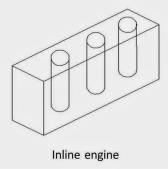
In-line engine. In this type of engines, cylinders are positioned in a straight line one behind the other along the length of the crankshaft.
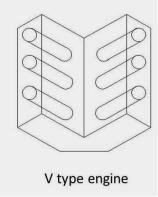
 Д V-type engine. An engine with two cylinderИbanks inclined at an angle
to each other and with one crankshaft known as V-type engine.
17
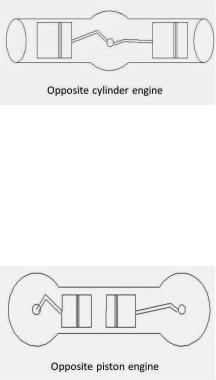
Opposed cylinder engine
An engine with two cylinders banks opposite to each other on a single crankshaft (V-type engine with 180o angle between banks).
СиOpposite piston engine. In this type of engine there are two pistons in each cylinder with the combustion chamber in the center between the pistons. In this engine a single combustion process causes two power strokes, at the same time.
W-type engine. An engine same as V-type engine except with three
banks of cylinders on the same crankshaft known as W-type engine.
to a masterбАrod which, in turn, connected to the crankshaft. 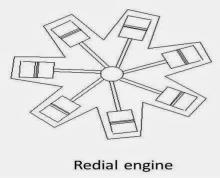 Д
Д
Radial engine. It is an engine with pistons positioned in circular plane around the central crankshaft. The connecting rods of pistons are connected
According to air intake process:
Naturally aspirated. In this types of engineИintake of air into cylinder occur by the atmospheric pressure.
Supercharged engine. In this type of engine air intake pressure is increased by the compressor driven by the engine crankshaft.
Turbocharged engine. In this type of engine intake air pressure is increase by use of turbine compressor driven by the exhaust gases of burning fuel. In these types of engines, there is no extra equipment to burn the fuel. In
18
these engines burning of fuel starts due to temperature rise during compression of air. So it is known as compression ignition engine.
Make up the table which can be useful for retelling the text.
20. Find more information devoted to modern automobile systems using internet. Make a brief report.
С21. Read and remember new words and word collocations. vehicular traffic – дв жение транспорта иpedestrian traffic – пешеходное движение
pavement markings – разметка на покрытии (дорог) traffic markers – дорожные указатели
sign – знак
arterial routeбА– маг стральная дорога
one-way street – ул ца с односторонним движением assign – назначать, поручать
traffic volume – нтенсивность движения
hourly pattern – часовой расчет интенсивности движения ordinance – постановление
right-of-way – полоса отвода дороги
off-centre lane – центральная разделительная полоса
Make up 3 sentences using new words.
22. Read and translate the text.Д
TRAFFIC REGULATION
Traffic engineering deals with the directionИand control of vehicular and pedestrian traffic on existing highways and streets. Thus it is concerned with the planning, design, and operation of all devices that aid the flow of traffic. Among these are pavement markings, traffic markers, signs, and traffic signals. Traffic engineering also deals with means for improving the efficiency of the existing system by the designation of arterial routes and oneway streets, and by controlling the use of these and other facilities. The integration of street and highway lighting into the over-all highway plan generally is considered a traffic engineering responsibility too. Interwoven into all the functions is accident reduction; and traffic engineers usually are assigned the responsibility for accident records and statistics. Parking likewise falls within the province of the traffic engineer because of the impact that parking problems have on street and highway operation.
19
The scope of aspects the traffic engineer deals with: traffic characteristics, traffic regulations, traffic-control devices, and environmental improvements. Traffic characteristics include such aspects as: physical factors, traffic volume, volume counting, speed characteristics, traffic stream flows, accidents, vehicular limitations and human characteristics.
As for traffic volume, the traffic engineer must be acquainted with some Сvolume characteristics: hourly pattern, day-of-week variation, classification of vehicles, trends in volumes and the methods of volume counting. Traffic regulations cover traffic laws and ordinances, various types of traffic controls: speed control and curb-parking control. Traffic-control devices иconsist of traffic signs, markings, signals, islands and street and highway
lighting.
Traffic regulations contribute to safety and decrease accidents. A most favourable effect on efficiency and the incidence of traffic accidents is dual highway.бАA dual highway separates opposite-direction traffic by a median divider. The separation of opposite-direction traffic by a median reduces the possibility of head-on collisions and sideswipe accidents. The width of the dual highway is varied for reasons of topography. Of necessity, the dual highway has not less than four traffic lanes. This number is efficient for traffic safety, because the driver has only one car alongside to watch.
Although the traffic engineer is concerned primarily with the traffic regulation and control, he must take into account the roadway elements, because sometimes, traffic-engineering functions are expanded to deal with
1.Traffic engineering deals withД…
2.It is concerned with … И
3.Interwoven into all the functions is …
4.Traffic engineering usually are assigned …
5.Traffic characteristics include …
6.Traffic engineer must be acquainted with some volume characteristics …
7.Traffic regulations cover various types of traffic controls …
8.Traffic-control devices consist of …
9.Traffic regulations contribute to …
10.Traffic engineer must take into account …
24. Match English collocations and their translations. hourly pattern – интенсивность движения
off-centre lane – полоса отвода дороги right-of-way – центральная разделительная линия
20