Материал: BASIC_SURGICAL_TECHNIQUES budapest
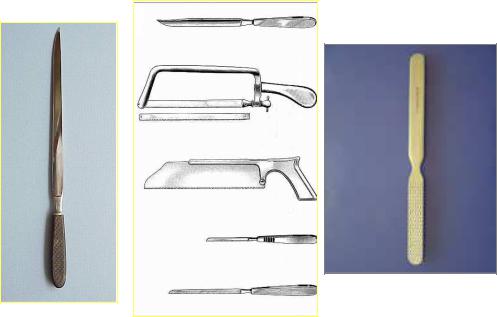
Amputating knife, saws, raspatories
Amputating knives of different sizes are manufactured with oneor two-sided cutting edge for limb amputations. Various types of saws are suitable for cutting the bones. One side of the raspatory is smooth while its other side is rolled up. The semi-circle end of it is a little sharp. Use: blunt separation of the periosteum and connective tissue from the surface of the bone.
Figure 20. Amputating knife, various types of saws, raspatory
4.1.2. Grasping instruments
These instruments are used to grasp, pick up, and hold the tissues or organs during the operation for the purpose of having a better retraction, a more precise incision and a more effective movement. The minimum requirement for most of them is to produce as little as possible injury to the tissue or organ while grasping it. The only exception for this is related to those instruments which are used to crush the tissues. Forceps, towel clamps, vascular clamps, needle holders, organ holders, and sponge holding forceps belong to this category.
Non-locking grasping instruments: thumb forceps
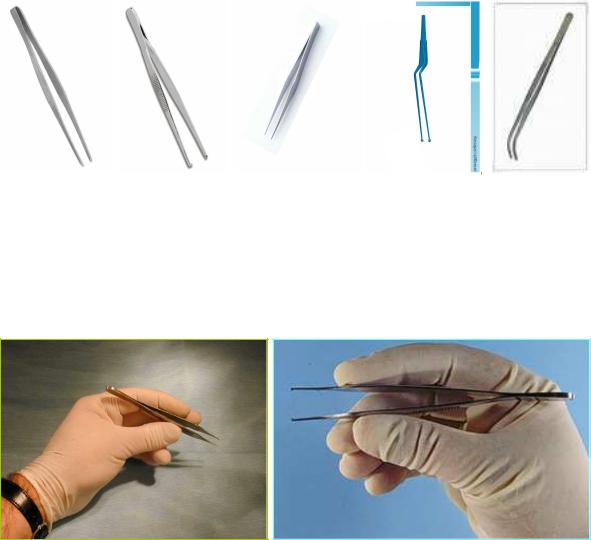
These are the simplest grasping tools. Forceps are made of different sizes, with straight, curved or angled blades. They can have blunt (smooth forceps), sharp (splinter forceps), or ring tips (Figure 21.). Forceps are used to hold the tissues during cutting and suturing, to retract tissues for exposure, to grasp vessels for electrocautery, to pack sponges and gauze strips in the case of bleeding, to soak up the blood, and to extract foreign bodies.
26
|
|
|
|
|
|
|
|
|
|
|
|
A |
|
B |
|
C |
|
D |
|
|
|
|
|
|
|
|
|
|
|
E |
|
||||
|
|
|
|
|
|
|
|
|
|
|
|
Figure 21. Forceps
A. Smooth forceps, B. Toothed forceps, C. Splinter forceps, D. Ring forceps (brain tissue forceps), E. Dental forceps
Forceps should be held like a pencil. They grip when compressed between the thumb and index finger. This makes possible the most convenient holding, the finest handling and free movements (Figure 22.). In this way the forceps actually act in a manner as if our thumb and index finger are elongated. Any other type of holding is not acceptable in surgery.
Figure 22. Correct holding of the forceps
As a general rule, always use such that kind of forceps with which you can perform the desired work with as little as possible injury to the tissue. The teeth of toothed forceps prevent tissues from slipping. Accordingly, only a small pressure is required to grasp tissue firmly. Thus, to grip skin and subcutaneous tissues, the toothed forceps is used most frequently. However, vessels and hollow organs must not be grasped with them due to the risk for bleeding and perforation. For these purposes, or for holding sponges or bandages, the smooth forceps should be chosen. These have blunt ends with coarse cross-striations to give them additional grasping power. Skin gripped firmly with smooth forceps for a prolonged period can necrotize. The forceps is not suitable for a continuous grasping of the tissues. To perform this, we can use the various tissue graspers, retractors, and tension sutures. The hands and fingers of the assistant can also help us for the same purpose.
27
Towel-holding clamps
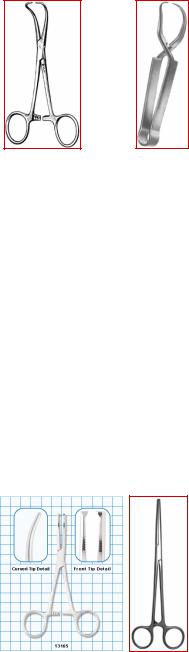
These serve to fix the draping towels to the ether screen, to one another, and to the skin of the patient. These locking grasping instruments serve to fix the grasped object.In the case of the Schaedel towel clip the springiness of the distal part, while in relation to the Backhaus towel clip the ratchet lock of its proximal portion serves to fix the grasped draping towel (Figure 23.).
A B
Figure 23. Towel clamps
A. Backhaus, B. Schaedel towel clamps
Hemostatic forceps (hemostats)
These instruments are the main means of establishing hemostasis during an operation. They are used to stop bleeding by grasping and clamping the ends of the cut vessels or for preventive hemostasis by applying them before cutting the vessel.
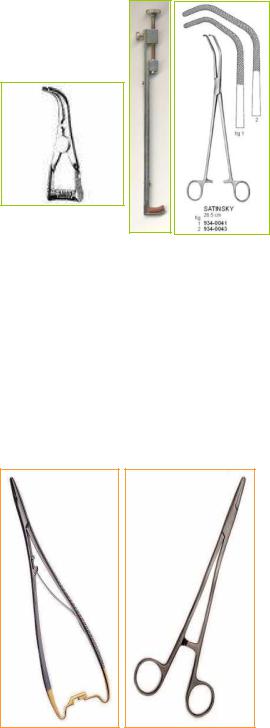
Kocher and Lumnitzer clamps are traumatic hemostatic forceps. The grasping part is straight or curved and there are teeth in the inner portion of it (Figure 24.). The Péan clamp, abdominal Péan clamp and mosquito clamp can also be listed here. In these cases the grasping portion can also be straight or curved and its inner surface is serrated (Figure 15.).
The atraumatic hemostatic forceps are applied if the damage to the vessels or tissues must be avoided because their function is expected latter, e.g. if the circulation is to be restored after their removal. The Dieffenbach forceps (Bulldog clamp) and the formerly used Blalock clamp - which had rubbers at its grasping part and there was a screw at the proximal part for fixing it– belong to this group. The Satinsky tangential occlusion clamp permits a partial occlusion of the lumen of the larger blood vessels. In this way, while an anastomosis is made, the blood flow below the clamp is undisturbed (Figure 25.).
AB
Figure 25. Traumatic hemostatic forceps
A. Kocher, B. Lumnitzer clamps
28
A
BC
Figure 25. Atraumatic hemostatic forceps
A. Bulldog, B. Blalock, C. Satinsky clamps
Needle holders
In modern surgery suturing is performed almost exclusively with curved needles that are held with needle holders designed for the grasping and guiding of needles. The needle holders grip the needle between the jaws, specially developed for this purpose; they usually have a ratchet lock. The Mathieu needle holder has curved shanks with a spring and a locking mechanism. It should be held in the palm. The Hegar needle holder resembles a hemostatic forceps, but the shanks are longer and the relatively short jaws are made of a hard metal. The serrations are designed to grip needles. During suturing in deep layers, needle holders with long shanks should be used (Figure 26. and 27.).
AB
Figure 26. Needle holders
A. Mathieu, B. Hegar needle holders
29
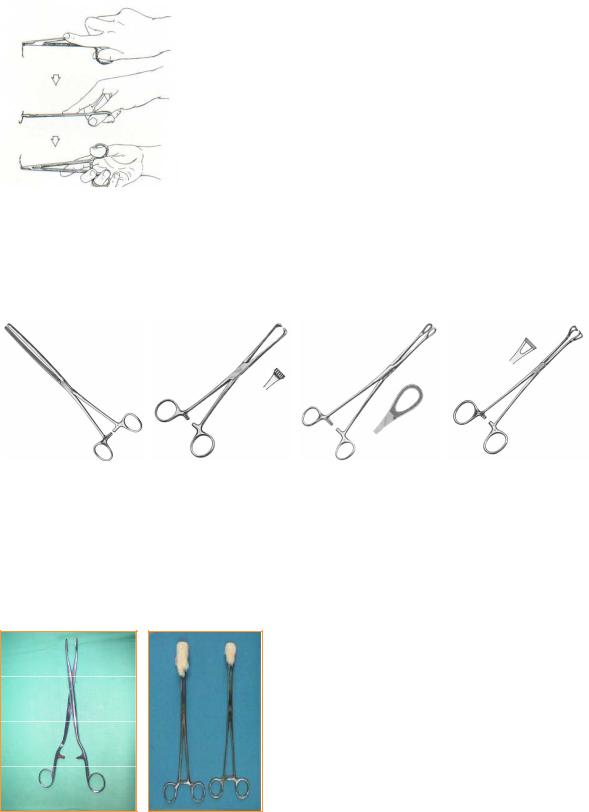
Figure 27. Correct holding of the Hegar needle holder (1st- 4th rule of holding the istruments)
Tissue-grasping forceps
These are special instruments used for delicate grasping and holding of the organs. The Klammer intestinal clamp, the Allis clamp (used to grasp and hold the lung), gall bladder forceps, and the Babcock forceps can be listed here (Figure 28.).
A |
|
B |
|
C |
|
D |
|
|
|
|
|
|
|
Figure 28. Organ holders
A. Klammer, B. Allis clamp, C. Gall bladder forceps, D. Babcock forceps
Sponge-holding forceps
In general surgery, it is used to grasp the swabs for disinfecting the surgical area prior to operation, or removing the blood and secretions from surgical territory during operation. Swab together with the sponge-holding forceps are called the handled swab. The sponge-holding forceps are also suitable for creating various subcutaneous tunnels (Figure 29.).
A B
Figure 29. Sponge-holding forceps (A) and handled swab (B)
30