Материал: BASIC_SURGICAL_TECHNIQUES budapest
monofilament threads at least externally but at the same time we can get their advantages of being braided. Manufacturing of monofilaments with better and better mechanical properties lead to improvement of handling and knotting difficulties of these threads.
Absorbable and non-absorbable sutures
Some of the suture materials are sooner or later disappearing and we find no sign of them in the body. These are called the absorbable suture materials. However, the others will stay in their place of insertion –without or with some changesforever. These latter threads are called the non-absorbable ones. Their comparsion is shown in Table 3.
The suture materials are actually needed till that time when the scar tissue is formed which then can replace the function of the threads. In ideal cases the thread is immediately absorbed with a minimal tissue reaction. It is aimful to choose the suture material based on the wound healing properties and dynamics of the given tissue or organ. Doing so, we can select a suture material which keeps its tensile strength for the whole period of time needed. A question arises here: is the tissue reaction developing during the absroption of an absorbable suture material or the foreign body reaction which occurs due to a nonabsorbable suture material more harmful to the patient?
Two types of absorption are: enzymatic and hydrolysis. The enzymatic absorption is active and done by celluar elements. It is the characteristic of the natural suture materials which contain proteins. The results of it can be severe tissue reaction, activation of the inflammatrory processes, formation of the microabsceses, and pathologic scar tissue. Its duration of absorption can not be defined and in different structures significantly different results can be obtained from the same suture material.
The hydrolysis is passive and done without participation of the celluar elements. It is the characteristic of the synthetic suture material. During hydrolysis the chemical and physical bonds located between the molecules of the suture material, become loose and the thread is disintegrated to such substances which are similar to the natural metabolites of the body and are lost from the body. The duration of the absorption of these suture materials can be estimated.
The advantages of the non-absorbable suture materials can be important when due to the properties of the tissue even after a long time there is no possibilty for formation of a scar which can insure a real mechanical strength. Exampels for this include: implantation of the cardiac prosthetic valves, implantation of the protheses which replace the ligaments of the joint, and fixation of the vascular grafts. It is important to know that always there is a possibilty for development of a severe fibrotic reaction around even the most modern and inert suture materials. This can be a bed for granulomas, microabscesses and rejection of the sutures.
Taken together, we can say that with some exceptions the synthetic, absorbable suture materials -which are absorbed by hydrolysis-, are prefered.
Table 3.Comparsion of absorbable and non-absorbable suture materials
|
Absorbable |
Nonabsorbable |
|
|
|
Advantage |
Body disintegrates it,no foreign body |
Permenant wound unifing |
|
||
|
remains behind |
|
|
|
|
|
No foreign body reaction |
|
|
|
|
Disadvantage |
Wound unifing time is limited |
Foreign body remains behind and can lead to |
|||
|
|
foreign |
body |
reaction, |
granuloma, |
|
|
microabscesses, fibrosis, rejecion of the suture |
|||
41
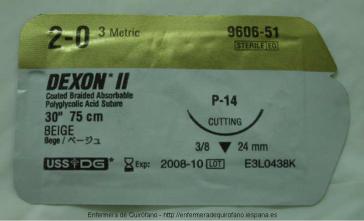
Table 4. Some important suture materials
Trade name |
Composition |
Basic |
structure |
Behaviour in |
|
use |
|
|
|
|
|
|
material |
|
body |
|
|
|
|
Softcat plain |
Sheep |
small |
Natural |
Monofilament |
Absorbable |
Since 2000, it is forbidden to use |
|||
|
intestine |
|
|
|
|
the catgut sutures |
|
|
|
Mersilk |
Raw silk spun |
Natural |
Braided |
Nonabsorbable |
It is not advisable any more |
||||
|
by silk warm |
|
|
|
|
|
|
|
|
Linatrix |
Linen |
|
Natural |
Braided |
Nonabsorbable |
For ligations |
|
|
|
Dexon II. |
Poliglicolic |
Synthetic |
Braided |
Absorbable |
Skin, |
subcutaneous |
tissue, |
||
|
acid |
|
|
|
|
muscels |
|
|
|
Vicryl rapide |
poliglactin |
Synthetic |
Coated braided |
Absorbable |
Skin (child) |
|
|
||
coated |
|
|
|
|
|
No need to remove the suture |
|||
PDS II. |
Polidioxanone |
Synthetic |
Monofilament |
Absorbable |
Soft tissues, children, plastic and |
||||
|
|
|
|
|
|
GIT surgeries |
|
|
|
Maxon |
Poliglicolic |
Synthetic |
Monofilament |
Absorbable |
Fascias and tendon sutures |
|
|||
|
acid |
|
|
|
|
|
|
|
|
Nurolon |
Polyamide |
Synthetic |
Braided |
Nonabsorbable |
Soft tissue sutures, ligations |
||||
Safil |
Poliglicolic |
Synthetic |
Braided |
Absorbable |
GIT surgeries, urology and OBG |
||||
|
acid |
|
|
|
|
|
|
|
|
Prolene |
Polypropylene |
Synthetic |
Monofilament |
Nonabsorbable |
Cardiovascular |
and |
plastic |
||
|
|
|
|
|
|
surgeries |
|
|
|
Steel |
Stainless steel |
Synthetic |
Monofilament |
Nonabsorbable |
Closure of sternum |
|
|
||
Suture size
The USP (United States Pharmacopoeia) unit is frequently used to determine the diameter of the threads. The USP unit is grouping the suture materials according to their size. Based on this, the thinnest suture material is 11/0. Then, we have 10/0, 9/0, 8/0, 7/0, 6/0, 5/0, 4/0, 3/0, 2/0, 0, 1, 2, 3, 4, 5, 6, and 7 which is the thickest one. Next to the USP unit, the metric system is also accepted (especially in Europe). This is compatible with SI and it is also registered in the EP (European Pharmacopeia). The metric system determines the thickness of the sutures in 1/10 mm. In Hungary the USP unit is used in practice.
Here we show some packed suture materials.We can get many important informations related to the suture and needle based on the international signs (Figure 45-47.)
Figure 45. Trade name: DEXON II, Size: in USP system: 2-0 and in metric system: 3 metric, structure: coated braided, absorbable suture material, composition: Polyglycolic acid, length: 75 cm, needle: cutting; sized 3/8 circle; length: 24 mm; P type needle.
42
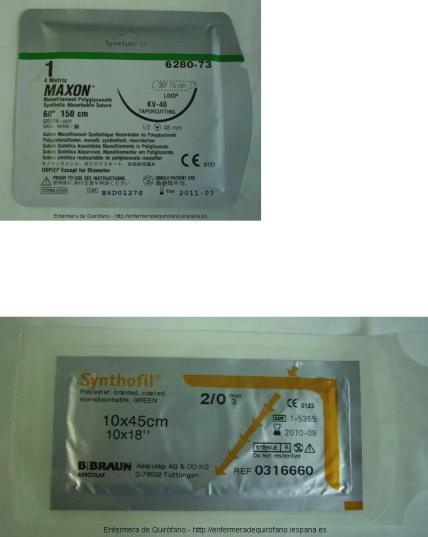
Figure 46. Trade name: MAXON, size: in USP system: 1 and in metric system: 4 metric, structure: synthetic; monofilament, absorbable suture material, composition of the green coloured one: Polyglyconate, length: 150 cm, needle: taper-cutting curved; sized 1/2 circle; length: 48 mm (loop suture material)
Figure 47. Trade name: Synthofil, size: in USP system 2/0 and in metric system 3 metric, structure: braided, nonabsorbable suture material, composition of the green coloured one: Polyester, 10 pieces each of them with a length of 45 cm, no needle inside the pack
4.3. Types of sutures
4.3.1. Interrupted sutures
Simple interrupted suture
This is frequently used to suture skin, fascia and muscles. After each stitch, a knot should be tied. All sutures must be under equal tension. The advantage is that the remaining sutures still ensure an appropriate closure and the wound will not open if one suture breaks or is removed. The disadvantage is that it is time-consuming since each individual suture must be knotted (Figure 48.).
43
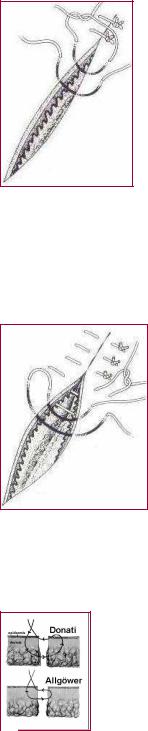
Figure 48. Simple interrupted suture
Vertical mattress suture (Donati or Vertical U-shaped suture)
It is a skin suture. It is a 2-row suture. It consists of a deep suture that involves the skin and the subcutaneous layer (this closes the wound) and of a superficial back stitch placed into the wound edge (this approximates the skin edges). The two stitches are in a vertical plane perpendicular to the wound line (Figure 49.).
Fig 49. Vertical matress suture
Allgöwer suture
It is a special form of vertical mattress suture: on one side of the wound, the thread does not come out from the skin, but runs intracutaneously. In this case, a thin scar is formed (Figure 50.).
Figure 50. Allgöwer suture
Horizontal mattress suture (U-shaped suture)
This is a double suture: the back stitch is 1 cm from the first one, parallel to it in the same layer. Can be used in short skin wound (Figure 51.).
44

Figure 51. Horizonal mattress suture
4.3.2. Continuous sutures
Simple continuous suture
This can be applied to suture tissues without tension, the wall of inner organs, the stomach, the intestines and the mucosa (Figure 52.).
Figure 52. Simple continuous suture
Advantages: 1. It can be performed quickly, since a knot should be tied only at the beginning and the end of the suture (here, only a part of the thread is pulled through and the strands of the opposite sides are knotted). 2. The tension is distributed equally along the length of the suture. During suturing, the assistant should continuously hold and guide the thread to prevent it from becoming loose.
Locked continuous suture
45