Материал: Russian Journal of Building Construction and Architecture
Issue № 2(34), 2017 |
ISSN 2542-0526 |
green roof if designed operated correctly and they care about climate features can help preserving a lot of energy in addition to all the advantages that are listed on (Table 6) (Mahmody, M, 2012, pages 82 and 73).
|
Table 6 |
Advantages of green roves (Peck &Callaghan, 1999) |
|
|
|
Dimensions |
Advantages |
|
|
Ecological |
Preserving natural diversity and creating new habitant, developing |
|
ecological-environmental quality in the city |
|
|
Climate |
Adjustment of city heat affect cooling |
|
Reducing the impact of cold wing and heat isolation |
|
|
Residential environment quality |
Improvement in the air quality O2 and CO2 exchange |
|
Reduction of noise pollution |
|
Reduction in flowing waters of rain |
|
Improvement of water quality and prevention of its pollution |
|
Reduction in electromagnetic radiation effects(up to 99 percent) |
|
|
Cultural economical |
Reduction of costs in ventilators (cooling in summer) |
|
Extend the operational life of roofing materials |
|
Recreation and health |
|
Increase in feelings of being a part of a place |
|
Saving energy (isolator in winter) |
|
Creating double green spots |
|
|
The history of green roves
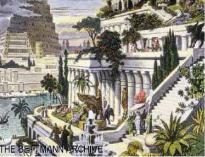
Recent roof gardens stem from history. The idea of creating a garden on the roof and planting on it was operated 2500 years ago on the roof of Zigoratha by Iranian. A green rove of 600 BC in roof garden belonged to Samira Mis Syria and one
can also see the suspended gardens in Babul (Fig. 5) which is one of the seven wonders of the world. There were some roof gardens made in Egypt, too, but that building for these roves were 14 meters high. In the Renaissance era there were some roof gardens in France and Italy. In 20th century Le Corbusier and Frank lloyd wright were also the naturalist who created green roves (Razavian, M, 2010, p. 137).
In the early 60th decade of 20th century paying attention to the quality of the nature in the city’s texture and environmental challenges in big cities especially in the middle of them
91
Russian journal of building construction and architecture
caused a new heating phenomenon and energy crises led to a new development of green roves which started from northern Europe (parks and green spots of Tehran city hall, 2010). Following that, green roves had become popular in Germany, France, Norway, Swiss and other countries in Europe and they also become a part of beautification projects in these countries (Peck &Callaghan, 1999).
Kinds of green roves
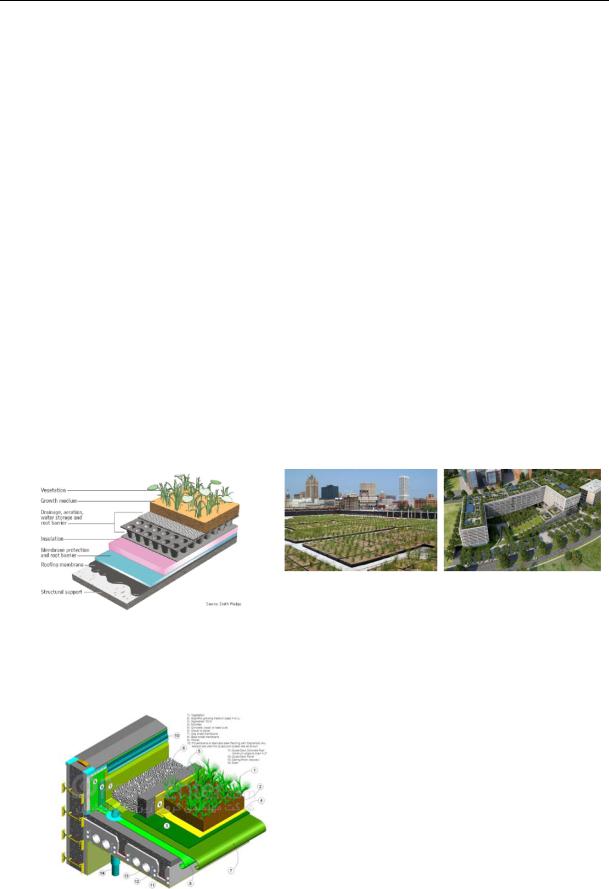
Green roves based on planting depth and required installation can be classified into different groups such as intensive/compressed, extensive/widespread/wide, modular/box plant. In Figures 6, 7, 8 there are traditional green roves which need standard depth of soil for growing big plants and lawn are considered as intensive or compressed gardens. These gardens need watering fertilizing and proper care. In contrast, widespread or wide roves are considered selfcare systems that require the least care and installation, they might just need harvesting or fertilizing once a year to grow. This kind of green roves can grow in a shallow soil (usually they use organic fertilizers with special formula).
Fig. 7. Modular green roof (Razavian, M, 2010, p. 137)
Fig. 6. Compressed green roof (Earth Pledge website)
Fig. 8. Widespread green roof (Iranian consulting engineering)
92
Issue № 2(34), 2017 |
ISSN 2542-0526 |
Therefore compressed planting roves have a deep planting surface and are available. Widespread green roof is a shallow planting surface, which is a part of the roof system and the building. A widespread green roof usually is out of reach and is not operational. Green roves have advantages and disadvantages that are listed in Table 7.
|
|
Table 7 |
|
Advantages and disadvantages of green roves (writer) |
|||
|
|
|
|
Advantages |
Disadvantages |
||
|
|
|
|
Creating a good place for |
Growing vegetables, fruits |
Roofs need reinforcement for locating a green |
|
those who are living in it- |
and flowers are possible |
spot on them and it is important that these |
|
because it has yard |
roves are not made for humans to walk on |
||
|
|||
|
|
|
|
Reduction and refining sounds |
|
Green roves also require acceptable building |
|
|
features. Many of the available buildings, are |
||
that enter the building to the |
Reduction in heating effects |
||
range of 18db and those that |
and environmental changes |
not appropriate for green roves because there |
|
is load in soil and plants. Here a concrete col- |
|||
go up to 3dB |
|
umn is much better than iron or wood. |
|
|
|
||
|
|
|
|
Works as a greenhouse or an |
Increase in a living place |
In some cases, designing these roves accord- |
|
inactive sun heating system |
ing to the climate of the region is a hard job. |
||
|
|||
|
|
|
|
Air purification |
Reduction of floods |
|
|
and reduction of CO2 |
|
||
|
|
||
|
|
|
|
Improvement of views around |
Increasing animals habitat |
|
|
a building with making it look |
in living areas |
|
|
green |
|
||
|
|
||
|
|
|
|
Reduction in heating power |
Increasing the financial |
|
|
value of building |
|
||
because of adding extra isola- |
|
||
|
|
||
Extend the life of the roof |
|
||
tion and cooling power of the |
|
||
materials( to two or three |
|
||
building especially if it is |
|
||
times) protecting it from UV |
|
||
made of glass |
|
||
radiation and climate injuries |
|
||
|
|
||
|
|
|
|
It is clear that all advantages of green roof are following the basics of architecture on the other side disadvantages can be solved with some works and this is one other advantage of green roof. In spite of this many reasons inIran keep us away of applyingthis method that will be mentioned. According to obstacle that keep us away from developing green roves, using the universal experience can tell us major prerequisites of developing green roves in Iran are listed as below (Nahrly, D, 2012, pp. 89––98):
93

Russian journal of building construction and architecture
––Introducing projects for operating cheap green roves and providing subsides.
––Determining plant species that are adapted to the climate of the city.
––Introducing projects to attract private sector for investing and advertising for green roves.
––Developing required infrastructure, material and equipment in a wide range and selling them.
––Preparing a complete software system on consoling and availability of materials that are needed for green roves.
––Increasing public awareness on importance of ecological matters and the need for all Iranian cooperation for this system.
––Collaboration and communication with other educational and research centers, supporting articles that are written in this field by related organizations and authorities.
––Collaboration of city halls with private organizations of environmental protection and developing the NGO of green roves.
––Informing managers and authorities of city halls about profits of green roves and holding conferences in this field.
––Collaboration of green space communities with institutions and private developers for overcoming existed problems and needs using their council or getting proper plant species, etc.
––Using the experience of other countries (e.g., Japan that in spite of having little land and compressed construction is following the operational roof garden as a recreational purpose).
––Creating legislation rules for buildings like those in Austria, Linz and Japan. In these countries getting a green roof is sometimes an obligation.
Conclusions
A house is a closed space that should not be isolated to those who are living in it to get fresh air. A yard as a symbol for this open place, although is going to be totally eliminated in the life of most citizens, but it is still considered necessary and for its functions there has not yet introduced and alternative. A yard aside from giving us the ability to look at the sky and its different shapes is an opportunity for gardening and farming. It is a place for the production of some groceries like vegetables that are a daily need. It is also an opportunity for keeping domestic animals or communicating with some other animals. It is place for playing, exercise, movements, jumping that are now impossible in new houses, especially for children and women who have less time for being exposed to public and open places. A yard is also a place
94
Issue № 2(34), 2017 |
ISSN 2542-0526 |
for meditation, thinking, imagination and art. In the past a yard also used to be a domestic recreation place. Sitting and spending an evening in it while talking in the fresh air refreshes one’s spirit. A yard was also a place for some messy activities that were not possible to do at home (polishing shoes) and many daily activities can not be done at home so they could be done in a yard, e.g. washing the dishes, the rugs, getting some fruit and foods dried for the use in winter, washing vegetables in big portions, washing some big pots that were not possible to wash at the sink or even some activities like drying clothes in the sunshine, which is of great importance for medical purposes as well as being free without Hijab to be exposed to sunshine, which is the same thing in medication. Absence of all these things is felt in every house that has created a confusion and sickness for those who are living in it, for this people might get sick of staying at home. Since the past till now a house has been a place for recreation and there was provided some equipment for the happiness of the people living in it. Swings, pool, beds that were for sitting and talking in the afternoons, was a traditional model of them. This way they had a close relationship with the close environment of a house and the open one of the yard which made a perfect place for living (Ghaznavian, M, personal weblog).
Unfortunately, in the recent architecture for many reasons that have been discussed in the article, yards are now forgotten elements of houses and their functions are now the unfulfilled need of people living in apartment. For this, a green roof can work to fulfil some of these needs.
A roof in the Iranian architecture is clearly a part of life and in addition to all the complex and beautiful parts, is sometimes used as a yard too. In some cities like Nain in some of the buildings with some special walls they brought up the surrounding areas of the roof to create a yard which was used for sleeping during summer. These walls also with shading sometimes during a day on the roof had a secondary rule for house cooling. These spaces were also used in mosques. In Motahary mosque above the roof there is a purification room that is called Chehelshir (Zandieh, M, & ParvardyNezhad, S, 2009).
Another example is Abbasian house in Kashan that has such a yard at the roof whose architecture uses special frames of reticulated bricks, that will enable its ventilatation (Asad pour, A, 2006, p. 74).
Developing and creating green spots has a crucial rule in human life, which can be an alternative of destroyed nature after a house has been built. Many technologies and activities are aimed at reducing human effects on earth, to name one can say effective use of natural resources, farming without using industrial materials and greening the roves.
95