Материал: Russian Journal of Building Construction and Architecture
Issue № 2(34), 2017 |
ISSN 2542-0526 |
A shift of the phase of oscillations is given by the expression identically to [20]:
|
C2 |
|
|
|
|
Р1 |
|
|
|
|
arctg |
arctg |
|
Е С( ) |
А |
|
. |
(6) |
|||
C1 |
|
|
СМ1 2 |
|
|
|||||
|
|
|
2 |
|
Р1 |
|
||||
|
|
|
E |
M2 |
|
|
Е D( ) |
|
|
|
|
|
2 |
|
А |
|
|||||
|
|
|
|
|
с М |
|
|
|||
|
|
|
|
|
1 |
|
|
|
|
|
The angle of the displacement between movements of the vibratory mill and direction of a constraining force is very important and the only parameter that we have available using which the energy balance for the compaction of the layer of an asphalt concrete mix can be identified, i.e. its power for maintaining the oscillations of the vibratory mill as the data on the angle of the displacement characterize the properties of the layer of an asphalt concrete mix as an energy absorber.
Determining the amplitude of oscillations and the angle of the displacement of the phases between the movements of the vibratory mill and the direction of a constraining force with the formula suggested by S. A. Varganov [3], we can identify the power for maintaining the oscillations:
N |
1 P A sin , |
(7) |
|
|
2 |
2 |
|
where N is the power of maintaining the oscillations, Watt; Р2 is a constraining force, N; А is the amplitude of the oscillations of the vibratory mill, m; is the angular frequency of the rotation of misbalances, s-1; is the angle of the displacement of the phases between the movement of the vibratory mill and the direction of a constraining force.
Using the expressions for the amplitude of oscillations, angle of the displacement between the phases of the movement of the vibratory mill and the direction of a constraining force as well as the characteristics of the physical and mechanical properties of a compacted layer, the power for maintaining the oscillations of the vibrator was identified.
The first half of the compaction of a vacuum asphalt concrete mix does not require much power to maintain the oscillations but as the compaction coefficient reaches 0.96, this power gradually increases from one run to another till it goes up to 0.75…0.8 kWatt. According to the calculation, the amplitude of oscillations of the vacuum-type vibratory roller during compaction ranged from 0.17…0.4 mm. The acceleration of the vacuum-type vibratory roller is 1.01…2.27 g depending on the frequency of the oscillations and a constraining force.
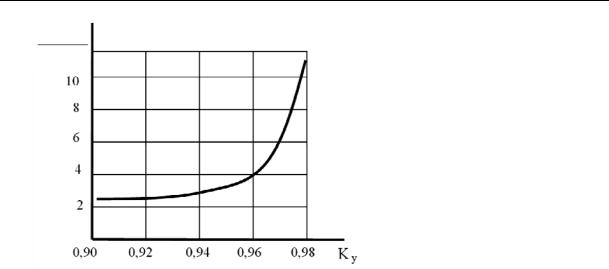
There were also calculations of the power of a regular vibratory roller as well. Fig. 2 shows relative capacities for maintaining the oscillations of the vacuum-type vibratory mill compared to a regular vibratory roller for the same parameters and modes of operation.
41
Russian journal of building construction and architecture
N Vibration
N Vibration + Vacuum
Fig. 2. Relative power for maintaining oscillations of the vacuum-type vibratory roller depending on the density of an asphalt concrete mix in the process
As Figure suggests, at the initial stage of compaction the power of the vibratory roller is 2.5…3 times higher than that of the vacuum-type vibratory roller. At the final stage of compaction this ratio goes up to 10…12. Thus in the technological process of the compaction of vacuum layers of an asphalt concrete mix using vibratory rollers a considerable amount of energy can be saved for operating the vibrator particularly in the final stage of compaction.
Conclusions
Based on the methods of formalizing dynamic models, a generalized dynamic model of the compaction of road asphalt concrete mixes and foundations was developed considering the major parameters of a compacting machinery as well as rheological parameters of a compacted material to allow a a qualitative as well as a quantitative evaluation of the dynamics of a system. The parameters of a compacted material in the model are presented by means of the physical and mechanical parameters that reflects the deformation modulus per a unit of the thickness of a compacted layer. Depending on the types of compacting machinery, the guidelines for the use of particular elements in a dynamic model are provided.
Mathematical modelling of compaction of road asphalt concrete mixes using vibratory rollers indicated that the first half of the compaction of an asphalt concrete mix does not require much power for maintaining the oscillations of vibratory mills while as the compaction coefficient reaches 0.96, the power gradually goes up from one run to another. At the initial stage of compaction, the power of a vibratory roller is 2.5…3 times higher than of a vacuum-type vibratory roller. At the final stage of compaction this ratio goes up to 10…12. Therefore a considerable amount of power is saved on operating a vibrator during compaction of vacuum layer of an asphalt concrete mixes using vibratory rollers, particularly at the final stage of compaction.
42
Issue № 2(34), 2017 |
ISSN 2542-0526 |
References
1.Al'bert I. U. Teoreticheskie osnovy dinamicheskikh metodov poverkhnostnogo uplotneniya gruntov [The theoretical basis of the dynamic methods of surface compaction]. Leningrad, VNIIG im. B. E. Vedeneeva, 1974.
67p.
2.Badalov V. V. Issledovanie katkov pri uplotnenii asfal'tobetonnykh dorozhnykh pokrytiy. Avtoref. diss. kand. tekhn. nauk [Research rollers during compaction of asphalt pavements. The abstract of thesis of cand. of eng. sci.]. Leningrad, 1974. 17 p.
3.Varganov S. A. [Theoretical and experimental studies of the dynamics of vibrating rollers]. Trudy VNIIStroydormash [Proc. оf Vniistroydormash], 1962, no. 28, pp. 55—97.
4.Blekhman I. I., ed. Vibratsii v tekhnike: spravochnik. V 6 t. T. 2. Kolebaniya nelineynykh mekhanicheskikh system [Vibration in engineering: Handbook. In 6 vol. Vol. 2. Oscillations of nonlinear mechanical systems]. Moscow, 1979. 351 p.
5.Zubkov A. F., Kharkhuta N. Ya. [Comparison of parameters of vibratory and static rollers for compaction of asphalt mixes]. Trudy SoyuzdorNII «Issledovanie sovremennykh sposobov i sredstv uplotneniya gruntov i konstruktivnykh sloev dorozhnykh odezhd» [Proc. of Soyuzdornii «Research of modern methods and means of compaction and structural layers of road pavements»], 1975, iss. 84, pp. 124—132.
6.Ivanchenko S. N. Rabochiy protsess i vybor parametrov katka s vakuumnym ustroystvom. Avtoref. diss. kand. tekhn. nauk [The workflow and parameter selection of the rink with a vacuum device. The abstract of thesis of cand. of eng. sci.]. Leningrad, 1985. 16 p.
7.Kovalenko Yu. Ya. Issledovanie samokhodnykh vibratsionnykh katkov dlya uplotneniya asfal'-tobetonnykh smesey. Avtoref. diss. kand. tekhn. nauk [The study of the self-propelled vibrating rollers for compaction of asphalt mixes. The abstract of thesis of cand. of eng. sci.]. Leningrad, 1979. 23 p.
8.Koltunov M. A. Polzuchest' i relaksatsiya [Creep and relaxation]. Moscow, Vysshaya shkola Publ., 1976.
278p.
9.Metodicheskie rekomendatsii po utochneniyu norm plotnosti gruntov nasypey avtomobil'nykh dorog v razlichnykh regional'nykh usloviyakh [Methodical recommendations for the refinement of norms of density of soil embankments roads in different regional contexts]. Moscow, SoyuzdorNII, 1988. 74 p.
10.Nosov S. V. Vliyanie tekhnologicheskikh parametrov dorozhnykh katkov na uplotnenie asfal'-tobetonnoy smesi [Influence of technological parameters of road rollers for compaction of asphalt mixture]. Stroitel'nye i dorozhnye mashiny, 2001, no. 7, pp. 5—7.
11.Nosov S. V. Vybor parametrov i rezhima raboty vibratsionnogo katka s vakuumnym ustroy-stvom dlya uplotneniya asfal'tobetonnykh dorozhnykh pokrytiy. Avtoref. diss. kand. tekhn. nauk [The choice of parameters and mode of operation of the compactor with the vacuum device for compaction of asphalt pavements. The abstract of thesis of cand. of eng. sci.]. Leningrad, 1989. 16 p.
12.Nosov S. V., Nosov V. V. Dinamicheskaya model' vibratsionnogo katka s vakuumnym ustroystvom [A dynamic model of the compactor with the vacuum device]. Izvestiya vuzov. Stroitel'stvo i arkhitektura, no. 7, pp. 101—107.
13.Nosov S. V., Nosov V. V. K voprosu po opredeleniyu modulya deformatsii uplotnyaemykh sloev dorozhno-stroitel'nykh materialov [To the question on the definition of the modulus of deformation of compacted layers of road construction materials]. Izvestiya vuzov. Stroitel'stvo, 1991, no. 10, pp. 104—108.
14.Nosov S. V. Osobennosti tekhnologii uplotneniya dorozhnykh pokrytiy katkami pri ispol'zovanii na nikh vakuumnykh ustroystv [Technology features a seal pavement rollers if you use them vacuum devices].
Stroitel'nye i dorozhnye mashiny, 1999, no. 9, pp. 6—9.
15.Nosov S. V. Tekhnologicheskie rezhimy raboty uplotnyayushchikh mashin i zakonomernosti up-lotneniya dorozhno-stroitel'nykh materialov na osnove razvitiya ikh reologii [The technological regimes of compacting machines and regularities of compaction of road construction materials on the basis of their rheology]. Nauchnyy vestnik Voronezhskogo GASU. Stroitel'stvo i arkhitektura, 2011, no. 3 (23), pp. 87—98.
16.Nosov S. V. Tekhnologiya uplotneniya goryachikh asfal'tobetonnykh smesey s primeneniem vib-ratsionnykh katkov s vakuumnym ustroystvom [Seal technology of hot asphalt concrete mixtures using vibrating rollers with a vacuum device]. Nauchnyy vestnik Voronezhskogo GASU. Stroitel'stvo i arkhitektura, 2012, no. 4 (24), pp. 53—63.
43

Russian journal of building construction and architecture
17.Nosov S. V. Uplotnenie asfal'tobetonnykh smesey s vakuumirovaniem [The compaction of asphalt mixtures with vacuum]. Nauka i tekhnika v dorozhnoy otrasli, 2010, no. 3, pp. 36—39.
18.Podol'skiy Vl. P., Ryabova O. V., Nosov S. V. Razvitie reologii dorozhno-stroitel'nykh materialov na puti sovershenstvovaniya tekhnologiy ikh uplotneniya [Development of rheology of road-building materials in enhancing technology seals]. Nauchnyy vestnik Voronezhskogo GASU. Stroitel'stvo i arkhitektura, 2011, no. 3 (23), pp. 99—108.
19.Rzhanitsyn A. R. Raschet sooruzheniy s uchetom plasticheskikh svoystv materialov [Calculation of structures with consideration of plastic properties of materials]. Moscow, Gos. izd-vo literatury po stroitel'stvu i arkhitekture, 1954. 288 p.
20.Rzhanitsyn A. R. Stroitel'naya mekhanika [Structural mechanics]. Moscow, Vysshaya shkola Publ., 1982.
400p.
21.Ksenevich I. P., etc, Ksenevich I. P., ed. Traktory. Proektirovanie, konstruirovanie i raschet [Tractors. Design and calculation]. Moscow, Mashinostroenie Publ., 1991. 544 p.
22.Shestopalov A. A. Intensifikatsiya protsessa uplotneniya asfal'tobetonnykh smesey ukatkoy s vakuumirovaniem. Avtoref. diss. doct. tekhn. nauk [The intensification of the process of compaction of asphalt mixes compacted with vacuum. The abstract of thesis of dr. of eng. sci]. Moscow, 1990. 32 p.
44

Issue № 2(34), 2017 |
ISSN 2542-0526 |
UDC 624.131.54 : 625.855.3
S. V. Nosov1
DETERMINATION OF RATIONAL CONTACT PRESSURE UNDER A ROLLER WHEN COMPACTING ASPHALT CONCRETE MIXES
Lipetsk State technical University
Russia, Lipetsk, tel.: (4742)55-59-84, e-mаil: nosovsergej@mail.ru
1D. Sc. in Engineering, Prof. of the Dept. of Building Materials and Road Technologies
Statement of the problem. Determining the applicability of rollers of different weight, type and mode of operation when compacting various asphalt mixes should be carried out on the basis of the rheological approach. This allows one you to take into account the exposure time of the seal on the compacted layer of the mixture, as well as the rate of change in operating contact stress under the roller rink. It should be understood that the modulus of deformation and tensile strength of asphalt mixture layer are also a function of these factors expressed implicitly. If there is insufficient contact pressure under the roller rink, sealing effect is reduced. At excessively large contact pressures the structure is destroyed forming mixture during compacting. In this regard, there is a task to develop a method of definition of rational contact pressures under seals rollers when compacting asphalt mixes based on the development of their rheology.
Results. On the basis of experimental and theoretical studies using simulation compaction of asphalt mixes process on a computer obtained regularities that determine the nature of the changes required under the existing roller contact pressure rollers. Thus in addition to the known technologies seal asphalt mixtures are the recommendations of the contact pressure to ensure a roller rink in the application of new advanced compression technology of asphalt mixes with evacuation.
Conclusions. The investigation results allow one to deduce process variables selected by rollers on the optimum operating modes to ensure maximum effect sealing asphalt concrete mixtures and high-quality asphalt.
Keywords: road rollers, contact pressures, rheological approach.
Introduction
Choice and use of a particular roller should be due to the strength characteristics of a compacted layer. Contact pressures occurring under the operating bodies of compactors should not exceed the strength limit of a compacted material [3, 19].
© Nosov S. V., 2017
45