Материал: Аврамова NUCLEAR ENGLISH 2013
good – «нет худа без добра»). If fission had been discovered then, Nazi Germany would have built an atomic bomb.
In 1939 Fermi immigrated to the USA in order to save his Jewish wife Laura from anti-Semitic persecution in Mussolini’s Italy. Many Jewish scientists had to leave Nazi Germany for the same reason. Historians agree that if Hitler had not forced Jewish scientists to leave Europe, he might have got the atomic bomb before America. Fermi and other famous scientists who had left Europe, including Leo Szilard, John von Neumann, Edward Teller and Hans Bethe played an important role in the American nuclear story.
In 1942, at the head of the multi-national research group, Fermi produced the first controlled, self-sustaining chain reaction. When in 1949 President Truman initiated the program to develop the hydrogen bomb, Fermi strongly opposed it. ‘It is clear that such а weapon cannot be justified on any ethical ground... The fact that no limits exist to the destructiveness of this weapon makes its very existence and the knowledge of its construction а danger to humanity as а whole,’ he wrote.
His warnings were ignored. The Cold War arms race between America and the Soviet Union put the world at mortal risk. But there is no doubt that the discovery of controlled nuclear energy, in which Fermi’s role was so crucial, did have long-term beneficial results: a potentially unlimited source of energy and keeping humanity from another world-scale war.
Exercise 1. Read the text again and answer the following questions.
1.What are Fermi's main contributions to nuclear physics?
2.Fermi and his group nearly made one more important discovery. What was it? Why did they fail?
3.What was Fermi's attitude to the hydrogen bomb program?
Exercise 2. Suggest explanations for the following facts mentioned about Enrico Fermi in Reading 4-D.
1.He failed to discover nuclear fission. This fact is called «a blessing in disguise».
2.He was an Italian but lived and worked in the USA.
3.He played a crucial role in the development of the A-bomb but was against the H-bomb program.
46
Exercise 3. Match the following Russian and English equivalents.
1. |
To create a theory |
a) Бета-распад |
2. |
To design a bomb |
b) Выделение ядерной энергии |
3. To increase the effectiveness |
c) Создать теорию |
|
4. |
To play a crucial role |
d) Неисчерпаемый источник энергии |
5. |
To put at mortal risk |
e) Гонка вооружений |
6. |
To oppose strongly |
f) Не может быть оправдан(о) |
7. To ignore the warnings |
g) Играть важную роль |
|
8. |
Cannot be justified |
h) Долгосрочные благоприятные |
|
|
результаты |
9. |
Beta decay |
i) Война мирового масштаба |
10. Arms race |
j) Подвергать смертельной опасности |
|
11. Unlimited source of energy |
k) Выступать категорически против |
|
12. World-scale war |
l) Повысить эффективность |
|
13. Long-term beneficial results |
m) Не обращать внимания на пре- |
|
|
|
дупреждения |
14. Release of nuclear energy |
n) Создать (спроектировать) бомбу |
|
Exercise 4. Re-write the sentences and replace the underlined parts with the words or phrases listed below.
Chain reaction, mortal danger, crucial, arms race, release, nuclear fission, beneficial, long-term effects
1.A competition between industrial countries to produce more and deadlier weapons is a waste of human and material resources which otherwise might be put to more beneficial uses.
2.Some specialists say that no matter how costly modern research may be the favorable and useful effects by far outweigh the costs.
3.Few specialists could predict the effects of the scientist's discoveries in the distant future.
4.The discovery of nuclear fission was of great importance for humankind in the 20th century.
5.On August 6, 1945, humankind became aware of the danger of complete destruction caused by nuclear weapons.
47
6.One free neutron can lead to the liberation of two or three; that makes the extraction of energy in useful quantities from the process of splitting the nucleus of certain atoms into parts possible.
7.The released neutrons can start a number of related changes in the
fissile material, each of which causes the next, but it can also die out quickly if there is not enough U235, i.e., no critical mass of fissile material.
Exercise 5. Read the last sentence in Reading 4-D again. Think about the questions below and write your answers to them.
1.According to the author, how did the developments in nuclear physics in the 20th century affect the humanity?
2.Do you agree with him? Why? Why not?
Reading 4-E
Nuclear Scientists and the Nuclear Bomb
Look through these encyclopaedia entries about four scientists and say what they have in common. Why do you think these scientists took part in the nuclear projects?
Hans Bethe – a German physicist who went to the USA to escape the Nazis in 1935, discovered the fusion reactions that power the stars, directed work on the first A-bombs and contributed to the H-bomb. At the same time he strongly opposed nuclear testing and the nuclear arms race.
J. Robert Oppenheimer – an American physicist who headed the atom bomb project known as the Manhattan Project. He directed the Los Alamos laboratory that created the first A-bombs and made a considerable contribution to the post-war nuclear arms race. Because of his opposition to the US H-bomb program he was tried and lost his security clearance (допуск к секретным материалам) in 1954.
Edward Teller – a Hungarian nuclear physicist who emigrated to the US in 1935. He was known as the father of the H-bomb and never expressed any doubt about it. Because of his fear of Russia he supported
48
the US H-bomb program after the first Soviet A-bomb test. Later he became an enthusiastic supporter of the US Star Wars program.
Andrey Sakharov - as a young Soviet physicist he was ordered by the KGB to work on the H-bomb and designed a kiloton weapon that exploded in 1955, only 13 months after the first US H-bomb test. He is regarded as the father of the Soviet hydrogen bomb. In the 1960s, he opposed nuclear proliferation and protested against atmospheric testing of the hydrogen bomb. In 1975 he became the first Russian to win the Nobel Peace Prize.
Do you know?
The Manhattan Project (1939 – 1945) was the top-secret plan to develop the world's first atomic bomb in the United States.
With the discovery of fission in 1939, it became clear to scientists that certain radioactive materials could be used to make a bomb of great power. At the beginning of World War II, news arrived in the U.S. that the Nazis were making an atomic bomb. The U.S. believed they could not allow the Nazis to build such a powerful weapon first and started the Manhattan Project to design a nuclear weapon. In 1942 Enrico Fermi and his associates achieved the first controlled nuclear fission reaction. In 1945 their work resulted in the first test of a nuclear weapon called «Trinity» which was a plutonium device.
The first uranium bomb (“Little Boy”) was dropped on Hiroshima on
August 6, 1945, killing at least 70,000 people. On August 9, 1945, a plutonium bomb (“Fat Man”) identical to the Trinity device was dropped on Nagasaki, killing at least 35,000 people.
49
Unit 5
Reading 5-А
Nuclear Reactor Primer
The paper-moderated, ink-cooled reactor is the safest of all.
Read Passage 1 and answer the questions below:
1.How much nuclear electricity did nuclear reactors produce worldwide as of July 2008?
2.Which country depends on nuclear power most?
3.In what way do nuclear power plants differ from conventional plants?
4.What are the principal categories of nuclear reactors?
5.How can you account for the difference between them?
1.Nuclear Power in the World Today
As of July 2008, there were more than 430 operating nuclear power plants in 31 countries and, together, they provided about 15 percent of the world’s electricity in 2007. Some countries depend more on nuclear power than others. For instance, in France about 77 percent of the country's electricity comes from nuclear power. In the United States, 104 nuclear power plants supply 20 percent of the electricity overall. In Russia, 31 nuclear power plants supply 16 percent of the country's electricity.
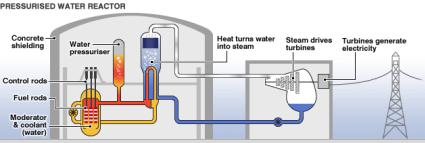
Actually, a nuclear power plant does not operate differently from a conventional power plant. Both heat water into steam, which drives a turbine generator. The main difference between the two plants is the method of heating the water. While conventional plants burn fossil fuels, nuclear plants derive the heat from nuclear fission, when one atom splits into two.
50