Материал: Аврамова NUCLEAR ENGLISH 2013
4.What is the nucleus composed of?
5.What is the chemical behavior of an atom determined by?
6.In what way do chemical combinations take place between atoms?
7.Why is the nuclear-atom model sometimes called the solar-system model of the atom?
8.What is the difference between the nuclear atom and the solar system?
Exercise 6. Do you know how the nucleus was discovered? Read the passage below and find out. Think of suitable headings for paragraphs 1-4.
Rutherford’s Alpha-Particle Scattering Experiments
1.At about the same time as Thomson conducted experiments with cathode rays, physicists such as Henri Becquerel, Marie Curie, Pierre Curie, and Ernest Rutherford were studying radioactivity.
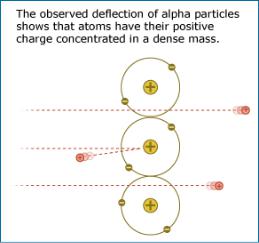
2.The experiment with radioactivity that contributed most to our knowledge of the structure of the atom was made by Rutherford and his colleagues. Rutherford bombarded a thin foil of gold with a beam of alpha particles and observed the beams on a fluorescent screen.
3.He noticed the following: most of the particles went straight through the foil and struck the screen. Some (0.1 percent) were deflected or scattered (at various angles) in front of the foil, while others were scattered behind the foil. However, a few particles were deflected sharply, by 90 degrees.
11

4. Therefore, Rutherford concluded that the gold atoms were mostly empty space, which allowed most of the alpha particles to pass through. However, some small region of the atom must have been dense enough to deflect or scatter the alpha particle. He called this dense region the nucleus; the nucleus contained most of the mass of the atom.
Exercise 7. Put each of the following words in its correct place in the passage below. Think of a suitable heading for the passage. Close the book and write the passage in your own words.
Particle, nucleus, neutron, electron, uncharged, radiation, proton, subatomic, weight, number.
When Rutherford bombarded nitrogen with alpha particles, a positively charged particle that was lighter than the alpha particle was emit-
ted. He called this particle a (a) |
|
|
and realized that it was a funda- |
||||||||
mental particle in the (b) |
|
|
|
. The |
proton has a mass about 1,836 |
||||||
times larger than the (c) |
|
|
! |
|
|
|
|
|
|||
|
However, the proton |
could not be the only (d) |
|
in the nucleus be- |
|||||||
cause the (e) |
|
of protons in any given element |
was |
less than the |
|||||||
(f) |
of |
the nucleus. Therefore, a third, neutrally charged particle must |
|||||||||
exist! It was James Chadwick, a British physicist and co-worker of Rutherford, who discovered the third (g) _____ particle, the (h) . Chadwick
bombarded beryllium foil with alpha particles and noticed very high-energy
(i) coming out. Chadwick concluded that this radiation was a stream
of (j) _____ particles with about the same mass as the proton.
Time for Fun
Enjoy the joke:
A neutron walks into a bar. "I'd like a beer" he says. The bartender promptly serves up a beer. "How much will that be?" asks the neutron. “For you?" replies the bartender, "no charge."
Reading 1-C
Quantum Mechanics Throws Light on the Atom: The Bohr Model
Before reading the passage refer to the list of terms in Exercise 1. They will help you understand the text.
Q: What happens when electrons lose their energy? A: They get Bohr'ed.
12
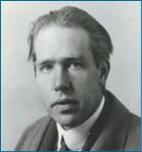
The Rutherford model of the atom presented a problem. If Rutherford was right and the electrons moved in a circle, they would lose energy, slow down and fall into the nucleus. In fact, it was calculated that the Rutherford atom would last only a few billionths of a second before collapsing! Something was missing! In 1913, the Danish physicist named
Niels Bohr noticed the problem with Rutherford’s idea. He modified
Rutherford’s model by proposing that electrons had set energy levels.
One method of observing indirectly what is going on inside the atom is tо analyze the spectra produced when samples of various elementary substances are made to glow. Bohr studied the spectra emitted by hydrogen. He chose hydrogen because the hydrogen atom has the smallest mass and nuclear charge and it is the least complicated structurally. Bohr discovered that the visible spectrum of hydrogen is bright line.
However, according to the classical theory of electromagnetic waves, atoms should emit radiation over а continuous spectrum. This prediction is not consistent with the bright-line spectra characteristic of hydrogen. So, the classical theory of electromagnetic waves could not explain the observed bright-line spectrum of hydrogen.
To account for the fact that the hydrogen atom does not emit electromagnetic waves continuously, Niels Bohr put forward the theory based on three postulates:
1.The electron in а hydrogen atom exists only in certain allowable orbits (оr shells) and while it is in any of these orbits the electron does not radiate energy.
2.These orbits are such that the angular momentum of the electron about the nucleus is an integral multiple of h/2, where h is Plank's constant (the universal constant relating the frequency of radiation, F, to its quantum of energy, Е).
3.Emission оr absorption of radiation occurs when an electron jumps
from one of the so-called stationary states of energy, E1, to another state of energy, Е2.
In other words, Bohr suggested that electrons move in circular orbits with set energy levels around the atomic nucleus. Only certain orbits are allowed, and in these allowable orbits, the electrons do not radiate energy.
13
The atom emits electromagnetic radiation (a photon), when its electron changes from an orbit with a higher energy to an orbit with a lower energy. The transition from one energy level to another is sometimes called
the “quantum jump” indicating that this process is not continuous.
Despite the new questions this model raised (e.g. how orbiting electrons avoid violating the rules of electricity and magnetism when they do not fall into the nucleus), this model was powerful and led to a number of new discoveries: from predicting the outcome of chemical reactions, to determining the composition of distant stars, to developing the atomic bomb.
Exercise 1. Learn the terms below.
1. |
Set energy levels |
a) Постоянные уровни энергии |
|
2. |
Samples of various substances |
b) Образцы различных веществ |
|
3. |
Allowable orbits (shells) |
c) Допустимые орбиты |
|
4. |
Bright-line spectrum |
d) |
Линейчатый спектр |
5. |
Continuous spectrum |
e) |
Сплошной спектр |
6. |
An integral multiple |
f) |
Целое кратное |
7. |
Angular momentum |
g) |
Угловой момент |
8. |
Quantum jump |
h) |
Квантовый скачок |
9. |
To violate the rule |
i) |
Нарушать правило/закон |
10.Outcome of a reaction |
j) Результат реакции |
||
Exercise 2. Read the text again and put these statements in the correct order. The first one is done for you: 1 – B.
A.To account for this difference, Bohr put forward three postulates.
B.Bohr analyzed the spectra emitted by the hydrogen atom to study the atom structure.
C.Bohr’s model is quite a good approximation to other atoms.
D.He chose the hydrogen atom, because it is the least complicated structurally and has the smallest mass and nuclear charge.
E.According to Bohr, the atom emits electromagnetic radiation (a photon), when its electron changes from an orbit with a higher energy to an orbit with a lower energy.
F.Bohr’s observation was not consistent with the classical theory, because the classical theory says that the atom should emit radiation continuously.
14
G.He observed that the spectrum emitted by the hydrogen atom was not continuous.
H.This transition from one energy state to another is called the
“quantum jump”.
Exercise 3. Use Reading 1-C to find the English equivalents for the following Russian phrases.
Представлять проблему; замедлять электрон; существовать несколько миллиардных долей секунды; предложить; объяснять; видимый спектр; согласно классической теории; это предсказание не согласуется с; спектры, характерные для водорода; выдвинуть теорию; допустимые орбиты; квантовый скачок; частота излучения; поднимать/вызвать новые вопросы; нарушать правило/закон; предсказать результат реакции; определить состав; создать атомную бомбу; несмотря на; фактически; однако; другими словами.
Exercise 4. Read the text again and answer the questions below.
1.What was the problem with the Rutherford model of the atom?
2.What method did Bohr use to study the atom structure?
3.Why did he choose the hydrogen atom?
4.What spectrum did hydrogen atom produce?
5.Why was his observation not consistent with the classical theory?
6.What postulates did Bohr put forward to account for this difference?
7.Does the Bohr model apply to the hydrogen atom only?
Exercise 5. 1) Speak about the structure of the atom and its fundamental particles.
2)Compare the Thomson and the Rutherford models of the atom.
3)Describe the Bohr model of the atom. Use the following expressions:
1.The question arises…
2.…according to the hypothesis…
3.…is referred to as…
4.It was found that…
It can be shown that…
It is possible that…
5.In fact, actually, as a matter of fact
6.The theory is consistent with…
15