Материал: Аврамова NUCLEAR ENGLISH 2013
Exercise 1. The following five sentences (A-F) summarize the five paragraphs of Reading 2-A. Read the sentences and then match them to the paragraphs of Reading 2-A, 1-5.
A.Subatomic particles can be classified into hadrons and leptons.
B.Hadrons are made up of quarks which come in six flavors and three colors.
C.Quarks are truly elementary.
D.The atomic nucleus consists of particles which are complex rather than elementary.
E.The quark hypothesis was proposed to explain the hundreds of particles known at the time as different combinations of quarks.
Exercise 2. Use Reading 2-A to find the English equivalents for the following Russian phrases.
Конечные составляющие; рассматривать; впоследствии было обнаружено; определять (распознавать) частицы; сложные, а не элементарные; есть основания полагать; выделить кварки; реакция на силу; обнаружить внутреннее строение; вводить гипотезу; предлагать; предполагать; «аромат» и «цвет»; произвольные названия (ярлыки); не иметь отношения к; обычное значение слова; за исключением фотона; несмотря на попытки; тем не менее; более того; то есть; согласно.
Exercise 3. Below you will see a list of words related to Reading 2-A. Translate the words and write ten sentences using the words below.
|
Verb |
Noun |
Adjective |
1. |
To constitute |
a constituent |
constituent |
2. |
To achieve |
achievement |
- |
3. |
To reveal |
revelation |
- |
4. |
- |
density |
dense |
5. |
To relate (to) |
relation |
related |
|
|
relative |
relative |
|
|
relativity |
|
6. |
To identify |
identification |
identical |
|
|
identity |
|
7. |
To observe |
observer |
observable |
|
|
observation |
|
8. |
To exist |
existence |
existing |
21
9. |
To respond (to) |
response |
responsible |
|
|
responsibility |
|
10. |
To behave |
behaviour |
- |
11. |
To detect |
detection |
- |
|
|
detector |
|
|
|
detective |
|
12. |
To introduce |
introduction |
introductory |
13. |
To require |
requirement |
requiring |
Exercise 4. Complete the following sentences using the words and phrases from Reading 2-A.
1.One of the principal achievements of the 20th century was…
2.In 1911 Ernest Rutherford showed that…
3.During the past few decades it has become apparent…
4.Those particles are now thought to be made up of…
5.Quarks seem to be…
6.Subatomic particles can be classified according to…
7.Those that feel the strong force are referred to as…
8.Those that respond to the weak force are referred to as…
9.Leptons give every indication of…
10.There are just six of them: …
11.Hadrons, on the other hand, seem complex, and there are…
12.It was in an effort to explain this great variety of particles…
13.The quark hypothesis was introduced …
14.The quark model states that…
15.The revised version requires…
16.“Flavor” and “color” have no relation to….
Exercise 5. Read the text again and answer the questions below.
1.Who was the first to show that the atom consists of a small dense nucleus surrounded by electrons?
2.What other particles have been identified since Rutherford’s discovery in 1911?
3.Are these particles really elementary? What are they made up of?
4.Into what two families can subatomic particles be divided?
5.According to what principle can they be classified?
6.In general, how many forces are there?
7.What force do hadrons feel?
22
8.What force do leptons respond to?
9.How many leptons are there?
10.Why are leptons regarded as truly elementary particles?
11.Why did the quark hypothesis appear?
12.Who was it introduced by and when?
13.What does the quark hypothesis state?
14.How many kinds of quarks does the revised version of the hypothesis require?
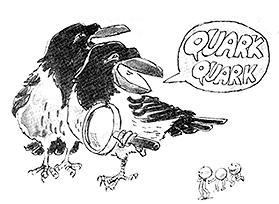
Do you know how the quark got its name?
In 1963, Murray Gell-Mann and George Zweig suggested that hundreds of the particles known at the time could be explained as combinations of just three fundamental particles. Gell-Mann chose the name "quarks," pronounced "kworks," for these three particles, a nonsense word used by James Joyce in the novel Finnegan's Wake (Джеймс Джойс «Поминки по Финнегану»): "Three quarks for Muster Mark!"
Reading 2-B
Classification of Quarks
Read the passage below and write it down in your own words.
There are six different types of quarks known as flavors with three "color charges" each. There are the up, the down, the charm, the strange, the top, and the bottom quarks, each with a "red" charge, a "blue" charge, or a "green" charge. For every quark flavor there is a corresponding type of antiparticle, known as anti-quark that differs from the
23
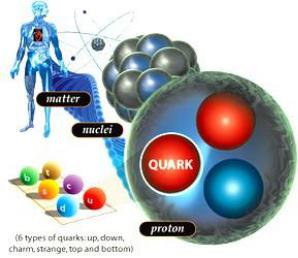
quark only in sign. There are six anti-quarks, each with "anti-color charges." The anti-colors are anti-green, anti-red, and anti-blue. So, there are in all 36 quarks.
Quarks have various properties, including electric charge, color charge, spin, and mass. Quarks are the only elementary particles which feel all four fundamental interactions, also known as fundamental forces (electromagnetism, gravitation, strong interaction, and weak interaction).
Reading 2-C
You are going to read a passage about neutrinos. Five sentences have been removed from the text. Choose from the sentences A-F the one which fits each gap (1-5). There is one extra sentence which you will not need to use.
A.But for a long time it was not known whether the neutrino had mass.
B.This discovery was of tremendous scientific importance because it radically changed our concept of the Universe.
C.Nobody doubted it any longer.
D.A solitary quark has never been observed.
E.One of them is the neutrino's fantastic penetrating capacity.
F.This makes the neutrino extremely difficult to detect.
24
The Mysterious Neutrino
The elementary particle called the neutrino from the Italian "little neutral one" was predicted in 1931 by the Swiss scientist Wolfgang Pauli. For а long time it remained just a hypothesis, and it was not before 1956 that American physicists С. Cowan and F.Reines made the first experiment in which а neutrino beam produced an observable effect. 1).____________.
Further studies revealed some very important properties of this particle. 2).____________. Neutrino beams fly through planets and stars without interacting with their matter. The reason is that the neutrino is electrically neutral. In fact, the neutrino is a lepton which has no electrical charge. It travels close to the speed of light, and is able to pass through ordinary matter almost unaffected. 3).____________.
It was established that neutrinos are created as a result of certain types of radioactive decay or nuclear reactions such as those that take place in the Sun, in nuclear reactors, or when cosmic rays hit atoms. 4).__________. In 1980 scientists at the Institute of Theoretical and Experimental Physics in Moscow managed to calculate the rest mass оf the electron neutrino - one of the three types of neutrino. The neutrino rest mass, which is approximately 35 electron volts (10,000 times less than the mass of the electron), was determined on the basis of analyzing the energy spectrum of electrons resulting from the radioactive decay of tritium. 5).____________.
Reading 2-D
Nanotechnology
You are going to read five paragraphs about nanotechnology. Choose the most suitable heading from the list A-F for each part (1-5). There is one extra heading which you do not need to use.
A.Graphite Versus Diamonds
B.Apocalyptic Scenarios
C.It’s a Small World
D.Products with Nanotechnology
E.Nanowires and Nanotubes
F.How New is Nanotechnology?
25