Материал: Аврамова NUCLEAR ENGLISH 2013
Enjoy the poem:
The well-known rhyme "This is the House that Jack Built" was parodied on the occasion оf Niels Bohr's birthday. Enjoy the poem below.
The Atom that Bohr Built
(With apologies to 'Jack' from Bohr's colleague, Professor Ru-
dolph E. Peierls)
This is the atom that Bohr built. This is the nucleus
That sits in the atom That Bohr built.
This is the drop that looks like the nucleus That sits in the atom
That Bohr built.
These are the compound levels galore That make up the spectrum
That's due to the modes That belong to the drop That looks like the nucleus That sits in the atom
That Bohr built. This is the shell and this is the core
That possesses the compound levels galore That make up the spectrum
That's due to the modes That belong to the drop That looks like the nucleus That sits in the atom
That Bohr built.
This is correspondence (as Bohr said before) That holds in the shell as well as the core That possesses the compound levels galore That make up the spectrum
That's due to the modes That belong to the drop That looks like the nucleus That sits in the atom
That Bohr built.
16
This is the day we celebrate Bohr
Who gave us the complementarity law
That gives correspondence (as Bohr said before)
That holds in the shell as well as the core
That possesses the compound levels galore
That make up the spectrum
That's due to the modes
That belong to the drop
That looks like the nucleus
That sits in the atom
That Bohr built.
The poem was translated into Russian by the Soviet and American scientist Valentin Turchin, a co-author of the book Physicists Continue to Laugh («Физики продолжают шутить»).
Атом, который построил Бор
Вот атом, который построил Бор. Это – протон, Который в центр помещен
Атома, который построил Бор. А вот электрон,
Который стремглав облетает протон, Который в центре помещен Атома, который построил Бор.
Вот мю-мезон, Который распался на электрон,
Который стремглав облетает протон, Который в центре помещен Атома, который построил Бор.
А вот пи-мезон, Который распавшись дал мю-мезон,
Который распался на электрон, Который стремглав облетает протон, Который в центре помещен Атома, который построил Бор.
17
А вот дополнительность. Это закон,
Который Бором провозглашен. Закон всех народов, Закон всех времен,
Успешно описывающий с двух сторон Не только протон И электрон, Но также нейтрон, Фотон, Позитрон, Фонон, Магнон, Экситон, Полярон, Бетатрон, Синхротрон, Фазотрон, Циклотрон, Циклон, Цейлон, Нейлон, Перлон, Одеколон, Декамерон,
И, несомненно, каждый нейрон Мозга, которым изобретен Тот замечательный беватрон,
В котором ускорился тот протон, Который в ударе родил пи-мезон, Который распавшись дал мю-мезон, Который распался на электрон, Который стремглав облетает протон, Который в центре помещен Атома, который построил Нильс Бор!
18
UNIT 2
Reading 2-А
Quark Hypothesis
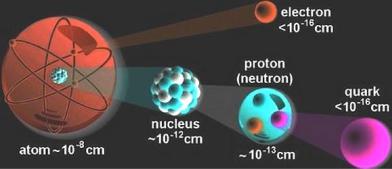
1.The word "atom" means “indivisible”, and it was once thought that аtoms were the ultimate, indivisible constituents of matter, that is, they were regarded аs elementary particles. One of the principal achievements of physics in the 20th century was the revelation that the atom is not indivisible or elementary, but has а complex structure. In 1911 Ernest Rutherford showed that the atom consists of а small, dense nucleus surrounded by a cloud of electrons. It was later revealed that the nucleus itself can be broken down into discrete particles, the protons and neutrons, and since then а great many related particles have been identified. During the past few decades it has become apparent that those particles, too, are complex rather than elementary.
2.They are now thought to be made up of simpler things called quarks. А solitary (одиночный) quark has never been observed, in spite of many attempts to isolate one. Nonetheless, there are excellent grounds for believing they do exist. More important, quarks seem to be truly elementary.
3. Subatomic particles can be classified into large families according to the kinds of interactions they participate in, or according to the kinds of forces they "feel." These forces are: gravitation, electromagnetism, the strong force and the weak force. All particles except the photon are classified according to their response to the last two forces. Those that feel the strong force are called hadrons (from the Greek word meaning "large'");
19
those that do not feel the strong force but do respond to the weak force are called leptons. There are just six of them: the electron and the electron neutrino, the muon and the muon neutrino, the tau lepton and the tau neutrino (and their six antiparticles). The leptons give every indication of being elementary particles. The electron, for example, behaves as а point charge, and even when it is studied at the energies of the largest particle accelerators, no internal structure саn be detected.
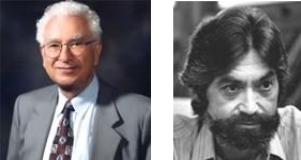
4. The hadrons, on the other hand, seem complex. They have а measurable size of about 10-13 centimeters. Moreover, there are hundreds of them, and most of them are massive and unstable. It was in an effort to explain this great variety of particles that the quark hypothesis appeared. It was introduced independently in 1963 by Murray Gell-Mann and by George Zweig, both of the California Institute of Technology.
Murray Gell-Man (left) and George Zweig (right)
5. The quark model states that a quark is an elementary particle and a fundamental constituent of matter. Quarks combine to form particles called hadrons, the most stable of which are protons and neutrons, the components of atomic nuclei. Quarks are never found in isolation; they can only be found within hadrons. When the quark hypothesis was first proposed, there were supposed to be three kinds of quark. The revised version of the theory requires 18 kinds (and 18 anti-quarks). In the terminology that has evolved for the discussion of quarks they are said to come in six flavors, and each flavor is said to come in three colors. ("Flavor" and "color" are, of course, arbitrary labels; they have no relation to the usual meanings of those words).
20