Материал: voronina_ev_sotsialnokulturnaia_sfera_obshcheniia
1. Lead-in
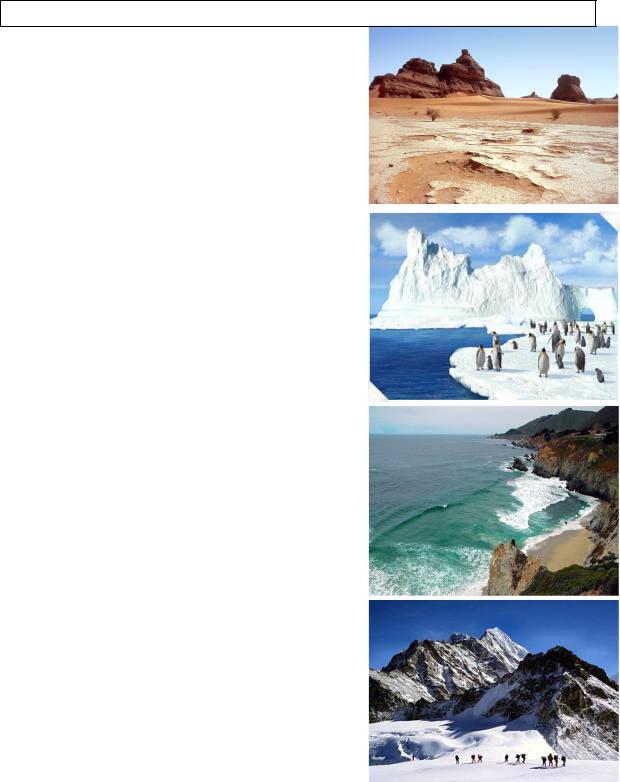
1.a Look at the information about four travel books by Michael Palin. Match the books with photos A-D.
1)Pole to Pole is about a 141-day journey from the North Pole to the South Pole.
2)Himalaya is the story of a journey across
the world’s greatest mountains, from |
A |
Afghanistan to China. |
3)Sahara is about a journey across the desert that is the size of the USA and covers ten different countries.
4)Full Circle is the story of a 50,000km trip round the Pacific Ocean. The writer visited 17 countries on four continents.
1.b These extracts come from the four |
|
||
books. Match each extract with one of the |
B |
||
books. |
|
|
|
A. The air is still, and a watery sun gives the |
|
||
place a lonely feel. The temperature is minus |
|
||
25 degrees Co. They say this is warm. |
|
||
B. We are out of the crowded Asian Pacific |
|
||
area and into the great empty spaces of |
|
||
Australasia. In Java there are 850 people for |
|
||
every square kilometer of land; in Australia, |
|
||
just over two. |
|
|
C |
C. Everest Base Camp is nowhere near as |
|||
romantic as it sounds. In high season, |
|
||
between June and August, this area is packed |
|
||
with mountaineers and trekkers. This year |
|
||
there were 32 separate expeditions. |
|
||
D. Morocco has changed colour. The greens |
|
||
and golds of the north have become a line of |
|
||
pale yellow trees running beside the road. |
|
||
Beyond them, the land is brick-red and bare. |
D |
||
1.c Read the book extracts and find |
|||
adjectives with these meanings. |
|
||
Extract A |
1 not moving |
2 sad and alone |
|
Extract B |
3 full of people |
4 with nothing in it |
|
Extract D |
5 light, not strong colour 6 not covered, nothing there |
||
|
|
56 |
|

1.d Match the adjectives in ex. 1.c with the best pair of nouns below.
1 |
_____ city/train |
3 |
_____ room/bottle |
5 |
_____ feet/wall |
2 |
_____ face/colour |
4 |
_____ person/life |
6 |
_____ lake/water |
2. Reading
2.a What famous explorers do you know?
2.b Read the interview with Michael Palin and put the questions 1-6 in the right place (a-f).
1 Which countries have your visited?
2 How many books have your written?
3 What have you learned from your different trips?
4 What’s the best place that you’ve visited?
5 When did you become a travel writer?
6 Have you eaten any unusual things?
Around the world with Palin by Stuart McCarthy
Michael Palin has visited many countries and he has become one of our most popular travel writers. I asked him about his fascinating life. a)______________________________________________________________
When I was 42, in 1988. I made a TV series – Around the world in 80 days – and wrote a book about that trip, and so I started this great career.
b)___________________________________________________________
I’ve written six travel books – one for each TV series.
c)______________________________________________________________
Perhaps you should ask which countries I haven’t visited! I’ve travelled from the North Pole to the South Pole, and across every continent. A very lucky man!
d)______________________________________________________________
Oh, definitely. I’ve eaten insects and a snake. I ate that when I was in China, in 1985. It tasted like chicken.
e)______________________________________________________________
Ah, my favourite place is in Peru – the river near Machu Picchu. It’s the most wonderful, magical place I’ve ever been to in all my travels.
f)______________________________________________________________
The most important thing that I have learned is that people are warm, kind and fun all over the world, and that a smile really is universal.
2.b Are this sentences true or false?
1 He wrote his first travel book after he made a TV travel series.
57

2 He has made six TV travel series.
3 He has never visited South America.
4 He ate insects in 1985.
5 His favourite place is in Africa.
6 He thinks there are friendly people everywhere.
Grammar: Present perfect and past simple
2.c Look at these sentences and answer the questions.
a)I made a TV series when I was 42.
b)I’ve travelled across every continent.
c)I’ve written six books.
d)I wrote a book in 1988.
1 Which sentences give the time when Michael Palin did something? 2 Which tense do we use when we give the time we did something?
3 Which tense can we use when we do not give the exact time we did something? 4 How do we form the present perfect and the past simple tense?
Grammar tip: I’ve been=I’ve gone and I’ve come back
2.d Complete this personal travel history with the present perfect or the past simple.
I 1)_______(visit) many different countries but I 2) ________ (not go) to South America and Africa – I hope to go there soon. I first 3) ________ (go) abroad in 1991. I went to France with my school and two years later I 4) ________ (visit) Spain – my favourite country. I also love Asia. I 5) ________ (work) in China and I 6) ________ (visit) Thailand and Japan. I 7) ________ (work) in China in 2003 – I 8) ________ (have) a wonderful time because it 9) ________ (be) so different from my country. Finally, last year I 10) ________ (study) at film school in New Zealand – that was great!
3. Speaking
3.a Do you know what places are shown in the pictures A-F? Find the places’ names in the list below in ex. 3.b.
58
A 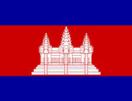 B
B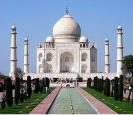 C
C 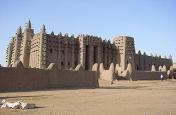
D 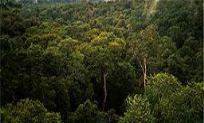 E
E 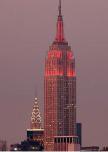 F
F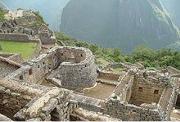
3.b Work with a partner and match the places with the encyclopaedia entries about them.
With your partner discuss the following:
have you ever been to any of them, or seen any of them?
what else do you know about them?
1 |
Heathrow Airport |
9 Mount Fuji |
|
2 the North Pole |
10 |
Uluru (Ayers Rock) |
|
3 the South Pole |
11 |
Easter Island |
|
4 |
Table Mountain |
12 the Grand Canyon |
|
5 the Coliseum |
13 |
Machu Picchu |
|
6 the Taj Mahal |
14 the Empire State Building |
||
7 the Great Wall of China |
15 the Amazon Forest |
||
8 |
Angkor Wat |
16 the Djenne Mosque |
|
A a steep-sided gorge carved by the |
K a volcanic island in the Pacific, |
Colorado River in the United States in |
discovered on Easter Sunday, 1722; |
the state of Arizona |
noted for the remains of an aboriginal |
|
culture, which includes gigantic stone |
|
figures. |
B a large isolated desert rock, |
L the largest mud brick building in the |
sometimes described as the world's |
world and is considered by many |
largest monolith, in the Northern |
architects to be the greatest |
Territory of Australia: sacred to local |
achievement of the Sudano-Sahelian |
Aboriginal people. Height: 330m. Base |
architectural style |
circumference: 9 km |
|
59

C a moist broadleaf forest that covers |
M a ruined Incan city in the south of |
most of the Amazon Basin of South |
Peru |
America |
|
|
|
D a 102-story landmark Art Deco |
N an extinct volcano in central Japan: |
skyscraper in New York City at the |
the highest mountain in Japan, famous |
intersection of Fifth Avenue and West |
for its symmetrical snow-capped cone. |
34th Street |
Height: 3776 m. Also called: Fujiyama |
E the southernmost point on the earth's |
O a large area of ruins of the former |
axis, at the latitude of 90°S |
Khmer Empire in Cambodia |
F a white marble mausoleum in central |
P a wall in China from Gansu to the |
India, in Agra: built (1632-43) by the |
Gulf of Liaodong, constructed in the |
emperor Shah Jahan in memory of his |
3rd century BC as a defence against the |
beloved wife, Mumtaz Mahal |
Mongols. Length: over 2400 km; |
|
height: 6 m; width: 6 m |
I the largest and busiest airport in the |
Q a mountain in South Africa, |
United Kingdom |
overlooking Cape Town and Table |
|
Bay: flat-topped and steep-sided. |
|
Height: 1087 m (3567 ft.) |
G the northernmost point on the earth's |
R an amphitheatre in Rome built about |
axis, at a latitude of 90°N |
75-80 A.D |
3.b Listen to a woman talking about one of the places. Which place is it?
3.c Listen again. What does she say about it? Make notes.
1 first view of it:
2 visits to it:
3 reasons for liking it:
3.d Work with a partner to share your travelling experience.
Student A: Talk about your last holiday for about one minute.
Student B: Listen to your partner. Ask questions to get more information.
3.e Choose six places from ex. 3.a that you would like to visit (you have to choose from at least three continents). Think of the reasons for visiting them. Then tell a partner about them.
4. Language skills
Grammar: the Reported Speech
4.a Work with a partner to discuss the following.
Do you prefer to go abroad for your holidays or stay in your own country?
What kinds of places do you like to visit on holiday?
60