Материал: voronina_ev_sotsialnokulturnaia_sfera_obshcheniia
2. Listening
2.a Listen to these people talking about how they use computers at work and write each speaker’s job in the table.
composer secretary
Speaker |
Job |
What they use computers for |
1 |
|
|
2 |
|
|
3 |
|
|
4 |
|
|
2.b Listen again and write what each speaker uses their computer for.
3. Reading
Pre-reading activities
3.a Work in pairs to answer the following questions:
1 What sort of difficulties do you think are experienced by computer users with limitations of vision or mobility?
2 What type of devices could be helpful to disabled users?
While-reading activities
3.b Match the FAQs (A-F) with the answers (1-6).
AHow can a blind person see a computer screen?
BHow can disabled people or very ill children make friends?
CWhat does a Picasso painting sound like?
DHow can you communicate with no words?
EHow can you use a computer with your mind?
FHow can disabled people become more independent?
46
Computers for the disabled
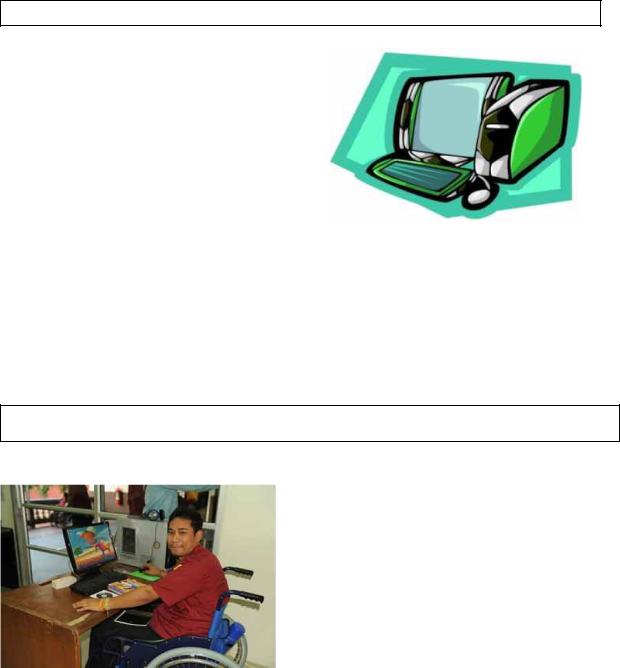
Can you hear or feel pictures? Can you move something without touching it? Dan Jellinek went to Los Angeles and found out that you can do all these things…and more.
Computers have started to change the lives of some disabled people. They can help them to communicate and to live more independently. The 14th international conference on computers and disabled people showed some exciting examples.
1.______________.
vOICe is a program that changes pictures into sounds. Different colours and shapes have different sounds. With practice, blind people can listen to the sounds and ‘see’ them by using their ears.
2.______________.
The program MouseCAT changes pictures into vibrations on the screen. Blind people can touch the screen and ‘feel’ the images. They can also use this program to speak – they write words and the computer says them.
3.______________.
Mindmouse can identify brain activity. It is like a hat. You put it around your head and operate the computer by thinking.
4.______________.
CharM is a computer system that can identify people’s emotions. In this way, people who can’t speak can communicate how they feel to other people. 5.______________.
Handy 1 is a robot arm with five different kinds of movement. It can help very disabled people do activities like eating and drinking.
6._______________.
It is often difficult for them to meet other children. DO-IT is an Internet program that helps them get help and support from other children who suffer the same problems.
Post-reading activities
3.c Read the article again. Write three ways computers can help disabled people. Example: Computers can help blind people to ‘see’ using…
3.d Work in groups and choose the most useful invention. Give your grounds.
_______________________________________________________________
_______________________________________________________________
_______________________________________________________________
_______________________________________________________________
_______________________________________________________________
47

Future forms
Future with will/won’t
To describe a decision made at the moment of speaking, often to make an offer.
I’ll help you with the books.
To talk about actions that will inevitably happen.
Next month I will be 23.
To talk about hopes, promises, fears, etc. especially with ‘expect’, ‘think’, ‘hope’, probably’, etc.
Electronic money will probably be more secure.
To make predictions when you don’t have ‘present evidence’.
People will vote in elections online.
Present Continuous
To describe fixed plans or arrangements (with a future time expression).
She is meeting the manager at 12.
Be going to + verb
To describe future intentions (not as definite as firm plans).
The company is going to open a new office in Rome.
To make predictions when you have ‘present evidence’ that
something is going to happen.
Look at the clouds; it’s going to rain.
Present Simple
To describe timetabled events, programmes, etc.
The plane leaves at 9.30.
4.a Revise the future form in the box. Then choose the correct answer.
1.I promise
a)I’ll buy you a 3G mobile phone.
b)I’m going to buy you a 3G mobile phone.
c)I’m buying you a 3G mobile phone.
2.A: Would you like to come to my party tomorrow?
B:I’m afraid, I can’t
a)I’ll meet Bob at the airport.
b)I’m meeting Bob at the airport.
c)I meet Bob at the airport.
3.In the near future Pcs
a)communicate with other devices without cables.
b)are going to communicate with other devices without cables.
c)will communicate with other devices without cables.
4.A: My laptop has crashed! B: Don’t worry!
a)I’m lending you mine.
48

b)I’ll lend you mine.
c)I’m going to lend you mine.
4.b Complete this conversation using the correct verb form.
Jorge: I hear you’re going on holiday next week. Carmen: Yes, we 1(go)_____to Paris. I can’t wait.
Jorge: I think you 2(love)_____Paris. How 3(you travel)_____? Carmen: Well, first we 4(fly)_____from Madrid and we 5(stay)_____in
Paris for five days.
Jorge: That sounds great! Are you going to any theme parks near Paris? Carmen: Yes, actually, we 6(visit)_____EuroDisney. After that, we are going to the south of France. We probably 7(stop)_____at
Futuroscope, near Poitiers. It’s a theme park based on new technologies, virtual reality, 3D images, …
Jorge: How lovely! When are you coming back home? Carmen: Well, I don’t know. I have a month’s holiday, so I hope we
Just 8(relax)_____by the sea for a few days and then …
4.c Write your own predictions about these topics.
1 Space tourism
e.g. There will be sightseeing trips to the Moon.
Yours:
2 The Internet
e.g. Everyone will have instant access to the Internet.
Yours:
3 Health and genetics
e.g. Electronic chips will be implanted inside our bodies to detect possible illnesses.
Yours:
4 Intelligent homes
e.g. Robots will do the house work for us. Yours:
5 Money/Holidays
e.g. Cash will disappear.
Yours:
Other future forms
Future Continuous (will be + present participle)
To talk about actions in progress at a stated future time.
This time next Saturday I’ll be skiing.
Future Perfect Simple (will have + past participle)
To talk about actions finished at a stated future time.
By the end of June I will have finished my exams.
49

Future Perfect Continuous (will have been + present participle)
To emphasize ‘how long’
By February I will have been working here for three years
4.d Look at the other future forms in the box. Translate these sentences into Russian.
1 Please don’t call tonight. I’ll be taking part in a videoconference. 2 He says he won’t have finished the report by Monday.
3 The technician will have repaired the computer by Friday. 4 Some day, we’ll be talking to our PC naturally, like a friend. 5 Next June she’ll have been teaching for 30 years.
6 In a few years’ time students will be using handheld and wearable computers in class.
4.e Expand these sentences using the Future Perfect Simple tense.
1 In ten years’ time/a lot of people/connect their television to the telephone line
2 Portable PCs/replace/desktop PCs/in a few years’ time
3 With the help of computers/doctors/find/cure/AIDS and cancer/by the year 2010
4 By this time next year/software manufactures/make/hundreds of new programs
5 By 2020/post offices and bookshops/disappear
6 By this time next year/I/buy/handheld computer
7 By the year 2030/robots/replace/human labour in industry
5. Speaking
5.a Think of a computerized machine you would like to invent. You may choose one of the machines below:
computerized fridge computerized car domestic robot computerized house
5.b Draw a picture of your machine and write notes to explain how it works.
Example: computerized fridge
What it does: speaks to you, phones shops to order more milk, eggs, etc. Advantages: more convenient, less work, etc.
How it works: you tell the fridge what you want, etc.
50