Материал: voronina_ev_sotsialnokulturnaia_sfera_obshcheniia
|
|
|
|
|
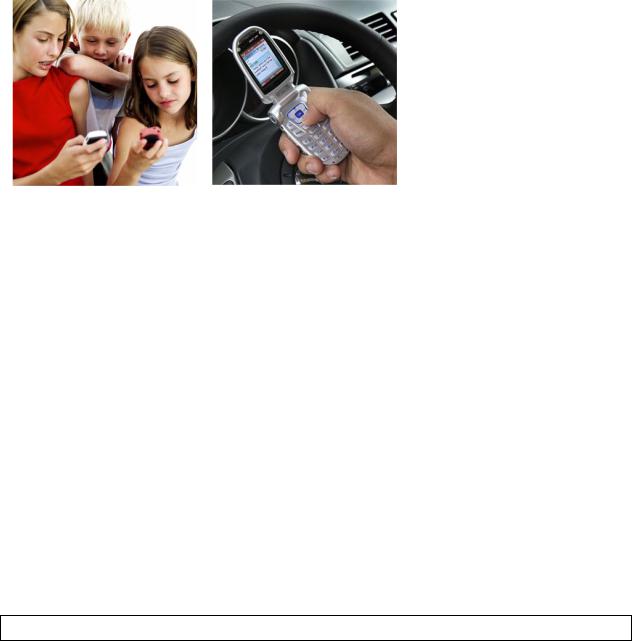
I think teachers should let us |
|
|
|
|
|
|
10) ________ text in classes. |
|
|
|
|
|
|
Over thousands of years our |
|
|
|
|
|
|
language has changed a lot. |
|
|
|
|
|
|
Text is a new type of the |
|
|
|
|
|
|
language and teachers 11) |
|
|
|
|
|
|
________learn it. |
|
|
|
|
|
|
Ahmed, 17, Bradford |
|
|
|
|
|
|
О Click here to add a |
|
|
|
|
|
|
comment. |
|
6.c Choose the best option and fill in the gaps in the text above. |
||||||
1 |
A |
effect |
B |
affect |
C |
improve |
2 |
A |
wrote |
B |
typed |
C |
passed |
3 |
A |
at |
B |
on |
C |
in |
4 |
A |
in |
B |
on |
C |
at |
5 |
A |
writing |
B |
write |
C |
written |
6 |
A |
However |
B |
That’s why |
C |
As a result |
7 |
A |
as a result |
B |
however |
C |
although |
8 |
A |
communicate |
B |
write |
C |
type |
9 |
A |
allowed to |
B |
let to |
C |
allowed |
10 |
A |
using |
B |
to use |
C |
use |
11 |
A |
can |
B |
need to |
C |
should |
6.d Work with a partner to discuss the following.
1Texting seriously affects young people’s ability to write good English.
2Texting will be permitted in exams within five years.
3Students will soon prefer to study British English rather than American English.
4In twenty years’ time, nobody will write letters.
7. Writing
Personal letters
7.a Match the functions in column A with the phrases in column B. |
|
||||
1 |
A |
A |
Dear + first name, |
B |
|
Asking about them |
|
|
|||
2 |
Giving news |
B |
Hi! How are things? |
How are you? |
How’s it |
|
|
|
going? |
|
|
3 |
Making suggestions |
C |
Great news about … |
Glad to hear that … Sorry to |
|
|
|
|
hear about … |
|
|
4 |
Name |
D |
Listen, did I tell you about … You’ll never believe |
||
|
|
|
what … Oh, and another thing. |
|
|
5 |
Referring to their news |
E |
Why don’t you … ? |
Maybe you could … How |
|
|
|
|
about …? |
|
|
6 |
Signing off |
F |
Well, got to go now. |
Give my love to … |
Say hello |
101

|
|
|
to … See you soon! |
|
|
7 |
Closing expressions |
G |
Love, |
Lots а love, |
Yours, |
8 |
Greeting |
H |
Your first name |
|
|
7.b You have received a letter from your English-speaking friend Julie who writes:
Hello Petya!
How are you? How are your English lessons going?
I started studying a foreign language this year at the university. It's pretty challenging for me. It took us a long time to learn to read and pronounce sentences with correct Russian intonation. I've gotten better at it, but it isn't easy. There are new challenges, such as conjugating verbs and declining nouns. It's crazy! Would you be able to help me? Could you give me any tips on how to handle these challenges?
Yours,
Julie
Write a letter to Julie (100-140 words). In your letter:
answer her questions,
ask at least 3 questions about learning languages in her university/country.
102

Unit 9
Customs and Traditions
In this module you will:
Read about traditional festivals in different countries
Talk about parties
Test your knowledge about Scotland
Practise making suggestions and advice, asking for ideas, responding to suggestions, congratulating
Listen to a programme about April Fool’s Day
Write theses to give an oral presentation
Learn how Christmas is celebrated in different countries
Useful vocabulary:
Nouns |
festival, dance show, music concert, championship, parade, |
|
celebration, bonfire, firework, feast, going-away party, reception, |
|
parade, barbecue, fancy dress party, house-warming party, sit- |
|
down meal, hot drinks, snacks, soft drinks, practical joke, event, |
Verbs |
competition |
take place, take part, celebrate, commemorate, |
|
Adjectives |
traditional, international, national, folk |
Phrases and |
to dress casually/smartly, to wear formal/casual clothes, to bring a |
collocations |
drink, to give presents, to listen to/make speeches, to play music, |
|
to sing songs, to join in the fun, all over the world, to play a |
|
joke/trick on sb, to be taken in by |
103
1. Lead-in
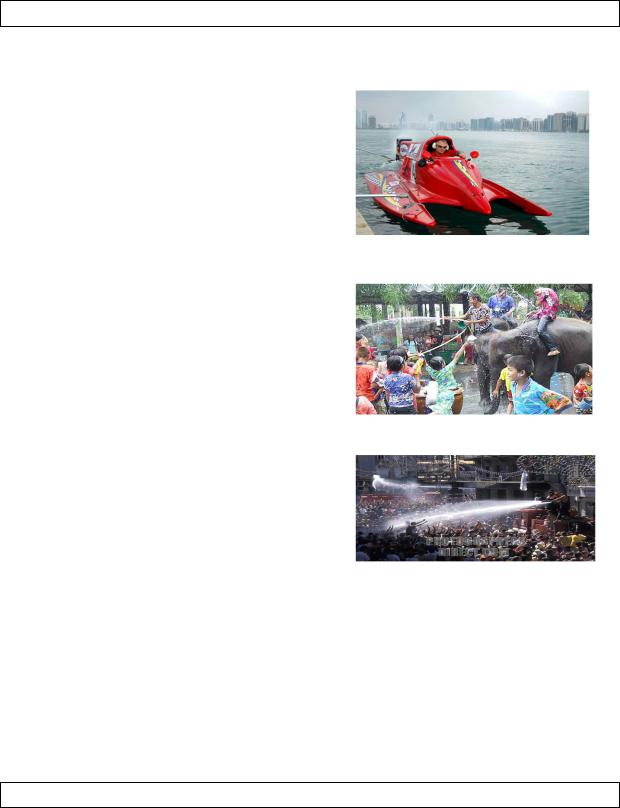
1.a Read about the water festivals and match the photos A-C with the festivals 1-3.
1. The Songkran Water Festival A
This festival is the start of the Thai New Year in April. On day one, Thais clean their houses, visit temples with food and visit old relatives. Day two is the famous ‘water-throwing day’ when people throw water at each other. No one is safe – not even police officers! On day three, there are dance shows and music concerts.
2. The Abu Dhabi F1 Water Festival |
B |
This five-day festival in December is part |
|
of the World Powerboat Championship. |
|
There are a lot of races and competitions |
|
(powerboat, water ski jumping and jet ski) |
|
for international teams. The festival starts |
|
with big parade, there is a large show and |
|
there is a lot of international food. |
|
3. The Vilagarcia Water Festival |
C |
This festival takes place on August 16th in |
|
northern Spain. After a parade people in |
|
the houses throw water on the people in |
|
the streets. After this, there is a drum |
|
dance and then the people jump in the sea! |
|
1.b Complete the table with information about the festivals.
Festival |
Month |
Days |
Activities |
Songkran |
|
|
|
|
|
|
|
|
|
|
|
2. Reading
Pre-reading activities
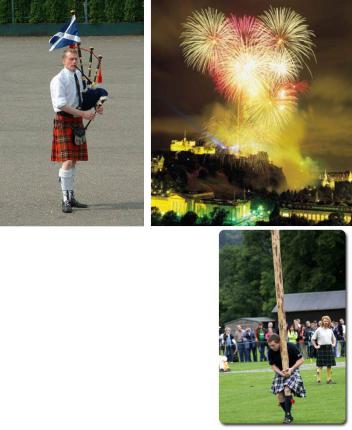
2.a Look at the photos below. What do you know about Scotland? Work in pairs and try to answer these questions.
104
1What is the capital of Scotland?
2How do Scottish people celebrate the New Year?
3What is Scotland’s national dish?
4What happens at the Edinburgh Festival?
5What are the following?
abagpipes
bfirst footing
ca kilt
dtossing the caber
While-reading activities
2.b Read about Scotland and check your answers for ex. 2.a.
Scotland – A place to celebrate
Scotland is famous for its own culture. Here are some of the ways visitors to Scotland can join in the fun.
Hogmanay, 31 December
Scotland celebrates Hogmanay, the New Year, with the music of bagpipes, Scotland’s traditional instrument, and dancing in the street throughout the night. At midnight, there are fireworks and everyone sings ‘Auld Lang Syne’, a song by Robert Burns, a famous Scottish poet. Soon after midnight, Scottish families go ‘first footing’, visiting the houses of friends and relations to continue the celebrations!
Burns Night, 25 January
Robert Burns is Scotland’s national poet and Scottish people have a big dinner every year to celebrate his birthday. The main part of the meal is ‘haggis’, Scotland’s national dish made from liver, cereals and fat served in a sheep’s stomach. Then everyone reads poems and sings songs written by the great ‘Rabbie’ Burns himself.
The Edinburgh Festival,
August
Edinburgh is famous all over the world for its arts festival. There is an official festival for theatre, opera and classic music, and the ‘Fringe’ festival where you can see a large variety of plays, films, comedians, dance companies and concerts. Finally, there is the Military Tattoo, a military parade held in Edinburgh Castle.
The Highland Games,
May-September
Nearly every weekend in the summer, there are highland games somewhere in Scotland but the biggest games are at Cowal. People from all over the world come to watch or take part. Over three thousand bagpipes and drummers play all day and there is a wonderful atmosphere. There are highland dancing competitions as well as events like throwing the hammer or ‘tossing the caber’
– throwing a large tree-trunk as far as possible! All the athletes wear traditional skirts called kilts.
105