Материал: voronina_ev_sotsialnokulturnaia_sfera_obshcheniia
3.g. Ask and answer questions with a partner about places in your (area) of the city, using the words from the vocabulary section? Use the model below.
-Is there a cinema in ….?
-Yes, there’s.
/- No, there isn’t.
-Are there any parks in ….?
-Yes, there are some/a lot of.
/- No, there aren’t any.
4. Speaking: On the street
4.a Complete the text with the words in the box.
language famous gardens city population students England
CITY FOCUS: CAMBRIDGE
Cambridge is a famous university 1) ________ in the UK. It’s in the east of 2)
________, 80 kilometres north of London. It’s a small city with a 3) ________ of 110,000. Cambridge is a beautiful city, and very green, with many parks and 4)
________. There are 31 colleges in the University of Cambridge – King’s and Trinity are two 5) ________ colleges. There are 17, 000 6) ________ at the university. There are also a lot of English 7) ________ schools in the city.
4.b Listen to talk. Where are the people?
at a university
at an English language school
on a tour bus
4.c Listen again and tick the words you hear.
colleges |
shopping |
railway |
bookshops |
centre |
station |
post office |
car park |
library |
university |
bus |
tourist |
market |
station |
information |
|
public |
centre |
|
toilets |
zoo |
|
park |
gardens |
4.d Listen again and choose the best words to complete the sentences.
1The bookshop is
a)in Trinity College.
b)opposite Trinity College.
c)next to Trinity College.
2The market is
a)next to Trinity College.
b)in the shopping centre.
c)between Trinity College and the main post office.
3Bus station is
a)next to the park.
b)opposite the main post office.
c)between the main post office and the market.
4 The library is
a)opposite the bus station.
b)in the shopping centre.
c)between King’s College and the tourist information centre.
11
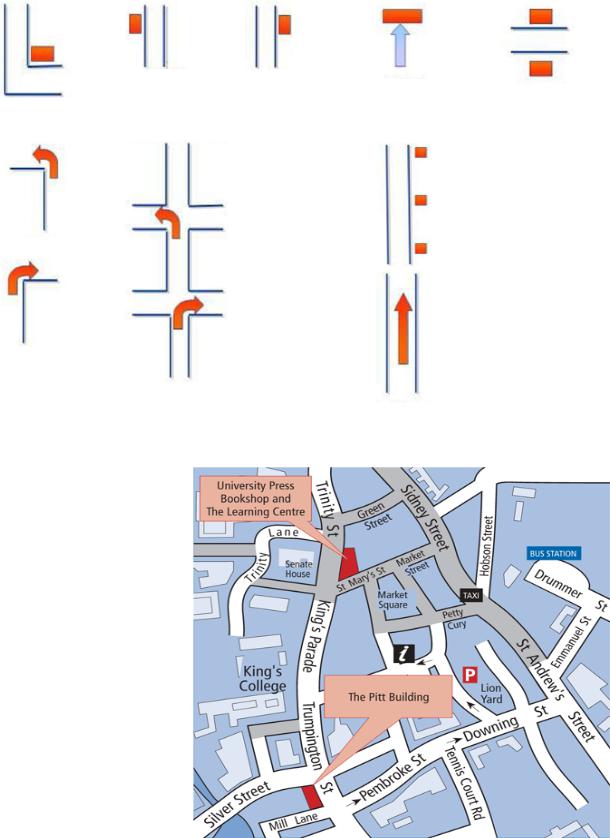
4.e Look at the pictures and expressions below. Translate them into your language.
on the left |
on the right |
as far as |
opposite |
|
on the corner |
|
|
||
|
|
|
|
|
of |
|
|
|
at the end of |
|
|
|
|
|
|
take |
the |
|
half way down |
turn left |
second |
|
|
|
turning on the |
|
at the beginning of |
||
|
|
|||
|
left |
|
|
|
|
take the |
first |
|
straight ahead |
turn right |
|
|
||
turning on the |
|
|
||
|
|
|
||
right
4.f Look at the map of Cambridge and make true sentences using the prepositions and the phrases below.
between
next to
in
opposite
It’s on the left/ right of the map.
It’s on the left/ right of the library.
It’s at the top/ bottom of the map.
12
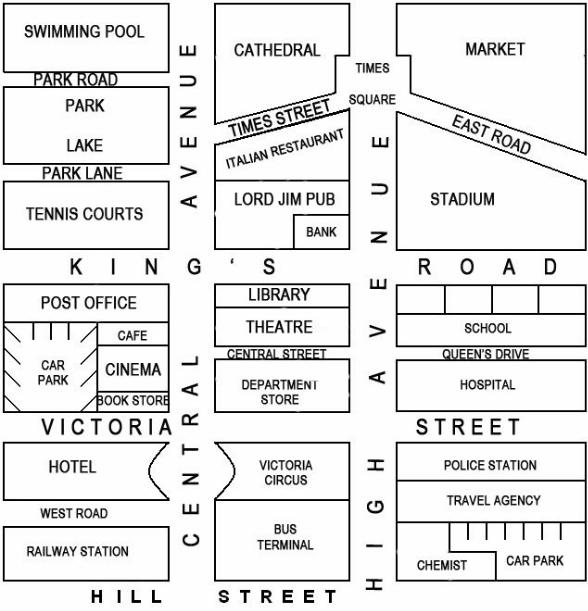
4.g Using the expressions above and the map below do the following tasks.
1.Work in pairs. You are in the Travel Agency, in High Avenue. Ask about facilities: Is there a post-office near here? Are there any banks in the town?....
Ask for directions: Where´s the ….? How can I get to ….? Can you tell me the way to …?
Your partner answers about facilities and gives you the directions.
2.Imagine you live in the corner of 3. Your friend is at the railway station.
East Road and Times Square. A friend |
She/He rings you up because she/he |
of yours comes to visit you. Write him |
hasn´t got your letter with him/her. Act |
an e-mail describing her/him how to get |
out a short dialogue. |
to your house from the railway station. |
|
13
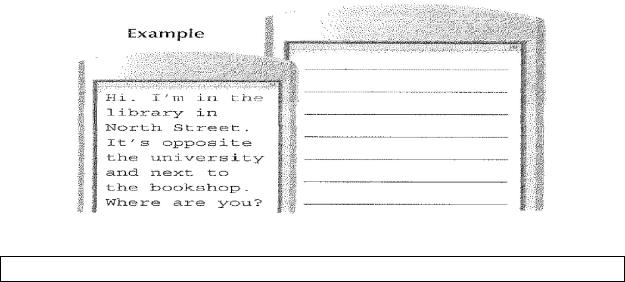
4.h Where are you now? Write a text message to your friend.
5. Reading
Pre-reading activities
5.a Listen to the beginning of the tale and guess its topic.
endangered animals eating habits country vs. city living living conditions
5.b Put the following sentences into the correct order.
a‘That’s just my neighbour – the dog, he wants to join us for dinner.’
bSo one day, he invited his country cousin to stay with him in his town house.
cThe town mouse was a very superior mouse, who thought that living in the town was far better than living in the country.
d‘Thank you, but I think I will return to the peace and quiet of my own house after all!’
eThey sat down to a meal, which to the country mouse was a feast.
While-reading activities
5.c Read the continuation of the story and choose the correct sentence from A-F to fill in gaps 1-5. There is one sentence that you won’t need to use.
AConversely, the introduction of city parks and forests, and traffic free zones, has helped in bringing a little of the countryside to the city streets.
BAfter work she meets with friends in a bar or restaurant before going on to a disco or nightclub.
CAlex, however, lives in a small village in the countryside.
DWhen you are tired of the noise, the traffic, and the stress, try to find peace and quiet.
EMore than half the world’s population now lives in cities.
14
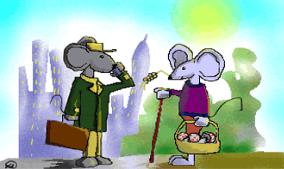
F Today, many town dwellers wish to reverse this trend and return to a slower pace of life like Alex, out modern ‘country mouse’.
Town or country mouse?
by John Russell
This simple tale (taken from Aesop’s famous stories) shows that what may be a good place to live for one person, may not be good for another. A modern version of this story might look like this: Maria lives in a big city surrounded by the speed and convenience of urban life. She works in an office with 1000 other employees, and travels too and from there on a crowded Metro. Her home is a flat overlooking a busy city-street, which is always alive with the sound of traffic and people passing by. 1) _____________
Weekends are spent in the shopping mall with its numerous shops, multiscreen cinemas, fast food and entertainment complexes.
2)
_________________________
He cycles to work down country lanes every morning, the sound of tractors, birds and animals in his ears. In the evening, he relaxes at home in front of the fire with a good book to read. At weekends, he goes for long walks in the fields with his dog.
Unfortunately, life is not as simple as stories make it. A lot of today’s ‘town mice’ such as Maria would be happy to live in the country. Many modern cities have very large populations (Tokyo or Mexico City - over 25 million) and can be crowded, dirty and dangerous places to live.
3)____________________ In much of Europe and North America this can be as high as much as 80% of a country’s population. (According to the United Nations, approximately 1 billion people in cities are living in slum conditions – overcrowded and unhealthy).
The 18th Century marked the beginning of the Industrial Revolution, the depopulation of the countryside, and the move to towns. The towns became places of mass employment in factories and offices.
4)_______________ Yet, a modern country existence is not without its problems; poor transport, lack of access to hospitals and education, and services found in towns such as large shops, banks and entertainment.
The debate between town and country is meaningless these days, as so many people live in towns, and very few people are actually able to choose where they live; this is dictated by their work or birth. The internet and other mass media have linked country areas to the world, providing access to information – even to remote areas. If countryside, other benefits of the city need to be
15