Материал: voronina_ev_sotsialnokulturnaia_sfera_obshcheniia
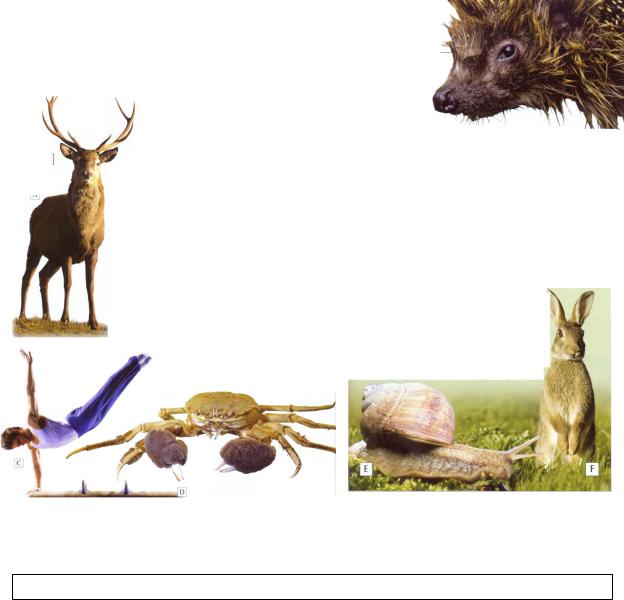
1.Lead-in
1.a Which of these animals can you see in the photos?
crab red deer elephant giraffe
gorilla hedgehog human leopard monkey panda rabbit snail squirrel tiger
1.b Which of the animals above do you have in your country? Which do you think are cute? Are any of them dangerous? Are any of them nearly extinct?
2.Reading
2.a Pre-reading activity
Look at the headline of the article below. What do you think the article is about?
2.b While-reading activity
Read the article and find out where these animals came from, where they invaded and who or what they caused problems for.
21
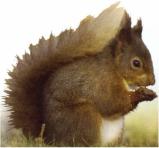
1 grey squirrels
2 red deer
3rabbits
4apple snails 5 mitten crabs
ANIMALINVADERS
Hоwmuchdangerarewein?Howmanymoanersarethere?
Imagine you run a small food shop in your local neighbourhood. Suddenly, a giant supermarket opens for business opposite your shop. What happens to you and your business?
In the natural world, things are often the same. The red squirrel was living happily in England when, in the 1880s, many people brought grey squirrels from North America as pets. Since then, these pets have escaped into the wild. They now eat the same food as the red squirrels, and they eat it more quickly. Consequently, now there aren't many native squirrels in England and they are in danger of extinction.
There are many invaders that don't cause extinctions, but they do destroy plants and harm the economy. For example, European red deer are destroying the forests in South America because they eat the young trees. Rabbits have spread from Europe and now eat farmers' crops all over the world. These kinds of invaders are causing problems for humans, unlike the grey squirrels,
which cause little damage to plants and don't damage the economy.
Few invaders are large land animals; most of them are fish or small animals like insects. There are thousands of these invaders and these smaller animals often mean farmers lose a lot of money. The apple snail from South America doesn't cause much damage in Europe, but it causes a lot of damage in southeast Asia because it loves to eat rice plants.
There are very few positive sides to these animal invasions. However, in Britain today, one invasion story offers some hope. Chinese mitten crabs first came on ships from China. These crabs destroy local environments and attack fish in fish farms. However, in China these crabs are an expensive food, so, now, Britain is selling them back to China. The crabs are travelling on ships again, but this time they are food, not invaders; and this time they are helping the British economy, not harming it.
22
2.c Post-reading activity
Read the article again and answer these questions.
1 |
What do you think happens to the |
5 |
Are there more large animal |
small food shop when a supermarket |
invaders than small ones? |
||
starts business? |
6 |
Why do you think the apple snail |
|
2 |
Is the red squirrel like the small |
doesn’t cause many problems in |
|
shop or the supermarket? |
Europe? |
||
3 |
Why did the grey squirrel come to |
7 |
Is it common to find good things |
Britain? |
about animal invasions? |
||
4 |
Do all invasive animals cause the |
8 |
Who is Britain selling mitten |
extinction of native animals? |
|
crabs to, and why? |
|
3. Language skills
Grammar: Expressing Quantity
3.a We can use a lot of with both countable and uncountable nouns. It means a large number or quantity. How do we use the other words in the box? Find and underline examples in the text.
a lot of few little many much
3.b Are these statements true or false? Use the examples you underlined in the text to help you.
1 We never use much in questions.
2 We often use many in positive sentences.
3 We don’t usually use much in positive sentences.
Instead, we use a lot of.
4 We never use much in negative sentences.
5 We can use many in questions and negative sentences.
3.c Complete this paragraph with much, many, a lot of, little or few.
There are many or a lot of animals that
are invaders, |
but perhaps there are |
2) ________ |
, if any, invaders that are |
worse than humans. 200,000 years ago there were very 3) __________
humans. Now there are nearly six billion of them. Unfortunately, there isn't 4) _________ information about the early history of this species, but it seems certain that the first humans
came from Ethiopia |
in east Africa. |
After 5) ___________ |
thousands of |
year (150-180) humans were living on every continent on Earth. How 6)
_________ damage have these invaders caused? They have destroyed 7) _____________ native plants and animals. Before humans, there was 8)
__________ pollution. Now, there is 9)
_________ pollution and it is causing 10) ___________ harm to the global environment. It seems that humans need to change things about their lifestyle if they want to survive.
3.d Use the sentence beginnings (or similar ones) to make true sentences about you.
23
In my country, there are many/is a lot of…
In my country, there are few/ is little…
In my house, there are many/ a lot of…
In my house, there aren’t many/isn’t much…
I’ve got many/a lot of…
I haven’t got many/much… I spend a lot of time…
I spend little…
3.e Ask your partner questions to find out if his/her life is similar to yours.
Have you got many pictures in your house?
Comparative – Superlative Degree
3.f Complete the table, then say how we form the comparative and superlative forms of adjectives and adverbs.
|
Comparative |
Superlative |
cheap |
cheaper |
………………………. |
large |
………………………. |
the largest |
big |
bigger |
………………………. |
noisy |
noisier |
………………………. |
busy |
………………………. |
the busiest |
expensive |
more expensive |
………………………. |
dangerous |
………………………. |
the most dangerous |
good |
………………………. |
the best |
bad |
………………………. |
the worst |
much/many |
more |
………………………. |
little |
………………………. |
the least |
far |
………………………. |
the farthest/the furthest |
3.g Look at the sentences. How do we form comparisons? When do we use as…as? When do we use than? When do we use more/less +adjective?
Cows are as big as horses. |
Snakes are more dangerous than |
Seals aren’t as smart as dolphins. |
spiders. |
Alligators are longer than lizards. |
Spiders are less dangerous than |
|
snakes. |
24
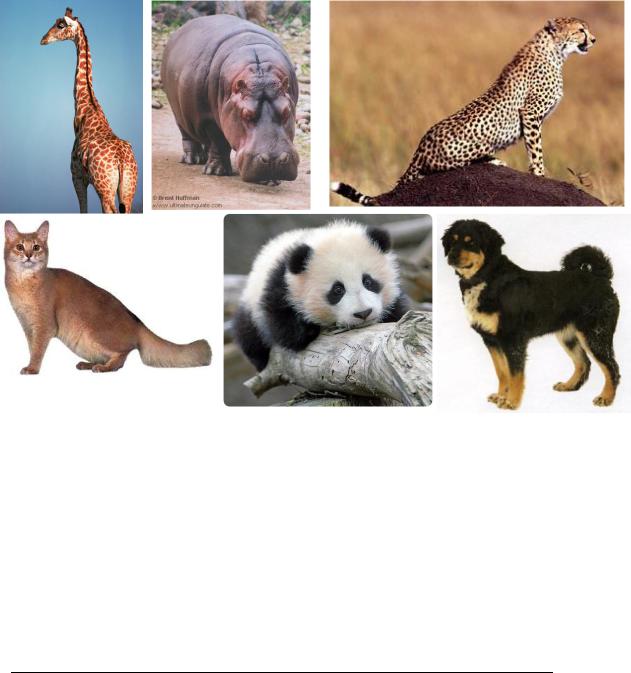
3.h Look at the pictures and compare these animals using as…as, less…than, more…than.
_________________________________________________________________
_________________________________________________________________
_________________________________________________________________
_________________________________________________________________
_________________________________________________________________
_________________________________________________________________
_________________________________________________________________
_________________________________________________________________
________
3.i Tick the correct sentence, as in the example.
1 a: A fish is less noisier than a cat. |
|
b: A fish is less noisy than a cat. |
V |
2a: Lions are not so big as hippos.
b:Lions are not as big as hippos.
3a: Going to the zoo is more entertaining watching TV.
b:Going to the zoo is more entertaining than watching TV.
4a: Cheetahs run faster than zebras.
b:Cheetahs run as fast than zebras.
5 a: Was the film as exciting as the book?
25