Материал: voronina_ev_sotsialnokulturnaia_sfera_obshcheniia

Tourist Information
Tourist 1_____. I’d like information about museums in London, 2_____ . Guide There are three hundred museums in London, you know! What do you want to
see?
Tourist Well, I’m 3_____science. Guide Ok, you can go to the Science
Museum. That’s a 4_____ . There are really interesting things to see.
Tourist Right. And when is it 5____?
Guide From ten in the morning until six in the evening. On Sundays, it opens at eleven and closes at eight.
Tourist How much are the 6_____ ? Guide Entrance is free!
Tourist That’s great! And 7_____do I get there?
Guide Well, you can get a bus or the tube. The tube station for the museum is South Kensington.
Tourist Where can I get a map? I don’t want to get lost.
Guide Here you are.
Tourist 8_____ .
Guide Not at all!
5.b Underline the phrases with the verb get in the dialogue. How do you say them in your own language?
5.c Work in pairs. Take turn to be a tourist and a guide in London. Use the brochure in ex. 1.d and the dialogue in ex. 1.a to ask and give information about places in London.
5.d Work in pairs. Complete the questions (1-6) to find out about your partner’s interests in art. Interview each other and tell the class your partner’s taste in art.
1 Do you go to galleries where … ?
2 Do you have friend (who) … ?
3 Do you like pictures that … ?
4 Do you often watch programmes (which) … ?
5 Do you like artists who … ?
6 Do you buy posters which … ?
6. Extra Activities
6.a You are going to read about a famous recluse. What is a recluse? Guess, then read the information below to check your answer.
A recluse is someone who:
a)likes media attention.
b)avoids media attention.
c)comes back after a period away from media attention.
Out of sight, out of mind?
In today’s multi-media age, it seems no artist with something to sell can afford not to do interviews and chat shows to publicise their latest product. People’s interest in celebrity means we often know more about the artists than their work. Below, our reporter Wendy Finch profiles the recluse from the world of the arts who decided not to play the media game. Why are we fascinated by the artists themselves when really their work should speak for them?
41
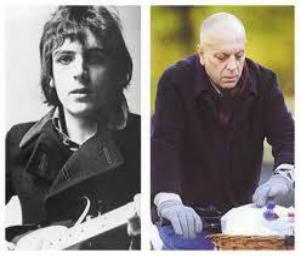
6.b Read more about one recluse and answer the questions.
1 How is the person’s character described in the article?
2 What is his most famous piece of work?
3 What did he do later in life?
4 How was his relationship with media?
5 Is there anything surprising in the article?
SYD BARRETT (1946-2006)
At the Pink Floyd reunion in London’s Hyde Park for Live8, there was one member missing.
Often called an eccentric genius, Syd Barrett formed the supergoup Pink Floyd in 1965 and wrote, sang and played guitar on all their early hit records, including the 1967 masterpiece Piper at the Gates Dawn. He left the band in 1968 after experiencing some kind of breakdown due to the pressures of stardom and touring. He made two solo albums, The Madcap Laughs and Barrett, both released in 1970, which continue to sell well.
Barrett then left the music business completely, deciding a musician’s life was not for him. He did not make any music at all after 1974. Once a household name, he is now more or less forgotten except by his fans. He moved back to his home town of Cambridge and started to use his original name of Roger Barrett.
He lived alone, quietly spending his time painting and gardening. He received a six-figure income from his Pink Floyd royalties, but his contact with the outside world was minimal. Although he hadn’t appeared or spoken in public since the mid1970s, fans and journalists still attempted to contact him.
In 1971 a journalist tracked him down. Syd told the reporter that he walked a lot, painted, wasted time and feared getting old. He also said that he felt full of dust and guitars. Another journalist reported that a bald, fat man answered the door and said that Syd couldn’t talk. In 1992, Atlantic Records offered half a million dollars for any new Syd Barrett recordings.
His family reported that he was content and reasonably healthy. More recently, when fans or journalists called on him he was polite and coherent, but unwilling to discuss his past as a famous rock star. Talking to one journalist on his doorstep in 2001, Syd asked him to leave as he didn’t do interviews any more.
42

6.c Find words or phrases in the text that mean the following.
aa very successful record or CD
ba great work of art
ca very well-known person
dpayments made to writer of a book, song, etc.
eto issue (a record, film, book, etc.) for sale or circulation
fthe fame and prestige of being a star in films, sport, etc.
ga person or thing that is very well known.
6.d In groups, discuss the following.
1What is so special about the person in this profile? Why can this profile be interesting?
2Do you think celebrities have the right to a private life?
3Which books, songs and films do you think are masterpieces?
4What rumours about media celebrities have you heard recently?
7. Writing: Project Work
7.a Get ready to give a two minute Power Point presentation about a famous recluse painter, singer, sculptor, etc.
Find some information about this person on the Internet or in magazines, books
Process and structure the information using the Power Point software
In your presentation, include visual aids together with the information about the person’s early life, later life
Present your findings to the class
43

Unit 4
The Age of Technology
In this module you will:
Read about computers for the disabled
Talk about invention of a computerised machine
Test your project-making skills
Practise using the future tense
Listen to people talking about how they use computers
Write a letter of complaint
Learn how to use the Web
Useful vocabulary:
Nouns |
technology, entertainment, network, icon, laptop, the disabled, |
Verbs |
bookmark, browser, favourites, link |
to fit, to upgrade, to connect, to operate, to click on, to download |
|
Adjectives |
interactive, virtual, wireless, computerised |
Linkers |
firstly, secondly, finally |
Phrases and |
Global Positioning System, touchscreen monitor, computer |
collocations |
addiction, cell phone, search engine, to chat online, to send emails |
44

1. Lead-in
1.a People who have grown up with PCs and microchips are often called the digital generation. Read what some people answered when questioned about the use of computers in their lives.
Computers: friend …
↓
‘I have a GPS, Global Positioning System, fitted in my car. With this navigation system I never get lost. And the DVD recorder is perfect for my children’s entertainment.’
‘I use an interactive whiteboard, like a large touchscreen monitor, at school. I find computers very useful in education.’
‘Assistive technology, for people with disabilities, has helped me a lot. I can hardly see, so I use a screen reader, a program that reads aloud onscreen text, menus and icons.’
‘This new HMD, head-mounted display, allows me to watch films, and enjoy virtual reality, the artificial environment of the latest video games.’
‘The upgraded wireless network at my university is great: we can connect our laptops, PDAs and Wi-Fi cell phones to the network anywhere in the campus. Communication is becoming easier and easier.’
or foe?
↓
‘Our society has developed technological dependence. When computers are down, our way of life breaks down: planes stop flying, telephones don’t work, banks have to close.’
‘Computers produce electronic waste, plastic cases and microchips that are not biodegradable and have to be recycled or just thrown away.’
‘They are responsible for health problems, e.g. computer addiction, an inappropriate and excessive use of computers.’
‘Cybercrime, crime committed with the help of computers, is creating serious problems.’
‘Citizens may feel a loss of privacy because of unauthorized use of personal data or receiving unwanted electronic messages.’
1.b Make a list of the ways your family uses computers at work and in your free time. Can you think of any problems that using computers might cause?
45