Материал: 100_Cases_in_Clinical_Medicine

CASE 32: ABDOMINAL PAIN
History
A 31-year-old woman has a 6-year history of abdominal pain and bloating. She has had an irregular bowel habit with periods of increased bowel actions up to four times a day and periods of constipation. Opening her bowels tends to relieve the pain which has been present in both iliac fossae at different times. She had similar problems around the age of 17 years which led to time off school. She thinks that her pains are made worse after eating citrus fruits and after some vegetables and wheat. She has tried to exclude these from her diet with some temporary relief but overall there has been no change in the symptoms over the 6 years. One year previously she was seen in a gastroenterology clinic and had a sigmoidoscopy which was normal. She found the procedure very uncomfortable and developed similar symptoms of abdominal pain during the procedure. She is anxious about the continuing pain but is not keen to have a further endoscopy.
She has a history of occasional episodes of headache which have been diagnosed as migraine and has irregular periods with troublesome period pains but no other relevant medical history. She is a non-smoker who does not drink alcohol. Her paternal grandmother died of carcinoma of the colon aged 64 years. Her parents are alive and well. She works as a secretary.
Examination
Examination of the cardiovascular and respiratory systems is normal. She has a palpable, rather tender colon in the left iliac fossa.
INVESTIGATIONS
|
|
Normal |
Haemoglobin |
11.9 g/dL |
11.7–15.7 g/dL |
Mean corpuscular volume (MCV) |
84 fL |
80–99 fL |
White cell count |
5.3 % 109/L |
3.5–11.0 % 109/L |
Platelets |
244 % 109/L |
150–440 % 109/L |
Erythrocyte sedimentation rate (ESR) |
8 mm/h |
!10 mm/h |
Sodium |
138 mmol/L |
135–145 mmol/L |
Potassium |
4.4 mmol/L |
3.5–5.0 mmol/L |
Urea |
4.2 mmol/L |
2.5–6.7 mmol/L |
Creatinine |
89 &mol/L |
70–120 &mol/L |
Glucose |
4.6 mmol/L |
4.0–6.0 mmol/L |
Question
• What is the most likely diagnosis and what investigations should be performed?
89

ANSWER 32
The pattern of the pain, the absence of physical signs, normal investigations and reproduction of the pain during sigmoidoscopy all make it likely that this is irritable bowel syndrome (IBS). This is a very common condition accounting for a large number of referrals to gastroenterology clinics. IBS is often episodic, with variable periods of relapse and remission. Periods of frequent defaecation alternate with periods of relative constipation. Relapses are often associated with periods of stress. In IBS it is common to have a history of other conditions such as migraine and menstrual irregularity. Under the age of 40 years with a history of 6 years of similar problems, it would be reasonable to accept the diagnosis and reassure the patient. However, the family history of carcinoma of the colon raises the possibility of a condition such as familial polyposis coli. The family history, the circumstances of the grandmother’s death and the patient’s feelings about this should be explored further. Anxiety about the family history might contribute to the patient’s own symptoms or her presentation at this time. If there are living family members with polyposis coli, DNA probing may be used to identify family members at high risk. If any doubt remains in this woman it would be sensible to proceed to a barium enema or a colonoscopy to rule out any significant problems.
The diagnosis of IBS relies on the exclusion of other significant conditions such as inflammatory bowel disease, diverticular disease or large-bowel malignancy. In patients under the age of 40 years it is usually reasonable to do this on the basis of the history, examination and a normal full blood count and ESR. In older patients, sigmoidoscopy and barium enema or colonoscopy should be performed. A plan of investigation and management should be clearly established. The symptoms tend to be persistent and are not helped by repeated normal investigations looking for an underlying cause. Symptoms may be helped by antispasmodic drugs or tricyclic antidepressants. Some patients will benefit from the consumption of a high-fibre diet.
KEY POINTS
•Irritable bowel syndrome is a common disorder and difficult to treat.
•Explanation of the condition to the patient is an important part of the management.
•Sigmoidoscopy with air insufflation often reproduces the symptoms of IBS.
90
CASE 33: HEADACHES AND CONFUSION
History
A 28-year-old black South African theatre nurse in London is admitted to the emergency department complaining of headaches and confusion. Her headaches have developed over the past 3 weeks and have become progressively more severe. The headaches are now persistent and diffuse. Her friend who accompanies her says that she has lost 10 kg in weight over 6 months and has recently become increasingly confused. Her speech is slurred. While in the emergency department she has a generalized tonic–clonic convulsion.
Examination
She is thin and weighs 55 kg. Her temperature is 38.5°C. There is oral candidiasis. There is no lymphadenopathy. Examination of her cardiovascular, respiratory and gastrointestinal systems is normal. Neurological examination prior to her fit showed her to be disorientated in time, place and person. There were no focal neurological signs. Funduscopy shows bilateral papilloedema.
INVESTIGATIONS
|
|
Normal |
Haemoglobin |
12.2 g/dL |
11.7–15.7 g/dL |
White cell count |
12.1 % 109/L |
3.5–11.0 % 109/L |
Platelets |
365 % 109/L |
150–440 % 109/L |
Sodium |
126 mmol/L |
135–145 mmol/L |
Potassium |
3.9 mmol/L |
3.5–5.0 mmol/L |
Urea |
6.2 mmol/L |
2.5–6.7 mmol/L |
Creatinine |
73 &mol/L |
70–120 &mol/L |
Glucose |
5.6 mmol/L |
4.0–6.0 mmol/L |
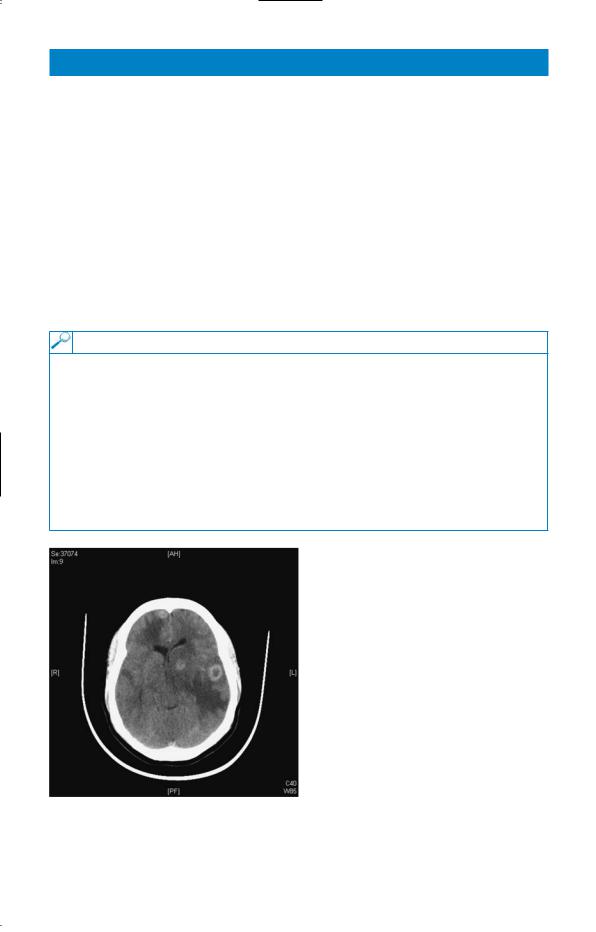
A computed tomography (CT) scan is shown in Fig. 33.1.
Figure 33.1 Computed tomography scan of the brain.
Questions
•What is the cause for this woman’s headaches, confusion and fits?
•What is the underlying diagnosis?
•How should this woman be further investigated and treated?
91

ANSWER 33
This woman has cerebral toxoplasmosis secondary to HIV infection. This condition is caused by the protozoan Toxoplasma gondii which primarily infects cats but can also be carried by any warm blooded animal. In the West, 30–80 per cent of adults have been infected by ingesting food or water contaminated by cat faeces, or by eating raw meat from sheep or pigs which contain Toxoplasma cysts. After ingestion by humans the organism divides rapidly within macrophages and spreads to muscles and brain. The immune system rapidly controls the infection, and the cysts remain dormant. The primary infection is generally asymptomatic, but can cause an acute mononucleosis-type illness with generalized lympadenopathy and rash. It may leave scars in the choroid and retina and small inflammatory lesions in the brain. If the host then becomes immunocompromised the organism starts proliferating causing toxoplasmosis. This is an AIDS-defining illness, but is relatively rare in solid organ transplant recipients. Cerebral toxoplasmosis usually presents with a subacute illness comprising fever, headache, confusion, fits, cognitive disturbance, focal neurological signs including hemiparesis, ataxia, cranial nerve lesions, visual field defects and sensory loss. Movement disorders are common due to involvement of the basal ganglia. CT or magnetic resonance imaging (MRI) will usually show multiple bilateral ring-enhancing lesions predominantly located near the grey–white matter junction, basal ganglia, brainstem and cerebellum. The clinical and radiological differential diagnoses include lymphoma, tuberculosis and secondary tumours. Anti-toxoplasma antibody titres should be measured, but are not always positive.
The other clues in this case to the diagnosis of HIV infection include the patient’s country of origin, the weight loss and oral candidiasis. The headaches and papilloedema are caused by raised intracranial pressure from the multiple space-occupying lesions. The hyponatraemia is due to the syndrome of inappropriate antidiuretic hormone (ADH) secretion (SIADH) consequent to the raised intracranial pressure.
This woman should be started on anticonvulsants to prevent further seizures. Treatment is started with high-dose sulfadiazine and pyrimethamine together with folinic acid to prevent myelosuppression. There should be a rapid clinical and radiological improvement. In cases that have not responded within 3 weeks, a biopsy of one of the lesions should be considered. Cerebral toxoplamosis is uniformally fatal if untreated, and even after treatment neurological sequelae are common.
The patient should be counselled about HIV infection and consented for an HIV test. Her HIV viral load and CD4 count should be measured, and antiretroviral drugs started. She should be advised to contact her previous sexual partners so that they can be tested and started on antiretroviral therapy. She should also tell her occupational health department so that the appropriate advice can be taken about contacting, testing and reassuring patients. The risk of HIV transmission from a healthcare worker to a patient is very small.
KEY POINTS
•Toxoplasmosis is the most common opportunistic infection of the central nervous system in patients with AIDS.
•Patients can present with headache, confusion, fits and focal neurological deficits.
•The clinical and radiological response to treatment is usually rapid.
92

CASE 34: SEIZURES
History
A 23-year-old African-Caribbean woman is admitted to the emergency department having had two tonic–clonic generalized seizures which were witnessed by her mother. Her mother says that her daughter has been behaving increasingly strangely, and has been hearing voices talking about her. Recently, she has complained of severe headaches. She has lost weight and has noticed that her hair has been falling out. She has also complained of night sweats and flitting joint pains affecting mainly the small joints of her hands and feet. She works as a bank clerk. She smokes 5–10 cigarettes per day and consumes about 10 units of alcohol per week. She is taking no regular medication. She has no significant medical or psychiatric history.
Examination
She is drowsy but responsive to pain. There is no neck stiffness. Her scalp hair is thin and patchy. Her temperature is 38.5°C. She has numerous small palpable lymph nodes. Her pulse rate is 104/min regular, blood pressure 164/102 mmHg. Examination of her cardiovascular, respiratory and abdominal systems is otherwise normal. Neurological examination reveals no focal abnormality and no papilloedema.
INVESTIGATIONS
|
|
Normal |
Haemoglobin |
7.2 g/dL |
11.7–15.7 g/dL |
Mean corpuscular volume (MCV) |
85 fL |
80–99 fL |
White cell count |
2.2 % 109/L |
3.5–11.0 % 109/L |
Platelets |
72 % 109/L |
150–440 % 109/L |
Erythrocyte sedimentation rate (ESR) |
90 mm/h |
!10 mm/h |
Sodium |
136 mmol/L |
135–145 mmol/L |
Potassium |
4.2 mmol/L |
3.5–5.0 mmol/L |
Urea |
16.4 mmol/L |
2.5–6.7 mmol/L |
Creatinine |
176 &mol/L |
70–120 &mol/L |
Glucose |
4.8 mmol/L |
4.0–6.0 mmol/L |
Lumbar puncture |
|
|
Leucocytes |
150/mL |
!5/mL |
Cerebrospinal fluid (CSF) protein |
1.2 g/L |
!0.4 g/L |
CSF glucose |
4.1 mmol/L |
#70 per cent |
|
|
plasma glucose value |
Urinalysis: ''' protein; ''' blood
Urine microscopy: '' red cell; red cell casts present
Chest X-ray: normal
Electrocardiogram (ECG): sinus tachycardia
Computed tomography (CT) of the brain: normal
CSF Gram stain: negative
Questions
•What is the likely diagnosis?
•How would you investigate and manage this patient?
93