Материал: 2033
LESSON 4. PROTECTION
СибАДИRead the text and define the core points. Write the summary of it.
27 childcare institutions in the municipality of Odense protected from damage from leaks and seepage from the water and heating installations.
Anker Boye, Mayor of Odense, describes the newly completed collaborative development effort with local company DanTaet as a genuine winwin project. An investment in the order of DKK 50-60.000, which protects from incurring damages easily totaling half a million DKK or more. Does that sound too good to be true? Actually, it is not according to Jens Oxenvad, Property Engineer in the City and Culture Administration of the municipality of Odense, having just completed a collaborative project in around 27 of the municipality's childcare institutions with Odense-based company DanTaet. The company is the leading developer and supplier of protection systems ensuring that leaks and seepage from water and heating installations are detected quickly avoiding costly consequential damage. 600 cubic meters of water caused major mold problems.
“We have unfortunately suffered major mold problems in several of Odense’s institutions. For instance, a leaking water pipe in a kindergarten caused 600 cubic meters of water to seep into walls and floors before the leak was discovered. This happened three months after the leak had started and the damage understandably, was comprehensive at that time”, says Jens Oxenvad, adding that on top of expenses to eradicate the mold, Odense incurs expenses for alternative housing for the users of the damaged institution while it is being renovated.
The project is of the municipality's active risk management, and the systems are now operational in 18 of Odense’s public schools and in nine of in all 120 child houses, numbering both kindergartens and nurseries.
11
Few but effective components
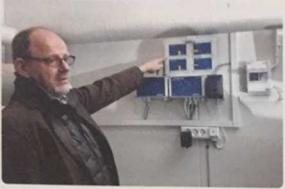
The components for leakage protection of supply water (System KMP-V) and district heating (System KMP-F) installations respectively are largely identical, consisting of electrically operated cut-off valves, control units, external sensors and Kamstrup Energy and Water Meters. The two systems have been developed in close collaboration with ultrasonic flow meter manufacturer Kamstrup, and are adapted to suit this company's flow meters.
СибАДИAlways water for fire extinguishing and cleaning
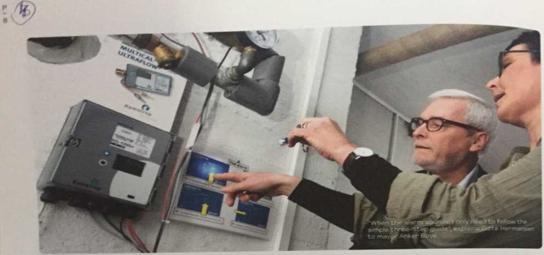
Tage Laurup, Sales Director of DanTaet, points to two motion sensors placed under the ceiling amid the long corridor in Bornehuset, Ejerslykke Nursery in Odense and explains: «Without these two sensors, the occupants would get little water, and the cleaning staff would have difficulty filling a bucket». The sensors detect motion, and the system in the basement is informed that the building is now in use, and water must be available. If the nursery’s fire cabinet is opened, the system in the basement will immediately force open the cut off valve. Hereafter, exceeding the consumption limit will only cause an alarm while the flow of water remains unimpeded. This property is essential to the emergency services' approval of the protection system in the nursery.
Property engineer: “The user - friendliness of the system has been of paramount importance – it must be easy and intuitive for users to respond when the alarm sounds”
Highly user-friendly system
The user-friendliness of the DenTaet systems has been of paramount importance to the municipality Jens Oxenved elaborates. “The managers of nurseries and kindergartens are not technicians, nor should they be; therefore the systems must be designed for use by persons with no technical skills”. Gitte Hermansen, the manager of Ejerslykke Nursery casts a glance at the two short-form guides hung on the wall above the control units that issue a text message alarm to her, and to the municipality in the face of leaks or seepage. “The guide is simple and easy to grasp, so I do not expect any difficulty when the alarm finally sounds. l can just read what to do” she says. This characterization is in line with that of the Technological Institute, which has performed a general evaluation of the KMP-V and KMP-F systems.
12
|
Ex.1. True or false. |
|
|
|
1. |
Leaks and seepage from water and heating installations are detected |
|||
|
|
quickly. |
|
|
2. |
The project is part of the private active risk management. |
|||
3. |
The systems are now operational in 18 public schools and 120 child |
|||
|
|
houses. |
|
|
СибАДИ |
||||
4. |
The components for the leakage protection are not identical. |
|||
5. |
The components for the leakage protection are manually operated cut-off |
|||
|
|
valves, control units and external sensors. |
||
6. |
The sensors detect motion. |
|
|
|
7. |
When the building is in use water must be available. |
|||
8. |
The consumption limit will only cause the stop of supply. |
|||
9. |
The flow of water remains unimpeded. |
|||
|
10.The system has been of extra importance to the municipality. |
|||
|
Ex.2. Match two columns and make word combinations (as they are given |
|||
|
in the text). |
|
|
|
|
Win-win |
damage |
|
|
|
Avoiding |
identical |
|
|
|
Consequential |
sensors |
|
|
|
Largely |
units |
|
|
|
Leaks of |
detected |
|
|
|
Quickly |
damage |
|
|
|
Cut off |
operated |
|
|
|
External |
valves |
|
|
|
Control |
project |
|
|
|
Electrically |
water |
|
|
Ex.3. Match word combinations from Ex.2.with its Russian equivalent.
Утечка воды, быстрая детекция, электроуправляемые, сверхудачный проект, избегая последствий, последствия вреда, контроллеры, внешние сенсоры, отсекающие клапана, преимущественно одинаковы.
Ex.4. Choose the correct answer.
1. |
Systems have been of paramount importance to the………… |
|
|
A) public |
B) country C) municipality |
2. |
Managers …………. technicians. |
|
|
A) are not |
B) are C) used to be |
13
3. The systems ………….. be designed for the use by……… with no
technical skills. |
|
|
A) need |
B) have to |
C) must |
A) people |
B) animals |
C) persons |
4. The managers casts a glance at the two….. guiders. |
||
|
A) short form |
B) long form C) flexi form |
|
5. |
The guide is …… to grasp. |
||
|
A) hard |
B) easy |
C) fast |
6. |
Leaks…………. detected quickly. |
||
|
A) were |
B) are |
C) have been |
7. |
Tage Laurup points to two……sensors. |
||
|
A) light |
B) bright |
C) motional |
8. |
The system will immediately force…. the cut off valve. |
||
|
A) close |
B) shut |
C) open |
9. |
The systems must be …… for use by persons with no technical skills. |
||
|
A) built |
B) designed C) created |
|
СибАДИLESSON 5. THE DISTRICT COOLING POTENTIAL
Read the text and define the core points. Write the summary of it.
District cooling’s greatest benefit is not its high energy efficiency - it is the scale of economy and the higher utilization of equipment, which makes it cheaper than locally based cooling such as central air conditioning or single room air conditioning. Moreover, district cooling goes hand in hand with district heating.
In recent years, urbanization, globalization and rising cooling demands have led to an increased interest in the environmental and economic benefits of district cooling (DC). The term DC is used to describe chilled water that is distributed through an underground network in order to provide efficient and reliable cooling for the buildings in many ways the advantages of DC are similar to those of district heating. There is a considerable synergy effect of centralizing the productions of energy, which reduces the need for peak load installations DC also implies risk reduction for the individual consumer, and economies of scale for the energy supply company.
This article will describe some of the benefits and barriers of DC in order to outline what action is necessary to capitalize on the growing potential for DС and harvest the benefits 125.000 MW (36 million TR). This corresponds to investments in DC of more than 60 billion euros. The market potential for Europe could be enormous.
Large market potential
In 2006 the international association Euroheat & Power described the European cooling market and its potential growth in the two reports called
14
Ecoheatcool Work Package 2 and 5. The European cooling market was estimated to be 660 TWh/уеаr. At the same time the current DС market share was only 1-2 % of the European cooling market. When DC reaches a market share of say 25 %, it will be supplying more than 160 TWh/year and the installed cooing capacity will be around125.000 MW (36 million TR). This corresponds to investments in DC of more than 60 billion euros. The market
potential for Europe could be enormous.
СибАДИWho benefits?
DC offers benefits to every link m the chain: the end-consumer, the utility company end the community in general. For the consumer the benefits include better economy, no noise from chiller, reduced risk of sudden repair costs, no hazardous refrigerants in the building, easier to certify the building with a green certificate (such as LEED. BREEAM etc.) and available space on rooftop and basement for other purposes. To the utility provider’s benefits include entering a profitable market, establishing a long-term relationship with customers, adding a new product and service to the portfolio (which can also help opening the district heating market), utilizing district heating operation expertise, strengthening environmental image and performance as well as obtaining synergies between power, heat and cooling production.
For the community in general the benefits from DC are significant. Euroheat & Power estimates that if DC accounted for 25 % of the European cooling production, C02 emissions would be reduced by 50 million tons. This is equivalent to the annual average emissions from 10 million cars. The electricity demand would be reduced by 50 TWh annually and investments in peak electricity generation capacity m the EU could be 30 billion euro less.
Competitions and barriers to entry
Even though DС has much in common with district heating. DC is still relatively unknown. One could say that DC today experiences many of the same barriers as district heating did 30 years ago in Denmark.
Few end-consumers consider DC because they are not aware of how much their current cooling costs are. One reason for this is that the cost of electricity for cooling production is hidden in the overall electricity bill and the cost of the building service staff also includes heating, ventilation and other building utilities. Furthermore, the investment costs for the chiller only occur every 10-15 years, which often means that no facility manager realty knows what the market price of a chiller plant is. For the utility companies, the largest challenge is to locate the potential cooling customers and find profitable DС areas. With district heating every building has a demand, but for DC the type and use of the building has a lot to say about its demand. These entry barriers can be handled by informing the building owner of the hidden costs related to traditional chiller plants, for instance by using scanning tools developed for identification of potential DС customers.
15