Материал: 2033
|
Ex.1. True or false. |
|
|
|
1. |
The investment cost for the chiller only occurs every year. |
|||
2. |
The cost of electricity for cooling production is hidden. |
|||
3. |
All end consumers consider DC because they are not aware of how much |
|||
|
|
their current cooling costs are. |
|
|
4. |
DC has little in common with district heating. |
|||
СибАДИ |
||||
5. |
DC is relatively unknown. |
|
|
|
6. |
For the community the benefits from DC are significant. |
|||
7. |
Emission is equivalent to the annual average emission from 10 000 cars. |
|||
8. |
DC offers goods to every link in the chain. |
|||
9. |
The market potential for Europe could not be enormous. |
|||
|
10.The article will describe some types of DC. |
|||
|
Ex.2. Match two columns and make word combinations (as they are given |
|||
|
in the text). |
|
|
|
|
Utilization of |
interest |
|
|
|
To go |
|
consumer |
|
|
Increased |
the need |
|
|
|
Economic |
share |
|
|
|
Underground |
capacity |
|
|
|
Reduce |
outline |
|
|
|
In order to |
hand in hand with |
|
|
|
Market |
in the chain |
|
|
|
Cooling |
equipment |
|
|
|
Every link |
benefits |
|
|
|
The end |
network |
|
|
Ex.3. Match word combinations from Ex.2.with its Russian equivalent.
Конечный потребитель, использование оборудования, возросший интерес, уменьшить потребность, с целью подчеркнуть, экономические преимущества, рыночная доля, подземная сеть, возможности охлаждения, каждое звено в цепи, идти рука об руку с.
Ex.4. Choose the correct answer.
1. |
DC greatest benefit is not its……. energy efficiency. |
||
|
A) low |
B) high |
C) bright |
2. |
DC goes ….. with district heating. |
||
|
A) hand in hand B) head in head C) band in band |
||
16
3.In recent years, demands have led to an…… interest in the environmental and …… benefits of DC.
|
A) reduced |
B) abstract |
C) increased |
|
A) economical |
B) emotional |
C) cultural |
4. In many ways the …… of DC are similar to those of district heating. |
|||
|
A) disadvantages |
B) advantages |
C) problems |
5. |
The effect reduces the ….. for peak load installations. |
||
СибАДИ |
|||
|
A) mode |
B) Code |
C) need |
6. |
The action is necessary to ….. on the growing potential for DC. |
||
|
A) capitalize |
B) capture |
C) catch |
7. |
This corresponds to investments in DC of ……. than 60 mln Euros. |
||
|
А) less |
B) more |
C) enough |
8. |
Current DC market share …… only 1-2 % of European ……. market. |
||
|
А) were |
B) will be |
C) was |
|
A) cooling |
B) heating |
C) baking |
LESSON 6. FROM VISION TO OPERATION Read the text and define the core points. Write the summary of it.
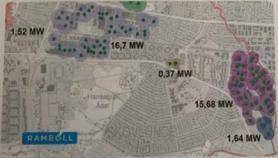
For utility companies thinking about going into DC, the process from idea to operation is described in the following and shown on the previous page. Firstly, the potential benefits of the prefect need to be estimated. As the location and size of the D distribution system has a large influence on the profitability of the system, the developers of a DC project have to map the potential customers in a certain area. In order to identify the most optimal location of a new DС plant within a certain area, it can be beneficial to use an automated mapping tool that uses the estimated coding demand and geographical location of each building in an area to calculate the economic difference between traditional cooling and a DC system. The result is a map like the one showed in the picture below. The green dots represent potential customers, and the blue/ purple circles illustrate the radius of piping that keeps each consumer profitable for the business case, if they change from traditional cooling to DC. Profitability of initiating a DC system does therefore occur where the purple circles are overlapping.
The mapper can also be used as a first draft for a customer database
17
Secondly, a feasibility study should be carried out and different concept designs should be tested in order to optimize profitability. Factors considered include but are not limited to cash flow, life cycle costs, investment costs, operational costs and income. In order to ensure a profitable project, risk management and mitigation begin at this stage as well. In this stage, careful consideration of the local natural resources can really increase both profitability and energy efficiency.
СибАДИThirdly, the actual business development begins and the strategic and organizational setups are designed internally, a go-to-market plan, a marketing plan and legal matters are cleared. Externally, key customers are visited and interviewed regarding their interest in DC and willingness to join the project. The first contracts with key customers are made at this stage.
Finally, the D system must be designed, and - based on the concepts developed in the feasibility stage - the final concept is developed and designed for realization. The optimal control strategies for operating the DС plant are also developed here. Following installation, operation begins and this stage focusses on optimizing operational costs and increasing the customer base.
The future of DC
So far, DC is still a blue ocean market. As described earlier, the market seems to be in a transition from steady to exponential growth. The package of EU-directives (for buildings, renewable energy and energy efficiency) will hopefully stimulate the development and national or local authorities develop integrated heating and coding strategies. City authorities should plan for district heating and cooling infrastructure as an integrated part of the urban infrastructure whenever it is cost effective. Thus, the building owner will get the opportunity to meet nearly zero carbon criteria in a more cost effective way using renewable energy (free cooling) and efficient combined heat and power via the district heating and cooling grids.
For utility companies DC is expected go from a nice to have to a need to have service in order to grasp all the optimization synergies with respect to heat and cold production and integration into the smart grid.
Ex.1. True or false.
1. Location and size of DC does not have a large influence on the profitability.
2. Developers have to map all people in a certain area. 3. It is beneficial to use an automated mapping tool.
4. A feasibility study should be carried out to optimize the structure.
5. Dc system must be based on the concepts developed in the feasibility stage.
18
6.The optimal control strategies for designing the DC plant are also developed here.
7.Operation stage focuses on declining the customer base.
8.Dc is still a blue ocean market.
9.The market seems to be in a transition from steady to exponential growth.
10.The package of EU directives will stimulate the development.
СибАДИ |
|||
|
Ex.2. Match two columns and make word combinations (as they are given |
||
|
in the text). |
|
|
|
Large |
profitability |
|
|
Map |
efficiency |
|
|
Customer |
plan |
|
|
Optimize |
customer |
|
|
Cash |
database |
|
|
Life |
setup |
|
|
Energy |
flow |
|
|
Strategic |
influence |
|
|
Go-to-market |
to join |
|
|
Key |
cycle costs |
|
|
Willingness |
the customers |
|
Ex.3. Match word combinations from Ex.2.with its Russian equivalent.
Оптимизировать прибыль, большое влияние, план вхождения на экономический рынок, клиентская база данных, разметка размещения клиентской базы, поток наличных, затраты в гарантийный период, основные клиенты, желание присоединиться, стратегическая организация,
энергетическая эффективность. |
|
|
||||
Ex.4. Choose the correct answer. |
|
|
||||
1. |
The utility companies thinking about going into… |
|||||
|
A) DC |
|
B) the UK |
C) the USA |
||
2. |
The potential benefits of the …. need to be estimated. |
|||||
|
A) object |
B) project |
C) subject |
|
||
3. |
Location and size of DC has a …… influence on the... |
|||||
|
A) large |
|
B) much |
C) little |
|
|
|
A) community |
B) stability |
C) profitability |
|||
4. |
Factors considered include but …………limited to cash flow. |
|||||
|
A) is not |
B) are |
C) are not |
|
||
5. |
To ensure a profitable project risk……. begins at this stage. |
|||||
|
A) agreement |
B) encouragement |
C) management |
|||
19
6. |
Consideration of the local natural resources can……. profitability. |
||
|
A) increase B) decline |
C) grow |
|
7. |
Key customers are …… and interviewed. |
||
|
A) visited |
B) invited |
C) paid |
8. |
Operation |
focuses on optimizing operational….. and increasing |
|
the customer…… |
|
||
|
A) Lists |
B) costs |
C) prices |
СибАДИ |
|||
|
A) money |
B) live |
C) base |
LESSON 7. HOW IS DC PRODUCED?
Read the text and define the core points. Write the summary of it.
Today most commercial buildings make use of traditional compressorbased cooling to suit their cooling needs. DС is normal produced by means of one or more of the following technologies:
• conventional compressor-based cooing;
• absorption cooling, transforming waste heat into cooling;
• free coding, utilizing cool ambient air or cool water from the ocean, take or river.
These three technologies are often combined to obtain the most optimal D system m a certain setting. If the surroundings include access to cold air or water, free cooling is very often the most desirable cooling method, as the operation expenses just composes maintenance costs. On the other hand, if there is easy access to cheap surplus heat, the chemical process of absorption cooling can be an optimal solution. Compressor-based cooling has low investment costs, and operates efficient - even at low loads. However, the operational costs of compressor-based cooling depend on the electricity price and the maintenance cost of the mechanical parts can be high. One of the biggest advantages of DC systems is however the option of using storage tanks to even out the cooling demand throughout the day and optimize the production. This lowers need for installed capacity due to higher utilization of equipment and makes the energy production cheaper and more energy-efficient, as the peak toad is spread out and everyone can get a lower coding price.
Current market for DC. Some of the most developed markets m Europe are Sweden and France. In Sweden the DС market share is estimated to be 25 % and from 2005 to 2009 they increased their installed cooling capacity with almost 50 %. In 2005 France had 400 WW (110.000 TR) installed and in 2009 the capacity was more than 600 MW (170,000 TR).
In Denmark, the number of DС projects is steadily increasing. As of today, the total installed capacity is estimated to be about 50 MW but the potential is much larger. On the Asian continent, Japan and Korea have more than 5000 MW (1,4
20