Материал: 2076
produce large numbers of the same goods. The first proponent in the US for this approach was Eli Whitney who proposed (interchangeable) parts manufacture for muskets, hence producing the identical components and creating a musket assembly line. The next step forward was promoted by several people including Frederick Winslow Taylor, a mechanical engineer who sought to improve industrial efficiency. He is sometimes called "the
Сfather of scientific management." He was one of the intellectual leaders of the Efficiency Movement and part of his approach laid a further foundation for quality management, including aspects like standardization and adopting improved practices. Henry Ford was also important in bringing process and иquality management practices into operation in his assembly lines. In Germany, Karl Friedrich Benz, often called the inventor of the motor car, was pursuing similar assembly and production practices, although real mass production was properly initiated in Volkswagen after World War II. From this periodбАonwards, North American companies focused predominantly upon production against lower cost with increased efficiency.
Walter A. Shewhart made a major step in the evolution towards quality management by creating a method for quality control for production, using statistical methods, first proposed in 1924. This became the foundation for his ongoing work on statistical quality control. W. Edwards Deming later applied statistical process control methods in the United States during World War II, thereby successfully improving quality in the manufacture of munitions and other strategically important products.
Quality leadership from aДnational perspective has changed over the past five to six decades. After the second world war, Japan decided to make quality improvement a national imperative as part of rebuilding their economy, and sought the help of Shewhart, Deming and Juran, amongst others. W. Edwards Deming championed Shewhart's ideas in Japan from
Break down barriers between departmentsИ
Management should learn their responsibilities, and take on leadership
Supervision should be to help people and machines and gadgets to do a better job
Improve constantly and forever the system of production and service
Institute a vigorous program of education and self-improvement
81
In the 1950s and 1960s, Japanese goods were synonymous with cheapness and low quality, but over time their quality initiatives began to be successful, with Japan achieving very high levels of quality in products from the 1970s onward. For example, Japanese cars regularly top the J.D. Power customer satisfaction ratings. In the 1980s Deming was asked by Ford
Motor Company to start a quality initiative after they realized that they were falling behind Japanese manufacturers. A number of highly successful quality
Сmethods not only provide techniques but also have associated quality culture (i.e. people factors). These methods are now adopted by the same western countries that decades earlier derided Japanese methods.
initiatives have been invented by the Japanese (see for example on this pages: Genichi Taguchi, QFD, Toyota Production System). Many of the
иdifferentiation is also called the quality gap). In the past two decades this quality gap has been greatly reduced between competitive products and
Customers recognize that quality is an important attribute in products
and services. Suppliers recognize that quality can be an important
ThereбАare a huge number of books available on quality management. In recent times some themes have become more significant including quality
differentiator between their own offerings and those of competitors (quality
services. This is partly due to the contracting (also called outsourcing) of manufacture to countries like India and China, as well internationalization of trade and competition. These countries amongst many others have raised their own standards of quality in order to meet International standards and customer demands. The ISO 9000 series of standards are probably the best known International standards for quality management.
culture, the importance of knowledge management, and the role of leadership in promoting and achieving high quality. Disciplines like systems thinking are bringing more holistic approaches to quality so that people, process and
applications outside of walls of manufacturing, extending into service sectors and into areas such as sales, marketing and customer service.
products are considered together rather than independent factors in quality |
|
management. |
Д |
|
|
The influence of quality thinking has spread to non-traditional |
|
|
И |
82
18. Read the text translating unknown words. What stands for ISO? Give summary of the text.
PRINCIPLES OF ISO
СThe International Standard for Quality management (ISO 9001:2015) adopts
a number of management principles, that can be used by top management to guide their organizations towards improved performance.
Customer focus
иvalue for the customer. Understanding current and future needs of customers and other interested parties contributes to sustained success of an organization.
The primary focus of quality management is to meet customer
requirements and to strive to exceed customer expectations.
Sustained success is achieved when an organization attracts and retains
the confidence of customers and other interested parties on whom it depends.
enable anбАorganization to align its strategies, policies, processes and resources to achieve its objectives
Every aspect of customer interaction provides an opportunity to create more
Leadership
Leaders at all levels establish unity of purpose and direction and create conditions in which people are engaged in achieving the organization’s
quality objectives.
Engagement of people
Creation of unity of purpose and direction and engagement of people Д
Competent, empowered and engaged people at all levels throughout the
organization are essential to enhance its capability to create and deliver value. To manage an organization effectively andИefficiently, it is important to
involve all people at all levels and to respect them as individuals. Recognition, empowerment and enhancement of competence facilitate the engagement of people in achieving the organization’s quality objectives.
Process approach
Consistent and predictable results are achieved more effectively and efficiently when activities are understood and managed as interrelated processes that function as a coherent system.
The quality management system consists of interrelated processes. Understanding how results are produced by this system enables an organization to optimize the system and its performance.
Improvement
Successful organizations have an ongoing focus on improvement. Improvement is essential for an organization to maintain current levels of
83
performance, to react to changes in its internal and external conditions and to create new opportunities.
Evidence based decision making
Decisions based on the analysis and evaluation of data and information are more likely to produce desired results.
Decision making can be a complex process, and it always involves Сsome uncertainty. It often involves multiple types and sources of inputs, as well as their interpretation, which can be subjective. It is important to understand cause-and-effect relationships and potential unintended consequences. Facts, evidence and data analysis lead to greater objectivity
иand confidence in decision making.
Relationship management
For sustained success, an organization manages its relationships with interested parties, such as suppliers.
InterestedбАparties influence the performance of an organization. Sustained success is more likely to be achieved when the organization manages relationships with all of its interested parties to optimize their impact on its performance. Relationship management with its supplier and partner networks is of particular importance.
19. Read the text translating unknown words. Prepare a presentation on one of these methods for quality improvement.
QUALITYДIMPROVEMENT
И
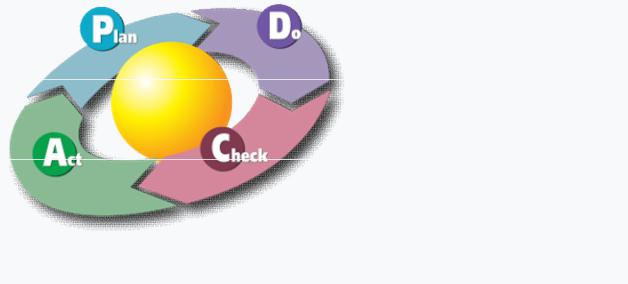
The PDCA cycle
There are many methods for quality improvement. These cover product improvement, process improvement and people based improvement. In the following list are methods of quality management and techniques that incorporate and drive quality improvement:
1. ISO 9004:2008 – guidelines for performance improvement.
84
2. ISO 9001:2015 – a certified quality management system (QMS) for organisations who want to prove their ability to consistently provide products and services that meet the needs of their customers and other relevant stakeholders.
3. |
ISO 15504-4: 2005 – information technology – process assessment – |
|||||
4. |
Part 4: Guidance on use for process improvement and process capability |
|||||
С |
|
|
|
|
|
|
determination. |
|
|
|
|
|
|
5. |
QFD – quality function deployment, also known as the house of quality |
|||||
approach. |
|
|
|
|
|
|
6. |
Kaizen – , Japanese for change for the better; the common English |
|||||
и |
|
|
|
|||
term is continuous improvement. |
|
|
|
|||
7. |
Zero Defect Program – created by NEC Corporation of Japan, based |
|||||
upon statistical process control and one of the inputs for the inventors of Six |
||||||
Sigma. |
|
|
|
|
|
|
8. |
Six Sigma – 6σ, Six Sigma combines established methods such as |
|||||
statistical process control, design of experiments and failure mode and effects |
||||||
analysis (FMEA) in an overall framework. |
|
|
||||
9. |
PDCA – plan, do, check, act cycle for quality control purposes. (Six |
|||||
Sigma's DMAIC method (define, measure, analyze, improve, control) may be |
||||||
viewed as a particular implementation of this.) |
|
|
||||
10.Quality circle – a group (people oriented) approach to improvement. |
||||||
11.Taguchi methods – |
statistical oriented methods |
including quality |
||||
robustness, quality loss function, and target specifications. |
|
|||||
12.The Toyota |
|
Д |
into lean |
|||
Production System – |
reworked in |
the west |
||||
manufacturingбА. |
|
|
||||
13.Kansei Engineering – an approach that focuses on capturing customer |
||||||
emotional feedback about products to drive improvement. |
|
|||||
14.TQM – total |
quality |
management is |
a management |
strategy |
aimed at |
|
|
|
|
|
И |
||
embedding awareness of quality in all organizational processes. First promoted in Japan with the Deming prize which was adopted and adapted in USA as the Malcolm Baldrige National Quality Award and in Europe as the European Foundation for Quality Management award (each with their own variations).
15.TRIZ – meaning "theory of inventive problem solving"
16.BPR – business process reengineering, a management approach aiming at optimizing the workflows and processes within an organisation.
17.OQRM – Object-oriented Quality and Risk Management, a model for quality and risk management.
18.Top Down & Bottom Up Approaches – Leadership approaches to change. Proponents of each approach have sought to improve them as well as apply them for small, medium and large gains. Simple one is Process Approach,
which forms the basis of ISO 9001:2008 Quality Management System
85