Материал: part07
DICOM PS3.7 2020a - Message Exchange |
Page 31 |
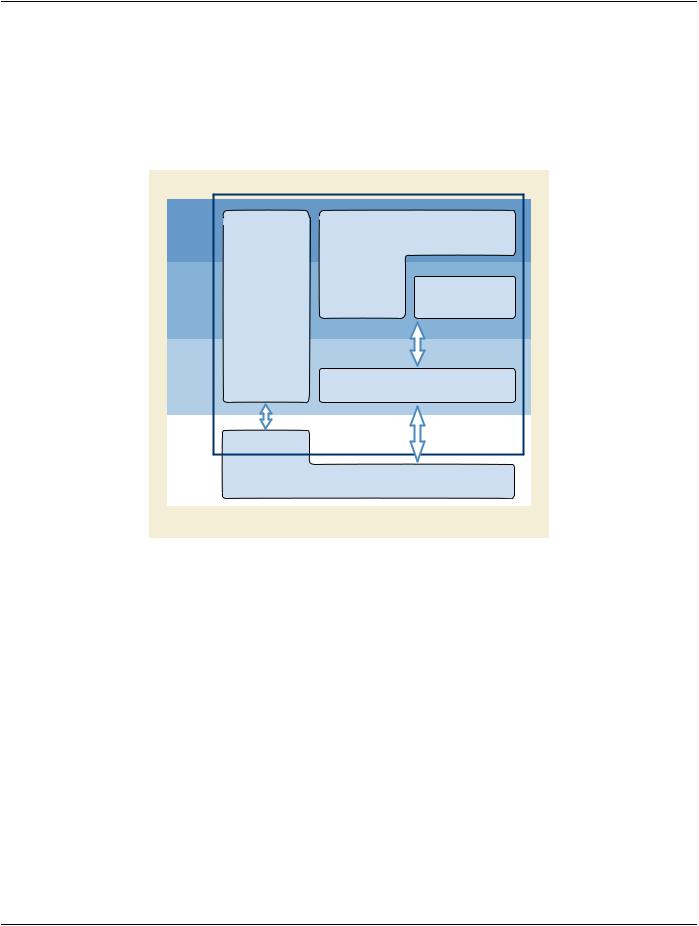
The DICOM Application Entity uses the services provided by the DICOM Message Service Element. The DICOM Message Service Element specifies two sets of services.
•DIMSE-CsupportsoperationsassociatedwithcompositeSOPClassesandprovideseffectivecompatibilitywiththepreviousversions of the DICOM Standard.
•DIMSE-NsupportsoperationsassociatedwithnormalizedSOPClassesandprovidesanextendedsetofobject-orientedoperations and notifications. It is based on the OSI System Management Model and more specifically on the OSI Common Management In- formation Services (CMIS) Service definition.
DICOM Application Entity
DICOM |
|
Service Classes |
|
PART 4 |
Association |
|
|
|
- Study Mgt. |
- Storage |
|
|
Negotiation |
||
|
- Patient Image Mgt. |
||
|
|
||
|
|
- Resutls Mgt. |
- Query / Retrieve |
DICOM |
|
|
|
PART 3 |
|
|
|
DICOM
PART 7
DICOM Message Service Element
(DIMSE)
(DIMSE-C and DIMSE-N Operations and Notifications)
DICOM
PART 8 & 9 Upper Layer Association
Services *
Upper Layer Presentation Data Service
(see figure 6.1-1)
* This figure expands upon figure 6.1-1 by showing that the Association Services specified in Part 8 are formally part of the Application Entity.
Figure 6.2-1. DICOM Application Layer Structure
The DIMSE-C and DIMSE-N services are supported by a single DIMSE protocol that uses the DICOM-specific Message formatting and encoding.
6.3 DICOM Message Structure and Command Set
Information is communicated across the DICOM network interface in a DICOM Message. A Message is composed of a Command Set followed by a conditional Data Set (see PS3.5 for the definition of a Data Set). The Command Set is used to indicate the opera- tions/notifications to be performed on or with the Data Set.
A Command Set is constructed of Command Elements. Command Elements contain the encoded values for each individual field of the Command Set per the semantics specified in the DIMSE protocol (see Section 9.2 and Section 10.2). Each Command Element is composed of an explicit Tag, a Value Length, and a Value Field.
The overall structure of a DICOM Message is shown in Figure 6.3-1.
- Standard -

Page 32 |
|
DICOM PS3.7 2020a - Message Exchange |
||
|
DICOM Message |
|
|
|
|
|
|
|
|
|
|
Command Set |
Data Set |
|
|
|
(defined in DICOM Part 5) |
|
|
|
|
|
|
|
|
|
|
|
|
|
|
|
|
|
Command Element
Tag |
Length |
Value |
|
|
|
Figure 6.3-1. DICOM Message Structure
6.3.1 Command Set Structure
The Command Elements in a Command Set shall be ordered by increasing Command Element Tag number. A Command Element Tag uniquely identifies a Command Element and shall occur at most once in a Command Set. The encoding of the Command Set shall be Little Endian Byte Ordering as defined in PS3.5. The requirements for the existence of a Command Element in a Command Set are defined in the DIMSE protocol.
Note
1.The use of Private Command Elements has been retired in this version of the DICOM Standard.
2.The encoding corresponds to the Implicit VR Data Element encoding defined in PS3.5.
A Command Element is composed of three fields; a Command Element Tag, a Value Length, and a Value Field.
Command Element Tag: An ordered pair of 16-bit unsigned integers representing the Group Number followed by Element Number.
Value Length: A 32-bit unsigned integer representing the explicit Length as the number of bytes (even) that make up the Value. It does not include the length of the Command Element Tag or Value Length fields.
Value Field: An even number of bytes containing the Value(s) of the Command Element.
The command type of Value(s) stored in this field is specified by the Command Element's Value Representation (VR). The VR for a given Command Element can be determined using the Command Dictionary in Annex E. The VR of Command Elements shall agree with those specified in the Command Dictionary. The VR definitions are defined in PS3.5
The Value Multiplicity (VM) specifies how many Values with the VR can be placed in the Value Field. If the VM is greater than one, multipleValuesshallbedelimitedwithintheValueFieldasdefinedinPS3.5.TheVMforagivenCommandElementcanbedetermined using the Command Dictionary in Annex E.
Note
1.The Message Length-to-End (0000,0001) Command Element is retired. Implementations may choose to send it for backward compatibility reasons. DICOM V3.0 conformant implementations must not rely on its presence for their oper- ation.
2.The delimitation of the Message length is actually achieved by relying on the fact that the Presentation Data Value (conveyingeachMessagefragment)isdelimitedasdefinedbytheOSIUpperLayerServiceandtheassociatedMessage ControlHeader(seePS3.8).ThisresultsfromthefactthattheDICOMV3.0ULprotocolortheOSIPresentationprotocol explicitly conveys the length of a PDV.
- Standard -

DICOM PS3.7 2020a - Message Exchange |
Page 33 |
7 Service Overview
The DICOM Message Service Element supports communication between peer DIMSE Service Users. A DIMSE Service User acts in one of two roles:
a.invoking DIMSE Service User
b.performing DIMSE Service User
DIMSE Service Users make use of service primitives that are provided by the DIMSE Service Provider. The DIMSE Service Provider is an abstraction of the totality of those entities that provide DIMSE services to peer DIMSE Service Users. A service primitive shall be one of the following types:
a.request primitive
b.indication primitive
c.response primitive
d.confirmation primitive
These primitives (which are shown in Figure 7-1) are used as follows to successfully complete a DIMSE service:
•The invoking DIMSE Service User issues a request primitive to the DIMSE Service Provider.
•TheDIMSEServiceProviderreceivestherequestprimitivefromtheinvokingDIMSEServiceUserandissuesanindicationprimitive to the performing DIMSE Service User.
•The performing DIMSE Service User receives the indication primitive from the DIMSE Service Provider and performs the requested service.
•The performing DIMSE Service User issues a response primitive to the DIMSE Service Provider.
•The DIMSE Service Provider receives the response primitive from the performing DIMSE Service User and issues a confirmation primitive to the invoking DIMSE Service User.
•The invoking DIMSE Service User receives the confirmation primitive from the DIMSE Service Provider completing the DIMSE service.
7.1 Service Types
DIMSE provides two types of information transfer services that are used by DICOM Application Entities:
a.a notification service
b.an operation service
- Standard -

Page 34 |
DICOM PS3.7 2020a - Message Exchange |
Request |
Pr |
Message |
|
||
|
|
|
|
imitiv |
(Command Request |
|
e |
and Associated Data) |
|
|
|
|
|
Message |
|
|
(Command Response |
|
e |
and Associated Data) |
|
|
|
|
imitiv |
|
|
Pr |
|
m |
|
|
Confir |
|
|
Invoking |
DIMSE- |
|
DIMSE-Service-User |
Service-Provider |
|
|
|
|
Indication |
Primitiv |
|
|
|
e |
|
imitiv |
|
Pr |
Response |
|
Performing
DIMSE-Service-User
Figure 7-1. DIMSE Service Primitives
Notification services enable one DICOM Application Entity to notify another about the occurrence of an event or change of state. The definition of the notification and the consequent behavior of the Application Entities is dependent upon the Service Class and Inform- ation Object Definitions. See PS3.3 and PS3.4.
Operation services enable one DICOM Application Entity to explicitly request an operation to be performed upon a SOP Instance managed by another DICOM Application Entity.
7.2 DIMSE Service User Interaction
The DICOM Message Service Element receives notification and operation requests and their related information from the DIMSE Service User. Two DICOM Application Entities take the roles as peer DIMSE Service Users in order to exchange notifications and operations.
Anotificationoroperationisimplementedasarequest/responseinteractioncarriedoutwithinthecontextofanestablishedapplication Association. Typically, one DIMSE Service User requests that a particular operation be performed (or notification be processed) and theotherDIMSEServiceUserattemptstoperformtheoperation(orprocessthenotification)andthenreportstheoutcomeoftheattempt.
When engaging in the operations or notifications, the DIMSE Service User takes on one of two roles:
a.it performs operations (on SOP Instances for which it has responsibility) that were invoked by a peer DIMSE Service User. It may also emit change-of-state notifications for SOP Instances to one or more peer DIMSE Service Users. These notifications may be invoked as a result of operations initiated by other DIMSE Service Users.
b.it invokes the performance of an operation on a peer DIMSE Service User. It may also receive notifications from a peer DIMSE Service User.
These roles are depicted in Figure 7.2-1.
Note
1.Role a) (called the Agent role in ISO terminology) is used by an implementation that conforms to a DICOM Service Class as an SCP.
2.Role b) (called the Manager role in ISO terminology) is used by an implementation that conforms to a DICOM Service Class as an SCU.
- Standard -

DICOM PS3.7 2020a - Message Exchange |
Page 35 |
|
Invoking |
Performing |
|
DIMSE-Service-User |
DIMSE-Service-User |
||
|
|
Operation |
|
DIMSE-Service-User |
|
DIMSE-Service-User |
||
|
(Role b) |
|
(Role a) |
|
|
|
|
|
|
|
Performing |
Notification |
Invoking |
|
|
|
|||
DIMSE-Service-User |
|
DIMSE-Service-User |
||
Figure 7.2-1. Operation and Notification Flow
7.3 Service Modes
Operations and notifications, on an Association, are used in one of the following two modes:
a.synchronous
b.asynchronous
In the synchronous mode, the invoking DIMSE Service User, on an established Association, requires a response from the performing DIMSE Service User before invoking another operation or notification.
Intheasynchronousmode,theinvokingDIMSEServiceUser,onanestablishedAssociation,maycontinuetoinvokefurtheroperations ornotificationstotheperformingDIMSEServiceUserwithoutawaitingaresponse.Intheasynchronousmode,theperformingDIMSE Service User may respond to the operations or notifications in a different order than they were received.
The mode selection (synchronous or asynchronous) is determined at Association establishment time. The synchronous mode serves as the default mode and shall be supported by all DIMSE Service Users. The asynchronous mode is optional and the maximum number of outstanding operations/notifications is negotiated during Association establishment. This negotiation is accomplished by Application Association Information as defined in Annex D.
7.4 Association Services
The DICOM Message Service Element does not provide separate services for the establishment and termination of application Asso- ciations. This section provides an overview of how an Application Entity using the DIMSE service uses the Association Services defined in PS3.8.
During the Association establishment phase, a DIMSE Service User shall exchange initialization information using parameters of the A-ASSOCIATE Upper Layer Service (see Figure 7.4-1) that include:
•Application context
•Presentation and session requirements
•DIMSE-specific user information
•Application Association Information
The A-RELEASE and A-ABORT Services defined in PS3.8 shall be used for the termination of an Association.
Note
The rules defining how the Association Services are used by a DIMSE Service User are defined in Annex D.
- Standard -