Материал: voronina_ev_sotsialnokulturnaia_sfera_obshcheniia

Unit 7
Sports
In this module you will:
Read about winter sports
Talk about doing exercises and being healthy
Test your knowledge of the Olympics
Practise using the passive voice
Listen to a presentation by the British Olympic Committee
Write a biography of a famous sports person
Learn about female fans
Useful vocabulary:
Nouns |
the Olympics, athletes, venue, event, stadium, spectator, |
|
audience, fan, advertising, jogging, snowboarding, ice skating, |
|
surfing, skateboarding, curling, ski jumping, ice hockey, extreme |
Verbs |
skiing, freestyle skiing, muscles, toe, elbow, knee |
to win, to lose, to beat, to sweat, to push, to slide, to encourage, |
|
Adjectives |
to organise, |
spectacular, healthy, injured |
|
Adverbs |
just, only |
Phrases and |
to burn calories, to lose fat, to hold competitions, to host the |
collocations |
Olympics/championships, light/heavy exercise, cross-country ski |
|
race, ski resort, medal winner, speed skater, |
81

1. Lead-in
1.a Work in pairs. Read the statements about diet and exercise. Do you think they are true (T) or false (F)?
1 Cleaning floors burns the same calories as playing a game of volleyball.
2 Heavy exercise, such as jogging or aerobics, is better than light exercise, like walking.
3 Special ‘sports drinks’ can help you exercise.
4 Orange juice contains more vitamin C than apple juice. 5 Exercises that make you sweat a lot help you lose fat.
1.b Here are some fun exercises you can do to keep fit. Read about them and check if your guesses were right or wrong.
1.c Match the headings (a-d) with the paragraphs (1-4).
a Dance to the Music! |
c Tidy Your Room! |
b Jump for Joy! |
d Easy as ABC! |
1______________
Sit on a chair and put one leg out in front of you. Point your toes and ‘write’ each letter of the alphabet in the air with your big toe. Then repeat the exercise with the other foot. This is great for people who like skiing, snowboarding or ice skating. 2______________
Put a tape measure on a wall outside your house and see how high
you can reach with one hand. Then, jump off one foot and see how high you can get. Then jump off both feet. Try to jump higher each day. This is useful basketball practice, by the way! 3______________
You don’t need a partner for this. Dancing is an aerobic exercise – this means it brings a lot of new oxygen to your muscles. This is really important because it makes your heart strong and keeps you healthy. Dance two or three times a week – at home or a discotheque!
4_______________
Do you think helping at home is useless and boring? You’re wrong. Housework can make your muscles and bones strong. Cleaning floors or windows are also great exercises for your elbows and knees. And thirty minutes of digging the garden can burn 200 calories!
82
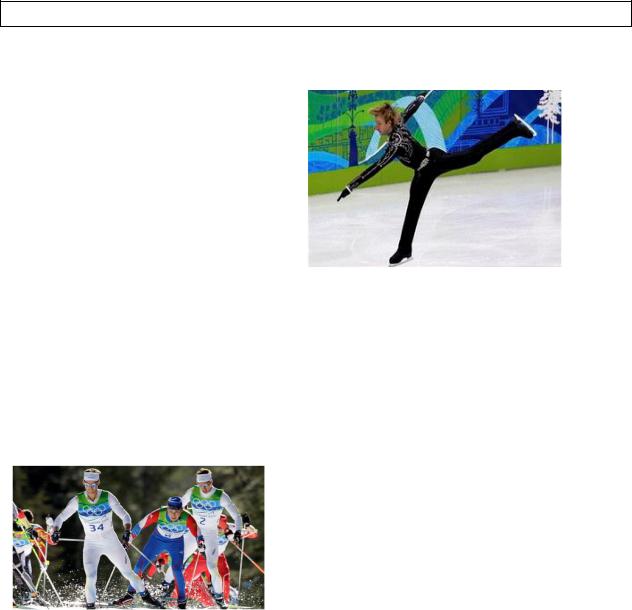
2. Reading
Pre-reading activities
2.a Work in pairs. Make a list of winter sports and discuss the questions:
have you ever done any of them?
would you like to try any?
which winter sports are popular in your country?
are there any famous winter sports people you know?
While-reading activities
2.b Read the encyclopaedia extracts (1-6) and match them with these headings. There is an extra heading.
|
snowboarding |
|
extreme skiing |
|
the history of skiing |
|
Winter Olympics |
|
ski jumping |
|
freestyle skiing |
ice hockey
1) __________ This spectacular sport was invented by the Norwegian, Sondre Norheim, in the 1840s and the first competitions were held in the 1860s. Jumpers fly through the air at up to 100 kph and spend several seconds literally flying.
2)__________ The oldest skis were found in Sweden and are around 5,000 years old. Skis have been used in Scandinavia for transport and hunting since prehistoric
times. One of the first cross-country ski races was held in 1843 in Norway. Alpine skiing was developed in the late 19th century in Switzerland. The first Alpine race was organized in 1911 by Sir Arnold Lunn and many of his rules for competitions have been used since then.
3)__________ This has only been done since the 1960s and was introduced into international competition in the 1970s. It is a mixture of skiing, skating, gymnastics and ballet.
83
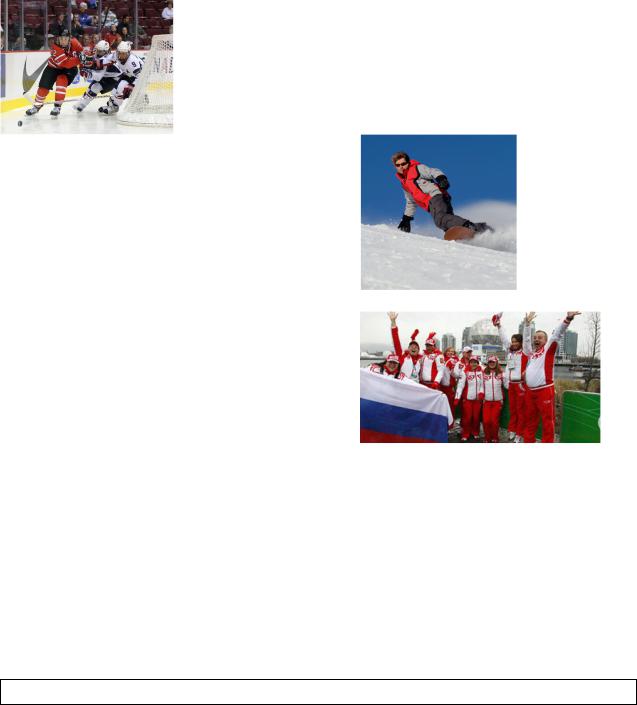
4) __________ The games have been held since 1924 and they are organized in ski resorts around the world every four years. The record for gold medals is held by Bjorn Daehlie of Norway (8 medals). The youngest medal winner is speed skater Yoon-mi Kim of Korea at the age of 13.
5)__________ This was started in the 1960s but has not been made an Olympic event because it is so dangerous. It involves skiing down some of the most dangerous places in the mountains and is only done by a few people. The definition of the sport is: ‘If you fall, you die.’
6)__________ This was developed from surfing and skateboarding and was the fastest-growing winter sport of the 1980s and 1990s. It was made an Olympic event at Nagano in 1998.
After-reading activities
2.c Mark the following statements as true (T), false (F) or not mentioned (NM).
1Ski jumping was invented to entertain the spectators.
2The Scandinavians now use skis for transport and hunting.
3Not many rules invented by Sir Arnold Lunn function nowadays.
4Speed skating is young people’s favourite kind of sport.
5Extreme skiing is not an Olympic sport.
6Skateboarding was extremely popular in the 1980s and 1990s.
3. Speaking
Read this quotation:
‘The only way to be healthy is to eat what you don’t want to,
drink what you don’t like and do what you don’t want to.’
Mark Twain (1835-1910)
In groups discuss the following points giving your grounds:
Do you agree or disagree with the quotation?
Do you need to be a real sports fan to stay fit and healthy?
Is it important to be fit and healthy? Why?
84

4. Language skills
Grammar: The Passive
4.a Look at the extracts from the previous text again and complete the sentences below. What tenses are used in A, B, and C?
A |
B |
C |
The record for gold |
Snowboarding was made |
The games have been |
medals is held by Bjorn |
an Olympic event at |
held since 1924. |
Daehlie of Norway. |
Nagano in 1998. |
Skis have been ______ |
It ______ only done by a |
The oldest skis ______ |
since prehistoric times. |
few people. |
found in Sweden. |
Freestyle skiing ______ |
They _____ organised in |
Ski jumping was ______ |
done since the 1960s. |
ski resorts around the |
in the 1840s. |
|
world. |
|
|
4.b Find other examples of the Passive in the extracts and complete the rule.
The Present Simple Passive = am, is or ____ + ____ form of the verb.
The Past Simple Passive = ____ or ____ + ____ form of the verb.
The Present Perfect Passive = ____ or ____ + ____ + ____ form of the verb.
4.c Read this sentence from extract 1. What information does the underlined phrase give you?
This sport was invented by the Norwegian, Sondre Norheim.
Find more expressions like this in the extracts.
4.d Complete the text and put the verbs in brackets in the correct Passive tense.
Curling 1___(play) on ice by two teams of four players. First, large stones 2___(push) across the ice and allowed to slide towards a circle, which 3___(call) ‘home’. After this, the players 4___(not allow) to touch the stone. They sweep the ice in front of the stone. In this way, the ice
5___(warm) and the speed and the direction of the stone 6___(change). The object of the game is to place your team’s stones in the circle closer to the middle than your opponents’ stones.
The oldest curling stone, bearing the date of 1511, 7___(find) in Scotland and in the 18th century, the first curling clubs 8___(form) there. Nowadays, the game 9___(play) in
85