Материал: voronina_ev_sotsialnokulturnaia_sfera_obshcheniia
many countries, e.g. in Switzerland, where natural outdoor ice 10___(find). In Canada and the USA, curling 11___(play) since the beginning of the 19th century. Curling 12____(make) more popular by the recent Winter Olympics. It 13___(play) for the first time at Nagano in 1998 but it 14___(not watch) by big audiences.
4.e Use the correct tenses and the clues to complete the sentences about Janica Kostelic, a Croatian skier.
1.Janica / born / 1982
2.She / first put on the skis at the age of three
3.She / selected for the national team / she / 16 years old
4.Janica / injured many times so far
5.She / allowed to ski in spite of her knee injuries
6.She / admired for her hard work and ambition
7. She / liked because of her sense of fun
4.f Winter Olympic quiz. Use the clue to write questions using the Passive. Do you know the answers to these questions?
Example: When was curling made an Olympic event?
1.When / curling /make an Olympic event?
2.When / first Winter Olympics / organise?
3.Who /ski jumping / invent by?
4.When / the first cross country ski races / hold?
5.When / extreme skiing / invent?
6.What two sport / snowboarding / develop from?
7.When / snowboarding / make an Olympic event?
8.Where / the last Winter Olympics / organise?
9.How often / the Winter Olympics / hold?
5. Listening
5.a Where was the last Summer Olympic Games held? Did you watch any of it? Did Russia win any medals?
5.b Which three cities below have never yet hosted the Summer Olympic Games?
Amsterdam |
Athens |
Berlin |
Melbourne |
Los Angeles |
Madrid |
Osaka Mexico City |
|
Moscow |
New York |
Paris |
Seoul |
5.c In 2005, London won the competition to host the Olympic Games in 2012. Listen to four extracts from the presentation that was made by the British Olympic
Committee and match them with the topics a-d.
a)transport
b)the sports facilities
c)accommodation for athletes
86

d) London’s special ambition for the Games
5.d Are these sentences true or false? Listen again and check.
1 The organisers want the Games to encourage children to play sport.
2 None of the sports venues already exists.
3 The Olympic park will be less than ten minutes from the city centre.
4 The Olympic stadium will have
18,000 seats.
5 Many venues will be a long way from the athletes’ accommodation. 6 The athletes will stay in single rooms.
7 Ten train and underground lines go to the venues.
8 Visitors to the games don’t have to pay to use the trains and buses.
Adding emphasis
5.e We can use just and only to emphasise how small something is. Listen and complete these sentences from the extracts. Is the emphasis positive or negative?
1 We’ll create an Olympic park which is ___ seven minutes from the center of London.
2 Half of the venues will be ___ five minutes from the athletes’ accommodation. 3 ___ ten per cent will be more than twenty minutes away.
4 Athletes will be ___ a short walk from the main stadium.
5 The Olympic park will be ___ seven minutes from central London by train.
6. Extra Activities
6.a Read this magazine article and choose the best title.
AMen : Women - 1:0
BCompanies spend billions on World Cup ads
CAdvertisers forget female fans
DRecord numbers of women watch World Cup
87
6.b While reading choose the best word to fill in the gaps from the list below.
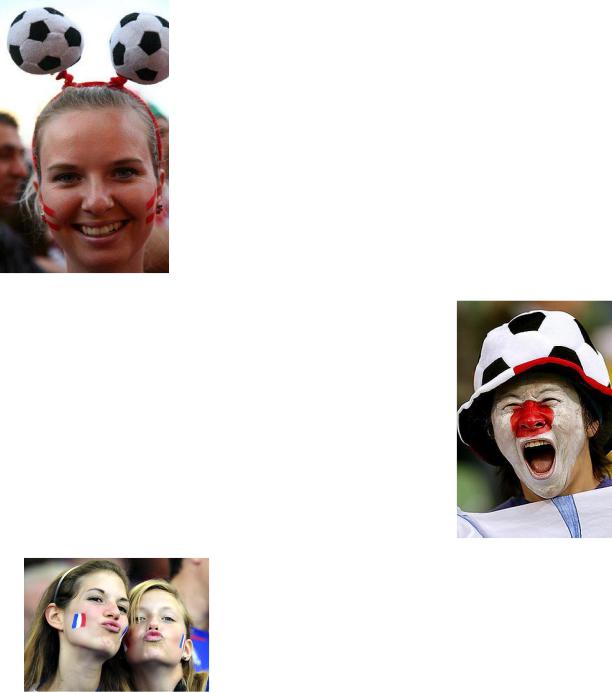
This year, female football fans are everywhere. You can see them in the stadiums, you can see them at the big screen 1)____and you can probably see them in front of your own television. However, despite the recent increase in the 2)____of women watching the World Cup, the majority of the advertisements during the games are aimed at men. This year, nearly 50 per cent of the tournament’s audience has been female. In South Korea, a female 3)____of 51 per cent watched their match against Togo. In England, 47 per cent of the audience was female during the match 4)____Sweden. ‘We’ve certainly missed an opportunity’, said an advertising executive. ‘There have been too many adverts for men and there haven’t been enough adverts for female fans’.
There have been some adverts that have been 5)____at women. However, these adverts have seen women not as fans, but as people who dislike the game. For example, one airline has been offering women-only holiday trips 6)____the World Cup.
‘The advertisers haven’t been clever enough. They’ve been too 7)____in women who hate football and they’ve forgotten about those who love the game’, said Sean Gabb, a business lecturer and author. ‘Companies have spent enough money on advertising, nearly $1 billion worldwide, but they’ve spent too much money on the male fans and not enough on the female fans’.
However, some companies think they have been clever. Adidas have said that, as this is the male World Cup, it makes 8)____to focus on advertising to men. They plan to focus on female products during next year’s women’s World Cup in China.
Other people have noted that women 9)____to be more casual watchers of TV sport than men, so it is difficult to keep their attention during the adverts. However, as Sean Gabb said, ‘Perhaps this is because they don’t want to 10)____their time watching adverts for shaving products and car tyres’.
1 |
A performances |
B events |
C plays |
2 |
A minority |
B amount |
C number |
88
3 |
A lots |
B majority |
C most |
4 |
A against |
B opposite |
C in front of |
5 |
A aimed |
B pointed |
C intended |
6 |
A escaping |
B to escape |
C escape |
7 |
A in love |
B interested |
C fascinated |
8 |
A sense |
B meaning |
C point |
9 |
A tend |
B like |
C dream |
10 |
A spend |
B enjoy |
C waste |
6.b According to the text, are these sentences true (T) or false (F)?
1 Many women have been watching football for many years.
2 Men are the target audience of advertisers during the World Cup.
3 More than half the English audience was female during the Sweden game.
4 The advertising executive thinks there should be more adverts aimed at women. 5 An airline offered special trips to the World Cup for women.
6 Companies did not spend a lot of money on advertising during this World Cup. 7 Adidas believes that it didn’t make a mistake with its advertising.
8 Women often stop watching during the advertisements.
6.c Discuss these questions with a partner.
Do you think that the advertisers missed an opportunity or do you agree with Adidas?
Do you think that women are casual watchers of sport or do you agree with Sean Gabb?
Who do you think watches more sport, men or women? Why?
7. Writing: Writing a biography of a famous person
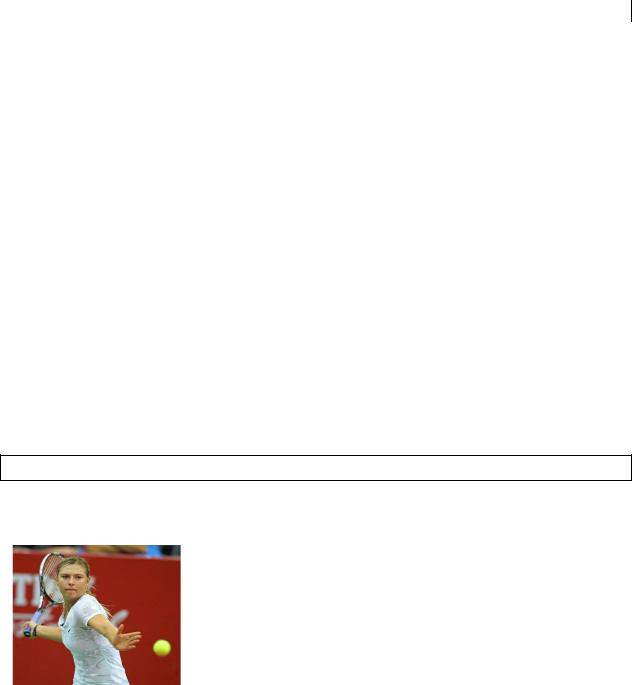
7.a Read the article about Maria Sharapova and complete these notes for a mini-biography.
Maria Sharapova Born in ___ (date), in ___(country)
Age when she started tennis: ___ years old
Age nine: moved to ___
Off-court interests: 1_____2_____3_____
Championships: _____
At the age of seventeen, Maria Sharapova won the Wimbledon tennis championship. She was the third youngest champion in
Wimbledon’s 118-year history. This success quickly made her one of the world’s best-known sports celebrities.
89
Born in 1987 in a small Siberian town, Maria started hitting tennis balls at the age of four. Her first tennis teacher was her father, Yuri Sharapov. When Maria was nine, she and her father moved to America. She went to a special tennis school in Florida, where she practised every day.
Maria’s mother had to stay at home in Russia. Maria didn’t see her for two years. She missed her mother and her family. But now this tall, good-looking young woman is the Number 2 player in the world.
Playing tennis is not Maria’s only interest. She does not go to high school but she studies all her school subjects through an Internet school.
She enjoys reading. The Sherlock Holmes stories are among her favourite books. Her other off-court interests are fashion, singing, dancing and movies. In 2005, Maria designed her tennis dress for the championships, and she produced a new perfume.
However, Maria’s main love is still tennis. She often plays charity matches to raise money for people in need, and she practices hard to be a champion.
‘Everyone’s trying to beat the World’s Number 2 player’, she says. ‘It’s absolutely normal. But I want to beat them as well. I love the competition.’
7.c Choose a famous person and write his/her biography (160-200 words). Include the following:
When / where he/ she was born
Why he/she became famous
Family, interests, hobbies
90